The park looked the same every morning: damp paths, scattered wet leaves, and a quiet that only felt safe to those who had never truly been in danger.
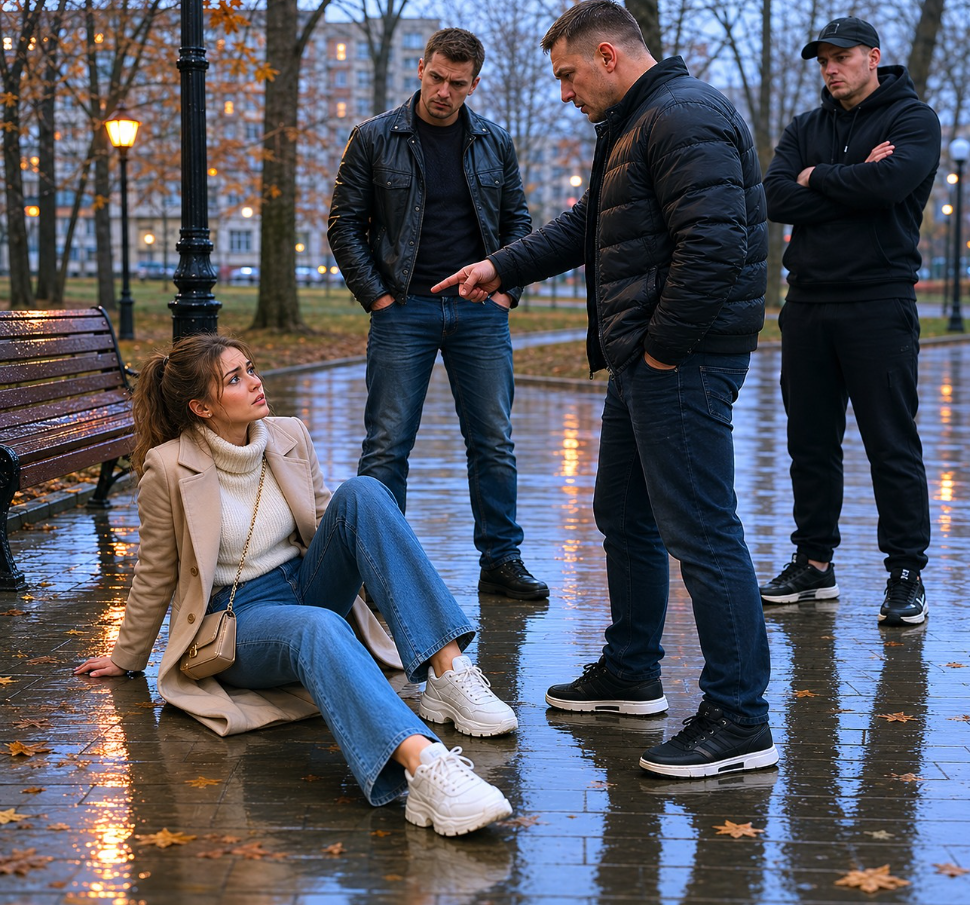
Darya lay on her side at the edge of the path, her cheek almost touching the soaked ground. A dull pain pulsed at the back of her head, a metallic taste filled her mouth, and her neck burned where her thin chain had been ripped away. Three men stood over her. Not in a hurry. Not nervous. That calm confidence was the most unsettling part of them.
“How brave you are, huh?” one of them in a grey jacket chuckled, lightly tapping her shoulder as if checking whether she was still conscious. “Do sports at home. Streets aren’t for everyone.”
Darya didn’t respond. Not because she couldn’t—but because she was watching. Calculating.
Too late.
Just one mistake: she had assumed this was an ordinary morning run. She missed the signs—the blocked path, the timing, the way they moved like they already knew what would happen. Now the question wasn’t how to escape cleanly. It was what she could still preserve.
They took her phone. Her wallet. The necklace her father had given her. But the real loss wasn’t in her belongings.
It was the fact that she had allowed herself to be caught unaware.
The leader, a shaved-headed man with a tattoo near his collar, grabbed her chin and forced her to look at him.
“Remember me,” he said. “Roman Klykov. So you can tell your friends who put you in your place.”
The others laughed. One rummaged through her bag, another checked her phone like it was a trophy.
At that moment, Darya made her decision. Not about survival—but about memory. She began storing everything: their faces, their voices, the way one favored his right hand, the faint limp in another’s step, the sound of a motor scooter waiting nearby.
When they finally left, the leader tossed one last remark over his shoulder:
“Stay home next time, pretty girl. This city isn’t for you.”
They never knew who she was speaking to.
Slowly, Darya pushed herself up. She pulled her soaked ID from the mud. It was dirty, damaged—but still readable:
Lieutenant Colonel, Special Operations Unit.
And just like that, the park was no longer the same place.
In a nearby café, the girl at the counter nearly panicked when she saw her face.
“Should I call an ambulance?”
“Just give me a phone,” Darya said calmly.
One call. One name: Oleg.
“Where are you?” came the immediate response.
“Near the park. Three attackers. I know who they are.”
A pause.
“Don’t move. I’m coming.”
Three hours later, handcuffs clicked in an abandoned garage. It was almost too clean, too easy—but only because mistakes had already been made: a camera captured them leaving, a bank card was used, a phone was left on.
When Darya entered the room, Roman Klykov recognized her too late.
“What… who are you?” he muttered.
Darya didn’t answer. She didn’t need to.
Her presence was the answer.
She thought it was over.
She was wrong.
Two months later, her phone rang at night.
“We have your family,” a cold voice said. “Do as we say if you want them back alive.”
Darya stood still by the kitchen window. Rain slid down the glass in thin lines. A pot of mint sat on the windowsill, unmoving.
“Let me speak to my sister,” she said.
Static. Then a fragile voice.
“Dasha… we’re here…”
The line cut.
And everything changed.
The ransom was assembled. The rules were simple: alone, unarmed, silent.
Oleg didn’t agree.
“This is a trap.”
“I know.”
“And you’re going anyway?”
Darya picked up her bag.
“If I don’t, they’ll come again. Next time, it won’t be a phone call.”
The exchange took place in an abandoned industrial zone. Cold lights, broken concrete, and silence that felt heavy.
Her family was released.
But Darya knew—it wasn’t the end. Only the beginning.
Behind it all was a name: Klykov.
And behind him, someone far more dangerous—his older brother, Arseny.
Not a street thug. Not impulsive. Not careless.
A system.
Darya worked for months. Quietly. Patiently. No heroics, no noise.
Files. Surveillance. Shipping logs. Shell companies. Money trails.
And slowly, the structure appeared.
This wasn’t a gang.
It was an operation.
The major raid began at dawn.
Multiple locations. Simultaneous arrests. The structure cracked under its own weight.
When Arseny Klykov was brought in, he looked at her and asked only:
“You did this?”
“No,” Darya said. “You built it. I just removed it.”
The trial moved slowly. Too slowly for what they had endured.
The turning point was her sister’s testimony. Not dramatic. Not exaggerated. Just honest.
And that was enough.
After the verdict, there was no celebration.
Only a quiet dinner at home.
A pie on the table. A father no longer watching every sound at the door. A mother finally breathing normally. A sister sleeping without fear of darkness.
That was the real ending.
Later, Oleg sent a message:
“Rest now.”
Darya looked out the window.
No triumph. No tears.
Just calm.
Because sometimes strength is not about striking back.
It’s about walking far enough that your family no longer flinches at footsteps in the hallway.