When the knock came, Andrei dropped the spoon.It struck the tile with a sharp metallic clang—far too loud for such a small kitchen—as if a gun had gone off between the walls.
The sound bounced off the ceiling, clung to the glass, and lingered longer than it should have.I was pouring tea.The old kettle rasped on the stove, its lid trembling as the water simmered.
The windows were fogged, the outside world blurred into shapeless gray. On the windowsill lay two tangerine peels from yesterday’s memorial—slightly dried, stubbornly present, like a memory no one dared to throw away.
Andrei didn’t move right away.He went pale before the second knock.Not the kind of pale that comes from surprise.The kind that comes from recognition.I wiped my hands on a towel and stepped toward the hallway.
He cut me off.Too fast.Too sharply.As if he was afraid I might hear something before he did.Voices drifted in from the corridor.Male voices.Quiet. Controlled.
Almost polite.But in our cramped apartment, even politeness sounded like a threat.I stepped out of the kitchen.
Two men stood in the doorway. One wore a black jacket, the other a gray coat. Neither took off their shoes. Damp footprints spread across the rubber mat.
“Is Andrei Viktorovich home?” one of them asked.No “good afternoon.”No “may we come in.”Straight to his name.Cold spread between my shoulder blades.
Andrei forced a smile.“There must be some mistake…”The man in the gray coat didn’t look at him.He looked past him.At me.Then around the apartment—at the furniture, the walls, the door to the room.That kind of look.
The kind people have when they’re already counting someone else’s belongings.“There’s no mistake,” he said quietly. “Time’s up.”Andrei shut the door.
Not violently.But abruptly enough to say this wasn’t the first time.He turned to me.And for the first time in years, he couldn’t find words right away.
“Don’t open the door,” he said quickly. “And if anyone asks… I’m not here.”It would have sounded ridiculous—if his hands weren’t shaking.
If his gaze didn’t slide away from mine.If something inside me hadn’t already started shifting days ago.After the funeral, the house had changed.
Not on the outside.Inside.Everything was where it had always been—the cabinet, the worn blanket, the jars neatly lined up. But the heavy, familiar sense of family that used to hold us together was gone.
In its place—something else.Tension.Like something was smoldering beneath the floor.Galina Petrovna died quietly.No last speeches.No reconciliation.The hospital called me in the morning. I went alone.Andrei said he’d be late.
At the cemetery, he arrived just before the farewell.He hugged me in front of everyone.Looked appropriately grief-stricken.But his eyes were dry.And angry.
I didn’t understand it then.I opened the envelope only that evening.I sat at the kitchen table, covering it with an old oilcloth so wax wouldn’t stain it.
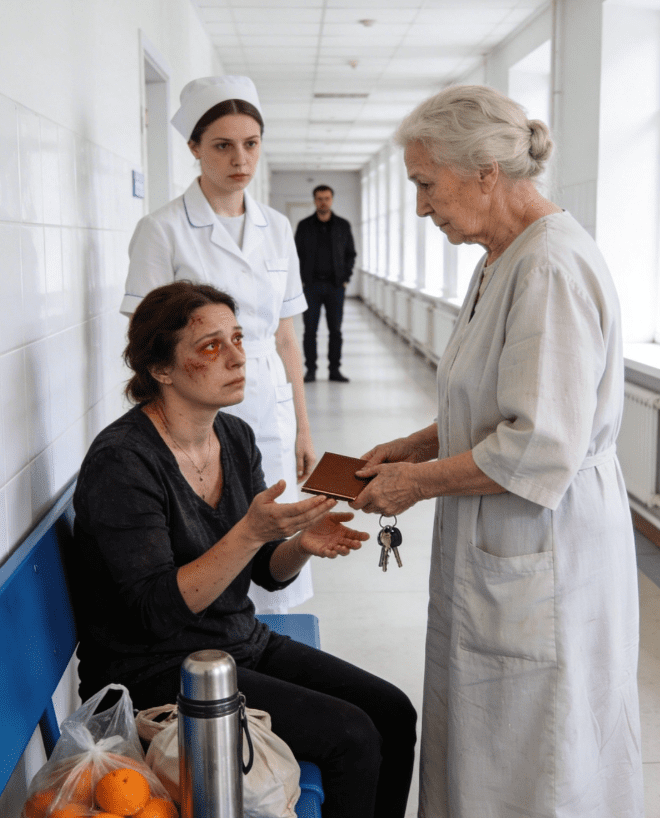
Next to me lay the keys, the savings book, and Galina’s glasses—the ones I couldn’t bring myself to throw away.The will was clear.The apartment.The dacha.The savings.All of it transferred to me.Not to Andrei.To me.
No ambiguity.No loopholes.Everything notarized months ago.I read it twice.Then again.Only then did I unfold the second sheet.Her letter.
The handwriting was uneven.Some letters slipped downward, as if her hand no longer obeyed her.But the meaning was painfully clear.“Lena, forgive me for putting this on you.”“I kept thinking a mother’s love could fix her son.”
“It didn’t.”She wrote about money.About debts.About loans I knew nothing about.About people you don’t want your name recorded with.About how she had already paid off his debts twice.About how he always promised it was the last time.
About how there had been no long business trip.There had been drinking.Then gambling.Then more debts.I sat there, unable to move.Twelve years of marriage cracked quietly inside me—quieter than the kettle, but far more frightening.
Every late return.Every sudden burst of anger.Every “there’s no money, the bonus is delayed.”Every disappearance over weekends.I had explained it all away.Fatigue.
Character.Hard times.How easily a woman explains the inexplicable just to keep a home from falling apart.The worst line came near the end.
“He tried to make me transfer everything to him this winter.”“When I refused, he said you would end up with nothing anyway—because without him, you are nobody.”
I read that line—and then I heard his voice.Not in memory.In reality.He was standing just outside the kitchen.Too quiet.I folded the letter quickly.Slipped the savings book into an old sewing box.
Stuffed the keys into my robe pocket.Andrei stepped in and asked why I wasn’t asleep.His face looked normal.Almost gentle.But his eyes went straight to the envelope.
“What’s that?”“Hospital prescriptions,” I said.He didn’t believe me.But he said nothing.The next day, the searching began.At first осторожно.Then openly.He said he was looking for his mother’s passport.
Then receipts.Then his diploma.He turned over drawers, closets, storage boxes, even the bag of old Christmas ornaments.I watched.And stayed silent.
Something new was growing inside me.Not hysteria.Not hatred.Clarity.Cold. Precise.For the first time, I saw my husband not as a husband—
but as a danger.Two days later, he sat across from me at the kitchen table.“Elena… my mother didn’t leave anything to you?” he asked softly.
I shrugged.“Just a scarf and a cup.”He smiled.“Don’t make this complicated. It’s all family anyway.”The word “family” sounded like a hook.
Not warmth.Not belonging.A claim.“If there are documents, give them to me. I’ll take care of it.”“I’ll take care of it.”In the letter, Galina Petrovna had underlined almost the same phrase.
“If he says ‘I’ll take care of it,’ know that there’s no time left.”I held my face stillAsked why he needed them.He started speaking quickly—about loans, about temporarily mortgaging the apartment, about selling the dacha, about how “we’ll fix everything later.”
Not “I.”We.How convenient that word is when you’re pushing someone else into a pit.For the first time, I said no.Firmly.Without explanation.Without apology.
Just no.He fell silent.His face emptied.Then he smiled—that same smile.“Don’t be stupid, Lena.”And left.That night, I didn’t sleep.
I sat in the kitchen in thick socks and his mother’s old sweater, listening to the faucet drip, staring at the peephole as if someone was already standing behind it.
In the morning, while Andrei slept under the weight of his pills, I went to the notary.The office was in an old building, smelling of paper, dust, and cheap air freshener.The notary wasn’t surprised.He simply opened a folder.
“Galina Petrovna asked me to give you additional copies.”Then he explained.Two weeks before her death, she had returned.Weak—but lucid.She had left a statement.
If her son tried to contest the will or pressure me into giving up the property, the notary was to hand over materials to the police—including a recording.
“What recording?” I asked.He handed me a flash drive.In the video, Galina sat in the same sweater I had taken her to treatment in.Her voice was weak, but steady.
She said she was afraid for me.That her son had gotten involved with dangerous people.That he had once said on the phone:“If she puts everything in Lena’s name, I’ll still take it. She’s quiet.”“She’s quiet.”
That hurt more than anything.All those years of patience.And to him, it meant only one thing:Convenient.I left the office a different person.
Not stronger.Not braver.Just unable to pretend anymore.On the way home, I bought a cheap phone.Called my friend Olya.Asked if I could stay if needed.“Come anytime,” she said.
Some sentences hold you together better than locks.When I got back, Andrei was waiting.No more pretending.“Where are the documents?”“Gone,” I said.He slammed his hand on the table.
The cup cracked along the handle.His mother’s cup.He didn’t even notice.“Do you understand what you’re doing?”Yes.For the first time, yes.I understood that in front of me was not a man in trouble.
But a man who had already chosen whom to sacrifice.First his mother.Then me.And then—another knock.He stepped back.And in that moment, I realized:
I wasn’t the one trapped.He was.That night, I left.Quietly.No scenes.No explanations.I took the documents, the letter, the flash drive, the keys.Nothing more.Three weeks later, I had filed a report.
Found a lawyer.Learned that the debts were far worse than I imagined.That he had promised money he didn’t have.That there were others.It didn’t break me.
After the main truth, the rest lands softer.The hardest thing was a final note I found later in the savings book:“Forgive me for understanding too late.”
“And you were more of a daughter to me than he was a son.”I sat with that note on the dacha veranda in late April.Old snow lingered by the fence.
Water dripped from the roof.Tea cooled in a glass holder she had treasured for years.It wasn’t beautiful.It wasn’t cinematic.It was just quiet.And in that quiet, for the first time, I felt no guilt for leaving.
Sometimes people ask when I knew I was saved.Not when I closed the door.Not when I filed the report.Not when I learned the truth.Later.
On a morning when I woke up, heard the wind move the oilcloth on the veranda, and realized that no one would force me to stay silent for someone else’s lies ever again.
She didn’t save me with words.She saved me by finally telling the truth.And sometimes love looks exactly like that—like an old savings book,like a set of keys in a trembling hand,
like a warning whispered too late—and a truth that makes it impossible to ever return.