If someone had told me earlier that one day I would stand up from a festive family table, calmly walk into the kitchen, return with a plate of appetizers, and say the sentence that would change everything… I would have laughed.
I was not that kind of woman. I was the type who replayed conversations in her head for nights on end, only finding the perfect response later—always too late. After everything was already over. When everyone was asleep. When nothing could be changed anymore.
But that day, everything unfolded differently.
And no one was ready for it. Not even me.
I met Kostya completely by chance. He helped me pick up groceries that had spilled outside my apartment building.
We started talking, and half an hour later we were still standing by my door, unable to say goodbye. He was the kind of man who forgot where he left his keys, but never forgot to ask how you were feeling.
I fell in love quickly. Too quickly. Too deeply.
He spoke about his mother carefully. Not negatively—just carefully. “She’s… particular,” he said once, and that single word carried more warning than any long explanation.
But I didn’t listen to warnings back then. Love has a way of editing out what it doesn’t want to hear.
Valentina Sergeyevna came to meet me a month later.
I prepared like it was an exam. Cleaning, flowers, a perfectly set table. I cooked my best dishes: rosemary-lemon roast chicken, creamy potato gratin, fresh arugula salad, and apple-cinnamon pie. Everything felt ready.
Kostya sneaked into the kitchen, tasting things, whispering, “My mother will love this.”
She didn’t.
She entered, scanned the room, and sat down like a judge entering court. After the first bite, she said:
“The chicken is a bit dry. Didn’t you baste it while roasting?”
“I did,” I replied.
“Then you overcooked it. And too much rosemary—it overpowers the meat.”
The gratin was “too heavy.” The pie earned only: “The dough isn’t bad.” That was her highest praise.
On the way home, Kostya said:
“See? She accepted you.”
I wasn’t sure whether to laugh or cry.
We got married eight months later.
And that’s when the real test began.
Valentina Sergeyevna appeared at every family gathering, and every time it was the same story. She never missed an opportunity.
“Liza, the salad layers are wrong.”
“Liza, this soup is too salty.”
“Liza, the fish is undercooked.”
“Liza, the dessert is too sweet.”
Always at the table. Always in front of everyone. Always right after people had started praising the food.
I smiled. Every time. What else could I do? Make a scene at a celebration? Ruin everything?
At home, I sometimes told Kostya it hurt. He would hug me and say:
“She doesn’t mean it badly.”
“That’s just how she is.”
“Don’t take it to heart.”
And I tried. I really did.
But something kept building inside me. Not anger exactly—more like quiet exhaustion. A slowly filling boundary.
Then came my birthday.
I spent days preparing. Not to impress anyone—just because I love cooking. The main dish was a slow-roasted mustard-honey spiced meat with a crisp crust and deep aroma that filled the entire room.
When I brought it out, everyone lit up.
“This is incredible!” my friend said.
Kostya looked at me across the table:
“You’re amazing.”
And then Valentina Sergeyevna spoke.
“It’s too spicy. Meat should speak for itself.”
Then came her detailed explanation of how she makes it “properly.”
On my birthday. At my table. In front of everyone.
Silence fell. Heavy and thick.
I smiled and said:
“Thank you, I’ll keep that in mind.”
But that night, I didn’t sleep.
Not out of anger. Out of clarity. Something had finally clicked into place.
By morning, I had made a decision.
Kostya’s birthday dinner would be at home, family-style.
I cooked everything calmly, without tension for the first time. No fear of criticism. No anticipation of judgment.
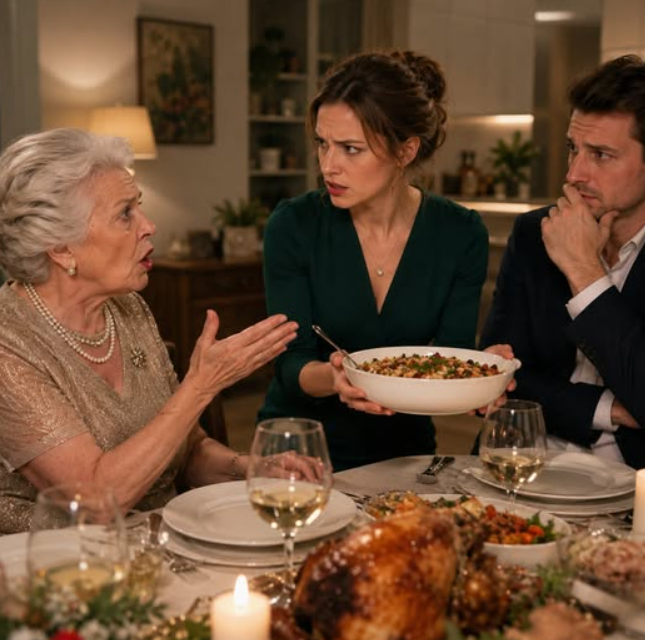
I served appetizers first, personally offering each guest exactly what I knew they liked. His uncle got his favorite roll, his sister got her preferred tartlets, his friend got stuffed peppers he once mentioned loving.
And I approached Valentina Sergeyevna last.
I placed the plate in front of her and looked at her calmly.
“I’m sorry, but I didn’t cook for you,” I said evenly. “Every time, you say my food isn’t to your taste. I wouldn’t want you to feel forced to eat something you don’t enjoy. That would be impolite of me.”
The table went still.
“This… what do you mean…” she began.
“I just want everyone here to enjoy the meal,” I said gently.
No shouting. No drama. Just a boundary spoken clearly.
And that was enough.
Someone laughed quietly. Then another voice:
“Finally someone said it.”
She stood up. Calmly, with dignity, and left.
The door closed softly, but the atmosphere changed completely.
Later, Kostya said simply:
“You were right.”
That evening, we called her. It wasn’t easy. The conversation was long and uncomfortable. But something shifted. For the first time, she admitted:
“Maybe I do go too far sometimes.”
Not an apology. But close enough—for her.
And somehow, that changed everything.
The tension didn’t vanish overnight, but the pattern did. The constant pressure eased.
The strangest part is that I didn’t need to scream. I didn’t need to fight. I didn’t need to prepare perfect arguments in my head for years.
I just needed one sentence, spoken at the right moment, without anger:
“I’m sorry, but I didn’t cook for you.”
Sometimes boundaries don’t need volume. They just need clarity.
And the roast meat?
It was perfect.