“Sign it! The bank is waiting! Don’t you understand—we’re going to be thrown out on the street!”
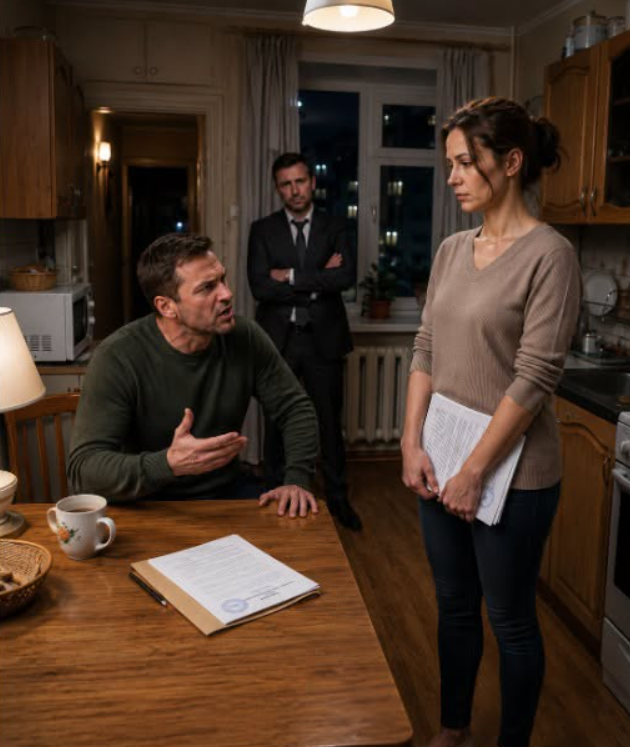
Andrey’s voice cracked through the kitchen so loudly that even the neighbor upstairs stopped stomping. On the table lay the sales contract—for my apartment.
Next to it, a pen. Behind it stood my husband and an unfamiliar man in a gray coat. The buyer. Andrey had brought him straight into our home. No warning. No call. As if this were normal.
I calmly poured myself tea. My hands weren’t shaking. Not anymore. For three months, I had rehearsed this evening in my head every single night.
“Andrey,” I said quietly. “Sit down.”
“What do you mean, sit down?! Sign it, Lena! This is urgent!”
I looked at the man.
“Mr. Igor Sergeyevich, please, have a seat. This will only take ten minutes. Would you like tea?”
The buyer hesitated, then sat. Andrey instantly stiffened. Something in my voice had changed. I was no longer the woman who always gave in.
And everything started long before that moment—eleven months earlier.
This apartment was mine. Inherited from my grandmother before the marriage. Legally, fully, exclusively mine. Andrey knew that. He just chose to forget it.
For eight years, we lived what looked like a normal life.
Then Andrey “started a business.” Crypto. Investments. Big promises. At first, he brought money home. Then debts followed. Friends, acquaintances, strangers. Loans piled up. Then credit lines. Then panic.
“Don’t worry, I’ll fix it,” he kept saying.
Then one evening he said something different.
“We’re selling the apartment.”
I laughed.
“Mine?”
“Ours, Lena. We’re a family.”
His voice had changed by then—tight, sharp, desperate. That was also the first time he raised his hand. He didn’t hit me. But the gesture was enough. Something inside me went cold.
The next day I went to a lawyer.
She adjusted her glasses and said calmly:
“The apartment is your separate property. Your husband has no rights to it. He cannot sell it. He cannot dispose of it. And his debts are not your responsibility.”
“And if he tries?”
“He can try. But he won’t succeed legally.”
So I prepared quietly.
The divorce was fast. He didn’t even show up. He said, “Handle it yourself, I don’t have time for this.”
He didn’t understand what it meant.
In his mind, nothing had changed.
But legally, everything had.
Still, he kept living in my apartment, as if it belonged to him.
Until that evening.
“Sign it!” he shouted again. “Everything is ready!”
The buyer looked confused.
“Andrey told me everything was fine… that his wife agreed…”
I let out a small smile.
“Wife?”
Silence fell instantly.
I opened a folder and placed it on the table. Slowly. Deliberately.
A fresh property registry extract.
And the divorce certificate.
The buyer read it once. Then again.
And then looked at Andrey.
Andrey turned pale.
“This… this can’t be…”
“Oh, but it is,” I said calmly. “We’ve been divorced for three months.”
The air in the room changed.
The buyer stood up immediately.
“Then I want my advance back. Eight hundred thousand. Tomorrow.”
His voice was flat. Final.
“Of course,” I replied. “And I suggest you handle it legally. If not, it becomes a fraud case. I will testify if needed.”
Fraud.
That word broke something in Andrey’s face.
“You ruined everything…” he whispered.
“No,” I said. “You tried to sell what was never yours.”
And then the truth spilled out.
His debts weren’t with banks. They were with people. Real people. People who didn’t wait patiently.
“I told them I would sell it… I promised…” he muttered.
“This apartment,” I corrected.
The next day, two strangers showed up at my door.
I didn’t let them in.
“I’m divorced. The apartment is mine. I have no connection to his debts,” I said through the door.
A long pause.
Then one of them replied:
“Understood.”
And they left.
They didn’t come back.
Andrey disappeared from my life the same way everything collapsed—loud at first, then suddenly quiet, then gone.
One evening he simply didn’t return.
The apartment became silent.
And for the first time in years, that silence didn’t feel like pressure. It felt like space.
That night my daughter came into the kitchen and sat beside me.
“Mom… were you scared?”
I thought for a moment.
“Yes,” I said. “But not today.”
“When then?”
“When I still believed that love meant signing away yourself.”
She nodded slowly, as if she understood more than I expected.
Outside, rain began to fall softly over the city. The sound was distant, blurred.
I sat with my tea in my own kitchen.
In my apartment.
For the first time in years—not borrowed, not shared, not taken.
Truly mine.