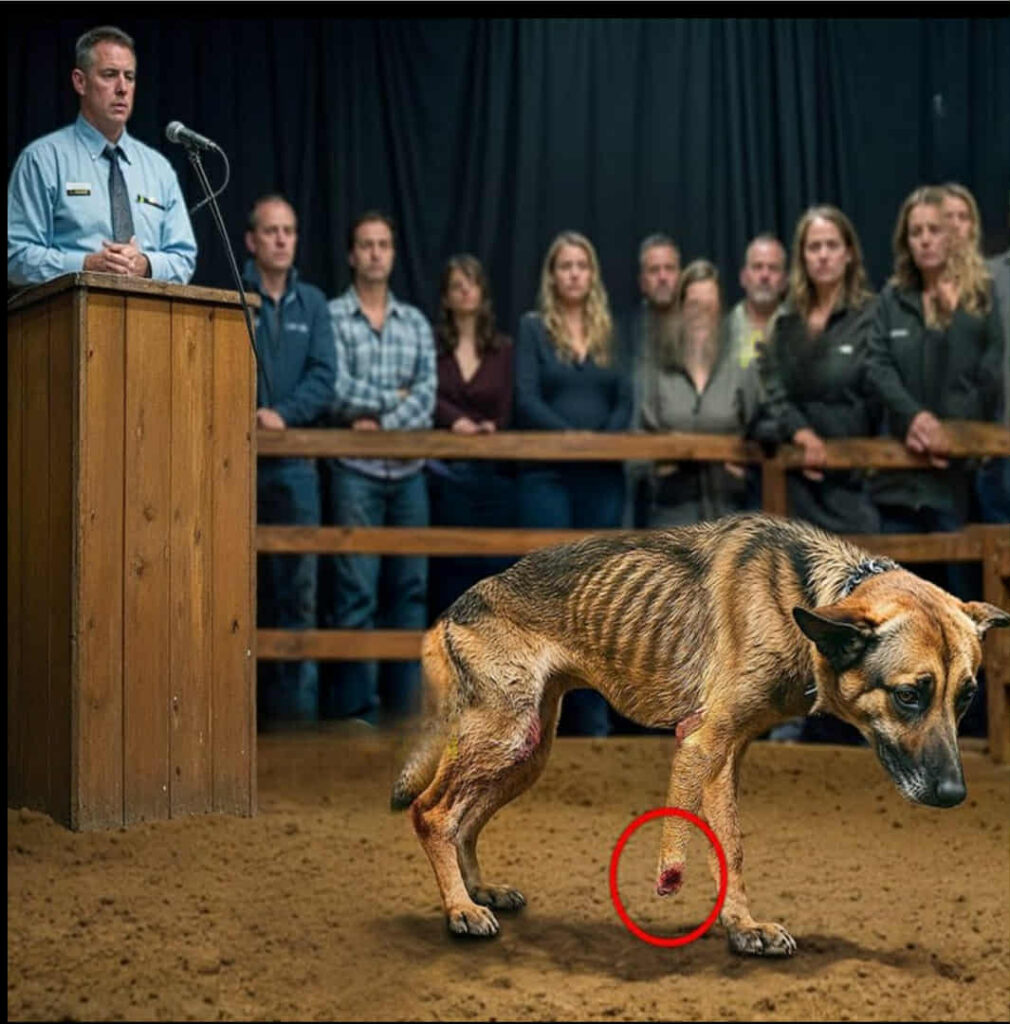
On the dust-choked plains of Montana, where the clang of metal mingled with the sharp calls of auctioneers, where life was measured by numbers scribbled on small white tags, a silent figure stepped into the metal cage at the center of the auction ring.
It did not move with the confidence of a strong, healthy animal. Instead, it dragged its body forward, each step slow and painful, as if every fiber of its being had known the cruelty of the world.
A thin, filthy, trembling German shepherd. No name was called; no applause followed. Only a brief pause in the relentless noise: a fleeting fracture in the rhythm of the living marketplace. Its right hind leg scraped along the hard-packed earth, every step sharp,
like a blade dragging across gravel. Once sleek black-and-gray fur now clung in matted clumps of mud and dried blood.
A faint scar encircled its neck—a chain mark meant not for protection, but for domination. No one knew its name; perhaps it had once had one. Now, it was only Lot 47. It did not whine, did not cry, did not seek attention. It simply stood there, a forgotten creature.
Its eyes held a mixture of surrender and quiet anticipation, as if it had long since grown accustomed to being seen as broken.“Not worth keeping,” someone muttered. “Probably bit someone,” whispered another. The auctioneer quickly moved on, eyes flicking nervously as no hands rose.
A few snide comments, some bored shoulder shrugs—around here, only the strong, alert, loud dogs mattered.
This four-legged being, labeled only as a burden, was considered superfluous. As the gavel nearly fell, a sound stirred in the back row: the soft rustle of worn fabric as a hand slowly rose. No one knew the man, only the faded leather coat,
dusty boots, and gray hair glimpsed behind calm, winter-blue eyes. Thomas Miller did not speak. A slow, deliberate nod was enough to quiet the room.
Sold,” the auctioneer said, dryly, awkwardly.
The dog—later named Rook—lifted its head. Not in hope, but instinct. Its eyes, dulled by years of fear and suffering, locked onto a gaze that judged neither, demanded neither, begged neither—it simply existed, understanding.
Thomas stepped forward in silence, pausing before the dog, gently placing a hand on its shoulder. Lightly, as if even the wind could lift it.
And then something unexpected happened. Rook leaned in. Shifting its weight onto its remaining legs, it pressed against Thomas’ shin, as if in that fragile moment it sensed: this hand, these eyes, this quiet heart had not come to take, but to find its own lost piece.
Amid the faint sounds and the slowly fading sunlight, Thomas led the abandoned, forsaken creature from the auction yard. They did not look back, for both knew: the only thing that mattered was the path ahead. As they passed through the rusty gate, their real story had only just begun.
The afternoon wind swept the empty yard, lifting the fine dust that clung to faded coats and the dog’s wounds. No one watched. The crowd had turned away, calculating profit. Only one remained: Thomas Miller, whose gaze did not search for value, but for something quiet, stirring within.
The German shepherd, still nameless, stood in the middle of the clearing like a forgotten question mark. Four fragile legs held a body long surrendered. Its right hind leg scraped the ground, not in resistance, not in retreat, but in the quiet of surrender.
Its coat, once surely sleek and shining, was now marred with mud, old wounds, and streaks of rust-colored blood.
Thomas did not approach like a buyer. He offered no pity, no urgency. He seated himself at a respectful distance, hand extended, palm up, calm and steady, like placing a breath into the eye of a storm. He said nothing, called nothing.
He only patiently offered his hand, knowing that the smallest touch could speak louder than any words.
Rook remained still for long moments. Its eyes slowly tracked the man’s face, cautiously weighing whether this gesture was real, or just another trap. The wind whistled through the boards, brushing under Thomas’ worn coat, caressing the scar around Rook’s neck that time could not erase.
The hand did not withdraw. It stayed steady, open, feather-light yet unyielding. Then something shifted.
After a long moment, Rook lifted its head—not in trust, but in a final effort to see someone in the world gentle enough not to reopen old wounds. Its whole body seemed to exhale, leaning forward and pressing gently against Thomas’ knee,
like a dried branch finding the last soft patch where it could root again. It did not bark, it did not tremble.
It only exhaled quietly, so faint it could have been the wind. Thomas remained still, hand resting on its shoulder: “I see you, and I will not hurt you.” Rook did not know why he did it. Perhaps exhaustion, perhaps the unexpected warmth, perhaps because there was nothing left to lose.
But its head pressed into the hand, and that simple touch—fragile as it was—was the first voluntary reach toward a human since it had been chained, beaten, and discarded as useless.
They stayed in the dust and the silence, unnoticed by the world, yet bound by a single moment where two lives touched. To an outsider, it might have seemed only an old man and a crippled dog. But to Thomas and Rook, it was the first moment they truly saw each other.
They moved through overgrown bushes and fallen fences, returning to Wilcox, a place that had once been a livestock ranch, now only a skeleton slowly swallowed by the forest. Rook crossed the weedy clearing,
passing broken barns and empty pens, heading straight toward the rear field—the old freightyard for goods and equipment.
He moved with a strange certainty, as if the scent of something buried deep in the earth had never left his memory. At a sparse patch of tall grass, he paused, nose to the ground, body slightly hunched. Thomas stopped behind him,
watching for a moment, then knelt, slowly beginning to dig, handful by handful, shifting the damp earth.
Rook sat beside him, eyes fixed on every mound of turned soil. The scent of the earth rose heavy and dense: decay, time, and the truth long hidden beneath. Thomas dug slowly, methodically. Minutes later, his fingers struck something cold and hard:
the edge of a rusted metal box, its surface obscured by decayed plastic.
He lifted it onto drier soil and opened the lid. Inside were yellowed photographs, aged with time yet still sharp enough to catch the breath: dogs tied up, caged in spaces smaller than their bodies, wires and electrodes attached to collars.
Each image numbered, as if evidence, as if seized property. Though none looked alike, every face bore the same emptiness.
Alongside the photographs were transaction files, coded notes, transfer logs, and training milestone records, sterile in their language. No resistance. Strong shock response. Successfully conditioned. Unmanageable. Turned over for destruction.
At the bottom lay a personnel list. Thomas picked it up. Each name had a title: supply transporter, handler, technician, logistics coordinator. His eyes settled on the bottom: Thomas Miller, transportation and placement support. The year assigned. No address, no ID—but it was him.
The wind whispered above them; the sky hung gray. Thomas remained still, gaze fixed on the name. Not just as identity, but now as proof of silence. He hadn’t caused the harm directly, but he had seen it, and had not turned away.
Rook did not look at the documents. He only stood, head turned to Thomas, gaze weighty but neither angry nor accusatory.
Thomas returned the papers to the box. He did not discard them, burn them, or hide them again. They were no longer avoidable evidence, but the beginning of reckoning that could no longer be postponed. Holding the box in his arms, he rose.
Rook followed silently, as if knowing the return would no longer be Thomas’ burden alone. Not a word was spoken until they reached the cabin. At the threshold, Rook stepped forward, nose gently touching the metal box in Thomas’ arms.
Not to inspect, not to judge—just once, in the language of a creature that had never learned to lie, Rook communicated the most important thing: you are not alone in carrying what has been buried.
Thomas set the box on the table. Dust fell in tiny particles, forming a hazy circle around long-buried truths. He did not open the lid again. Everything that needed to be seen had already etched itself into memory.
Rook stood beside Thomas, motionless, eyes following every move as if waiting for the first signal of a decision he could not yet name. No shouting, no urging. Just the calm, steadfast gaze: pain does not need sympathy. Only someone to do what is right.
Thomas understood. Rook did not need an apology. No beautiful words could erase the past. Action was required.
That afternoon, as the last light of the sun filtered through dense pine branches, Thomas packed a few things into the pickup: old files, the metal box, a new soft leash for Rook, and most importantly, a silence that no longer bore the weight of avoidance, but of readiness.
He did not speak much, merely touched the truck bed. Rook jumped onto the passenger seat, high but no longer tense. Perhaps he did not understand where they were going. Yet his gaze, calm and accepting, showed he was ready.
The pickup shuddered slightly as it moved along the dirt road through the autumn-laden forest. Thomas did not turn on the radio.
Inside the vehicle, the silence was thick—not for lack of words, but because sometimes, no words are needed when two beings already understand each other.