“Just as a precaution,” his mother said. That evening Anna realized violence was an inheritance in her husband’s family
Anna had just pushed her laptop aside and glanced at the dark reflection in the switched-off monitor. A pale, slightly hollow face stared back at her, hair tied in a hurried ponytail. A faded T-shirt. Dark circles under her eyes after a sleepless night spent finishing a report.
I was still alive then, she would think later. At that moment, I was still alive.
The lock clicked at 11:43 p.m.
Heavy footsteps echoed in the hallway, followed by the dull thud of shoes being kicked off. Anna automatically smoothed her shirt and took a few steps toward the door.
Sergey stood on the threshold, half out of his shoes, looking not at her but somewhere above her head, into the empty space of the hallway. He smelled of sharp cologne mixed with the stale air of the subway.
His eyes looked foreign.
“Sergey, what happened?” Anna asked.
Her voice sounded too thin, too pleading.
He didn’t answer. Slowly, almost thoughtfully, he flexed the fingers of his right hand. Anna noticed his knuckles turning white.
Then the blow came.
It wasn’t a sharp pain. It was a blunt explosion, a hot wave spreading from her temple down to her jaw. Her knees gave way, and she slid down the wall onto the old Soviet rug in the hallway.
Something warm ran across her eyebrow.
Blood.
Sergey finally looked at her. There was no fear on his face. No guilt.
Only irritation.
He rubbed his knuckles and said calmly:
“Don’t look at me like a beaten dog. It’s not an affair and it’s not the end of the world. I got fired. And this… was Mom’s advice. As a precaution. So you wouldn’t throw a hysterical fit.”
Anna froze.
The worst part wasn’t the pain.
It was the sentence:
“Mom’s advice.”
This hadn’t been a loss of control.
It had been an instruction.
And suddenly she remembered a family dinner two years earlier. Galina Petrovna had laughed while raising a glass of wine:
“Sergey’s grandfather was a real man. Sometimes he taught his wife a lesson with force. And they lived happily together until the day they died.”
Everyone had laughed.
Anna had felt uneasy, but she’d dismissed it as old-fashioned cynicism.
Now she understood:
it hadn’t been a joke. It had been a family manual.
In the bathroom, she pressed a cold wet towel against her face.
The mirror showed a stranger: a split eyebrow and a bruise already darkening around her eye.
From the kitchen she could hear Sergey calling his mother.
He talked about losing his job.
About unfair management.
Not a single word about hitting his wife.
As if he had merely taken out the trash.
Anna sat on the edge of the bathtub, watching drops of blood spread across the white tile.
The fear disappeared.
In its place came a strange, ringing calm.
Half an hour later she came out with a bandage over her eyebrow. Sergey was already pouring a second glass of cognac.
“So, have you calmed down?” he asked with a crooked smile. “You’re partly to blame, you know. You knew I was going through a hard time. You and your reports first thing in the morning… Your freelance work is basically a hobby. I had a real job.”
Anna said nothing.
She poured herself water and sat across from him.
At that moment a key turned in the lock.
Galina Petrovna swept into the apartment, perfectly styled despite the late hour, carrying a pot wrapped in a towel.
“Seryozhenka, I brought borscht. You need to eat properly,” she sang out.
Then she noticed Anna’s face.
Her eyes moved over the bandage and the swelling.
Not a single muscle twitched.
“Anya, why do you upset your husband?” she said reproachfully. “He has enough problems already. A home should be peaceful, not filled with a woman’s ambitions. And change your clothes—you look like a beggar.”
Anna glanced at the pot.
The borscht was deep red, almost the color of blood.
She felt nauseated.
Without a word, she went into the bedroom.
Through the half-open door she heard the rest:
“Mom, don’t start. It was just preventive. You said during a crisis you can’t let a woman get out of hand.”
“You did the right thing, son. A man has to remind a woman who is in charge of the house.”
Anna gripped the edge of the blanket.
Something inside her turned cold and solid.
That night she didn’t sleep.
Sergey snored peacefully beside her while she replayed the last seven years in her mind.
The shy, conflict-averse boy she had married. She had believed that love and patience could heal childhood wounds.
She had been wrong.
The program had been installed long ago.
She remembered another night a year earlier, when Sergey had first screamed at her and slammed his fist onto the table. She had packed a bag and decided to leave.
Galina Petrovna had arrived after midnight, sat across from her in the kitchen, and said:
“Don’t be foolish. Every marriage is like this. My father was much harsher with us, and we still grew up to be decent people. If a man hits you, it means he cares.”
Anna had stayed.
Now she realized she had stepped into the same trap her own mother had lived in for decades.
By morning, a decision had formed.
Not a panicked escape.
A plan.
When Sergey left to “take care of some things” — really to complain to his mother — Anna grabbed his old tablet. The password was Galina Petrovna’s birth date.
In the cloud storage she found a folder called Family Archive.”
What she discovered there made her blood run cold.
Letters from Sergey’s grandfather described “preventive methods for maintaining domestic order”: how to suppress a wife’s will so the household would remain obedient.
But the worst thing was a worn notebook.
Galina Petrovna’s diary from thirty years earlier.
The handwriting trembled; some lines were blurred by tears.
“Today my father broke my arm because I wore a short dress. Mother said I shouldn’t provoke him. I hate them. My son will never be weak. I will teach him to keep his wife in an iron grip so no one humiliates him the way I was humiliated.”
Anna sat frozen.
Now she understood:
Galina had not been born a monster.
She had once been a victim.
But the victim had become an executioner.
And she had passed that inheritance on to her son.
Anna photographed every page, sent the images to herself, and backed them up online.
Now she had evidence.
Not just against an abusive husband.
Against an entire family system.
Two days later she met her old friend Veronika, a family-law attorney.
One look at the bruise hidden behind Anna’s sunglasses was enough.
“My God, Anya… he hit you?”
“And his mother approved of it. They call it ‘prevention.’”
Veronika’s face hardened.
“Most victims go back. So you prepare quietly. Medical records, photographs, recordings, evidence. Tell me—does he have a weak spot?”
Anna remembered an incident from two years earlier.
Sergey had gotten drunk in a bar fight and broken another man’s jaw. His mother’s connections had kept him out of prison; he received a suspended sentence that had not fully expired yet.
Veronika nodded slowly.
“Good. Then you have leverage.”
A few days later Sergey came home carrying a bouquet of dark red dahlias.
“Let’s forget that stupid incident. I was nervous. Mom thinks we should take a vacation together.”
Anna smiled politely.
Inside, she was no longer the same woman.
That night, when he tried to put his arms around her, she gently moved away.
“Seriously? You’re punishing me now? I brought flowers!”
“I’m not punishing you. I just can’t pretend nothing happened.”
His face darkened.
“Mom said the best defense is attack. If I hadn’t hit you first, you would’ve destroyed me with your nagging!”
At that moment Anna knew with absolute certainty:
he would not change.
The following Tuesday she prepared her final move.
She knew Galina Petrovna always brought food for her son. When she heard her footsteps in the stairwell, Anna opened the apartment door slightly. At the same moment the nosy neighbor, Lyudmila Ivanovna, stepped out with a trash bag.
Perfect timing.
Anna spoke in a trembling, tear-filled whisper loud enough to be heard:
“Galina Petrovna, please… don’t tell Sergey to punish me anymore. I won’t complain, just don’t have me beaten again… it hurts so much…”
The trash bag slipped from the neighbor’s hands.
Galina went pale.
“What nonsense are you talking about?!”
Anna lowered her head and retreated into the apartment.
Seconds later Galina stormed inside, furious.
“Are you trying to ruin me? Make me look like a monster?”
Anna calmly raised her phone.
The voice recorder had been running the entire time.
“One more word, and this recording goes to your employer, social media, and the police. I also read your diary. Very educational.”
Galina stared at her as if she were seeing a ghost.
At that moment the front door opened.
Sergey had returned.
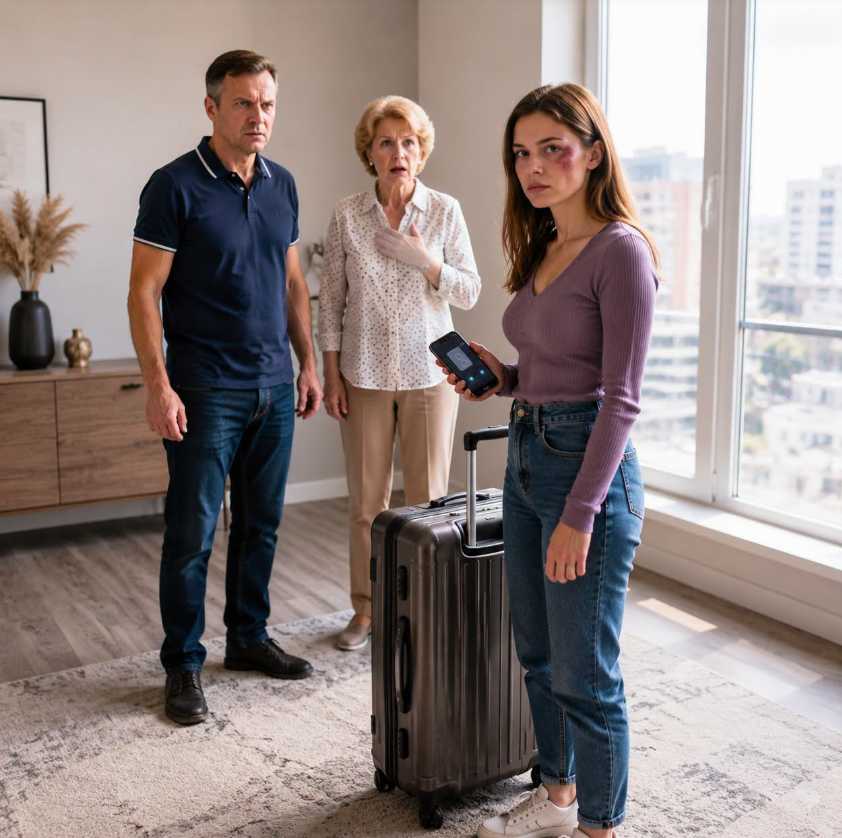
Anna stood beside the suitcase she had already packed.
“You have two choices,” she said quietly. “Either I call the police right now, document the injuries, and your suspended sentence becomes a real prison sentence. Or we divorce peacefully, and you don’t stand in my way.”
He turned pale.
His eyes moved from his mother to his wife and back again.
Finally he lowered his head.
“Mom… you went too far.”
Galina began to sob.
When they were alone, Anna handed him the tablet opened to the diary page.
He read silently.
Once.
Then again.
His face slowly collapsed.
When he reached the line about “my son will keep his wife in an iron grip,” he dropped the tablet and buried his face in his hands.
His shoulders shook.
It was not a grown man crying.
It was a little boy realizing for the first time that what he had been taught was love had actually been violence.
Anna watched him for a long moment.
Then she said softly:
“I’m sorry for the child you were. But I can’t remain the waiting room for your hell. Get help, Sergey. Just not with me.”
She picked up her coat, took the suitcase, and walked out.
A few seconds later Galina’s animal-like scream erupted from inside the apartment.
Anna did not turn around.
With every step down the staircase, breathing became easier.
A month later Anna stood by the window of a tiny sunlit studio apartment. The bruise had long since faded, leaving only a thin scar across her eyebrow.
She didn’t hide it.
It was a reminder.
Veronika later told her that Galina Petrovna had suffered a nervous breakdown, and Sergey had moved to another city and started therapy.
One morning an email arrived.
It contained only two words:
“Forgive me.”
Anna closed the message and walked to the window.
Below, the city hummed with life. The smell of fresh bread drifted up from the bakery downstairs.
She smiled faintly.
Sometimes it takes a single blow to understand that you are not a punching bag.
You are a person who has the right to leave the ring.
Her mother had taught her to endure.
Life had taught her to submit.
She chose a third path:
she left.
And for the first time in years, she finally began to live.