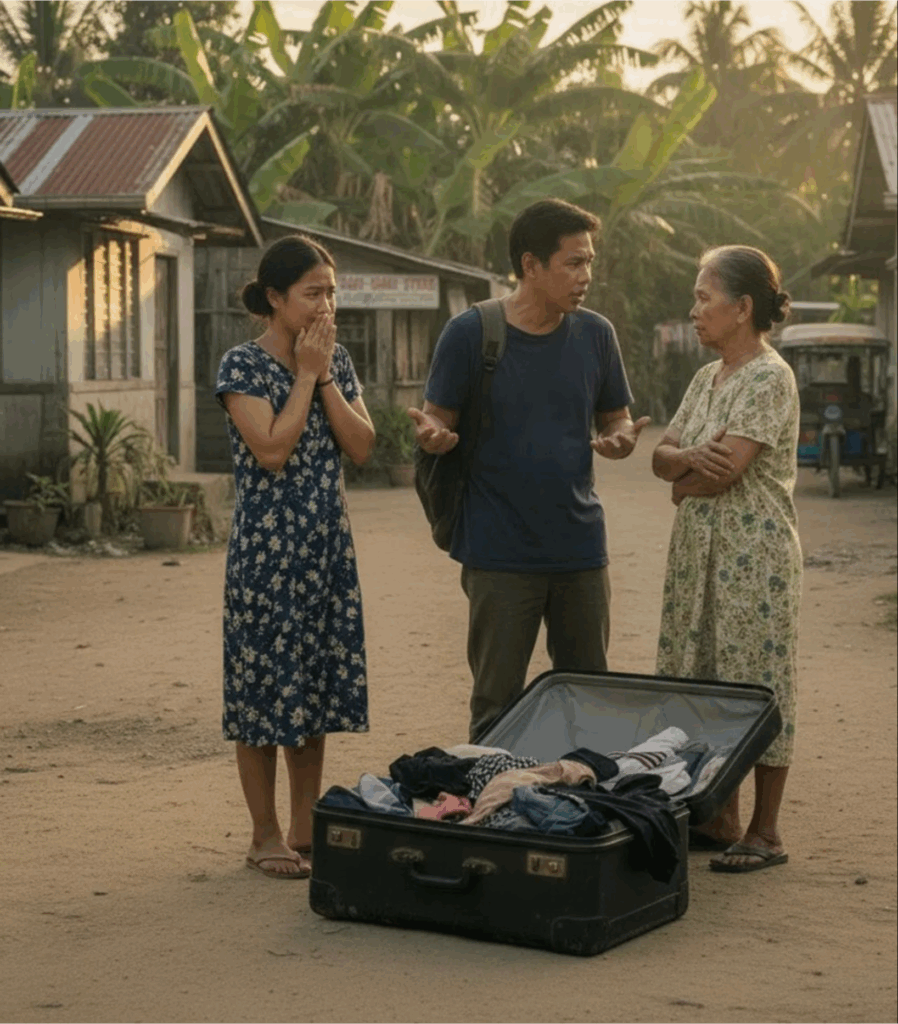
The day our son Henry was born was not a day of happiness, but of quiet collapse. My husband, Warren, did not hold my hand, nor did he say a single comforting word. When the doctors explained that Henry would live with a mobility disability and that his life would be filled with therapies and struggle, Warren’s expression changed.
He looked at our three-hour-old baby as if he saw a defect in him—as if life itself had made a mistake.“I didn’t choose this kind of life,” he said coldly, almost indifferently, and then simply walked out of the hospital room. He didn’t slam the door. There was no scene. That was the worst part of it all:
the silence in which everything became final.I was left alone there: with a newborn in my arms, a shattered future, and a world that suddenly filled with doctors, paperwork, and fear. The fluorescent lights were too harsh, the corridor too long, and the silence too loud.
Henry’s tiny fingers instinctively wrapped around mine, as if he at least knew we could not let go of each other.The following weeks brought no relief, only more questions. Papers, examinations, check-ups, and ever-growing lists of what he would not be able to do “normally.”
But Henry, against all predictions, wanted to live. Not loudly, not dramatically—just persistently. There was something stubbornly curious in his gaze, as if even then he wanted more than what the world offered him.His childhood was not easy. Mornings often began with painful stretches,
afternoons were filled with physiotherapy, and evenings with exhausted silence. There were days when the fatigue tested not only our bodies but also our faith. But every time, Henry got back up—literally and figuratively. If he fell, he tried again. If someone doubted him, he worked even harder.
School was not always kind. There were moments when unfamiliar stares measured him, when the word “different” hovered unspoken in the air around him. But Henry did not let that define him. Instead, he studied. Always more. As if he wanted to prove something—not to others, but to the world,
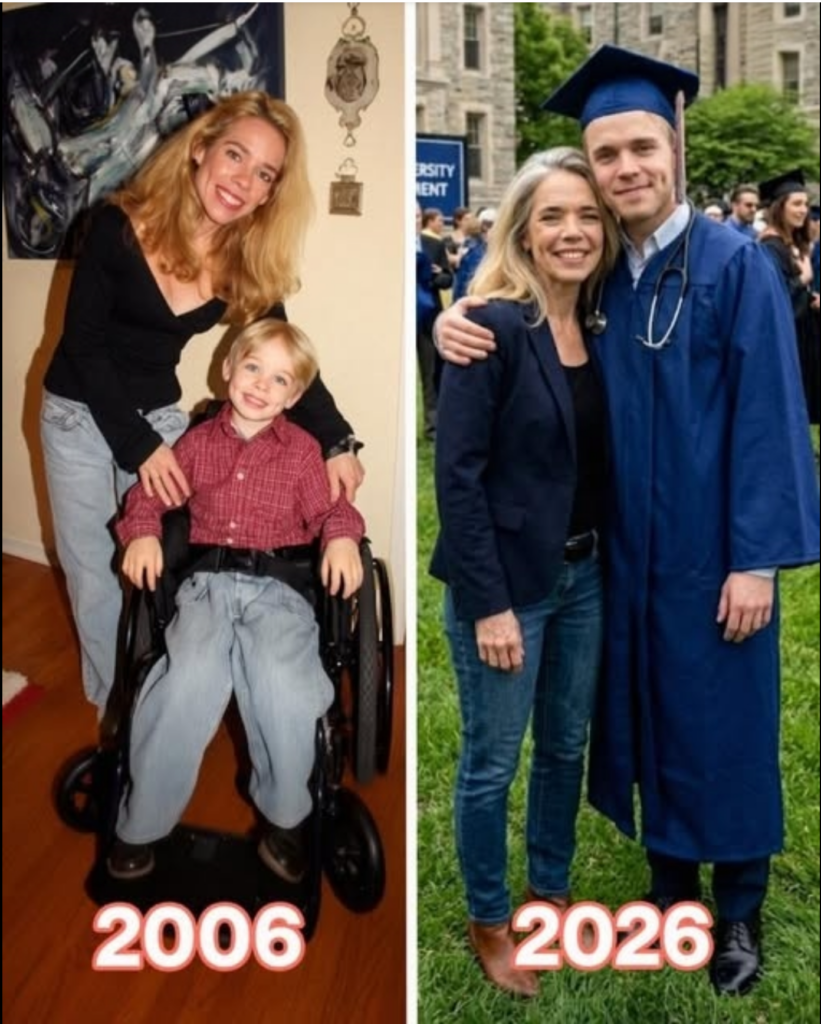
that value lies not in the ease of the body, but in the strength of the mind and heart.Years passed like this, slowly, steadily, filled with intertwined struggles and small victories. And with time, Warren’s name drifted further away, as if it belonged to another life.
We did not call him, did not look for him. Eventually, his absence was no longer pain—it was just a fact.We thought the past was finally behind us—until Henry’s name began to be spoken aloud again. When he excelled at university, when he graduated at the top of his class,
when people began to notice him as a young doctor, Warren reappeared. As if a door long closed had suddenly opened again.Henry invited him to the graduation ceremony.In the hall, Warren arrived confidently, in a suit, with a faint, practiced smile. His gaze ran over Henry:
the white coat, the diploma, all the visible signs of success. And only at the end did he notice what had never changed: the subtle, barely noticeable limp that remained part of Henry’s story.The speech began quietly. Henry did not try to impress anyone. He did not seek sympathy. He simply told the truth.
How he had been left alone with his mother from the very first day. How he learned that presence is not always loud, but always a choice. How an abandoned beginning became a slow, difficult, but steady construction. And how that eventually became medicine—not just a profession, but a way of seeing the world.
When his gaze reached Warren, his voice did not change, only softened for a moment.“This day is not about you,” he said calmly. “It is about the person who never stopped staying by my side.”The silence that followed was not empty. It was heavy.
As if everyone understood at once that stories are not always about the one who left, but about the one who stayed.The applause began slowly, then filled the hall. Not loud celebration, but recognition—of what is born from perseverance, pain, and quiet strength.
After the ceremony, Warren approached. His words were fast, disordered, as if trying to compress years into a single conversation. He explained, justified, tried to take back what could no longer be taken back.Henry listened to him.
Then he simply said:“You cannot step back into a story you once walked out of. You left on the first day. Mom stayed. And she made all of this possible.”There were no more words. No argument. Only a boundary that became final.
And in that moment, it was not the past that won, nor anger.Only what had always mattered: the one who stayed.