Part 1
For twenty years, I believed my daughter vanished without a trace in a quiet garden in Cairo.
Then a postcard arrived from Egypt.
It should have been impossible. The stamp was real, the ink slightly smudged from travel—but what made my hands go cold wasn’t where it came from. It was what was written on the back.
An address.
Three miles from my home in Ohio.
Below it, in sharp block letters, just one sentence:
“Come alone if you still want the truth about Tara.”
My daughter had been eight when she disappeared overseas. Twenty years later, I was sitting in my car outside a row of forgotten rental garages, the postcard shaking in my hand.
Unit 42.
The metal door groaned as I lifted it.
At first, I saw nothing but dust and shadow.
Then I saw her.
A woman sitting on a folding chair beside three cardboard boxes, as if she had been waiting there her entire life for me to arrive.
And when she looked up…
She had my eyes.
“You came quickly, Cassidy,” she said softly.
My voice broke before I could stop it. “Tara…?”
Her lips trembled, but her gaze stayed steady—guarded, almost wounded.
“I needed to know,” she whispered, “if you’d really come.”
Part 2
Twenty years earlier, my life split in two.
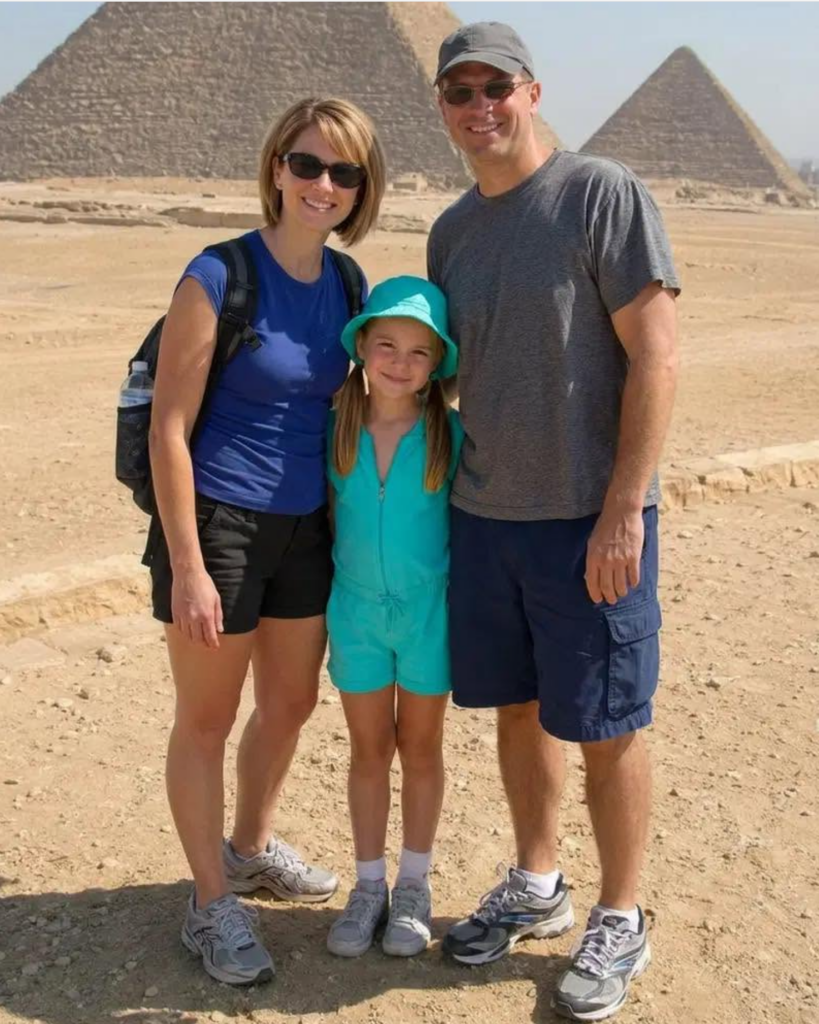
We had moved to Cairo because my husband, Grant, had been offered a reporting job overseas. It was supposed to be temporary. Exotic. A new chapter.
We rented a modest apartment above a courtyard garden.
And for a while, it felt like happiness.
Tara played there every afternoon.
She would chase light through the leaves, laughing like nothing in the world could ever reach her.
Then came a Tuesday that never ended.
I kissed her goodbye before work. Grant stayed behind to write.
“I’ll watch her,” he said.
But when I came home, the world was already broken.
Police lights washed the building in red and blue.
Grant stood frozen in the doorway, his face pale as ash.
“She was just… gone,” he said. “I looked away for a minute.”
No witness. No sound. No trace.
Only absence.
We searched for weeks—then months. Cairo swallowed every lead like it had never happened at all.
Grant cried in front of cameras, blamed himself, became the grieving father everyone sympathized with.
But at night, something in him went quiet. Distant. Controlled.
A year later, we returned to Ohio with nothing but grief between us. Our marriage collapsed soon after.
And Grant began to build something strange from the wreckage.
A career.
Books. Interviews. Speaking events.
All centered on one story:
**the daughter he lost in Cairo.**
And I was the mother who never stopped waiting.
Until the postcard arrived.
Inside the garage, the woman watched me carefully, like I might disappear if she blinked.
“I wasn’t lost,” she said finally.
My breath caught.
“I was taken.”
She opened one of the boxes and pulled out a stack of letters. Dozens of them. Carefully preserved, aged at the edges.
“Every birthday,” she said. “From nine until I stopped hoping.”
My hands trembled as I reached for them—but I didn’t touch.
“Why didn’t I get these?” I whispered.
Her eyes hardened.
“Because you were told I was gone.”
Then she said the name that changed everything:
Claire.
Grant’s closest friend. The woman who had always been just slightly too present in our lives.
Claire had taken her from the garden.
And when Grant found out that night…
He didn’t bring Tara home.
He rewrote the story instead.
Claire raised her under a different name. A different life.
Until, before she died, she left a confession.
Tara looked at me, voice steady but hollow.
“He chose himself,” she said.
And suddenly, twenty years of grief stopped being a mystery.
They became a decision someone had made for me.
That night, Tara showed me something on her phone.
A poster.
Grant’s face. A book tour announcement.
The Daughter I Lost in Cairo.
Her laugh was short, sharp, disbelieving.
“He made money from me,” she said.
I shook my head slowly.
“No,” I said. “He made money from what he did to us.”
We didn’t wait.
We went to his house before the event.
When he opened the door and saw her, the color drained from his face so fast it was almost unreal.
“Tara…” he whispered.
She studied him like a stranger she already knew too well.
“You remember my name,” she said. “That’s new.”
He tried to speak. To explain. To rebuild something with words.
But I stepped forward.
“You don’t get to explain anymore,” I said. “You already did that for twenty years.”
At the book event, the room was full.
Grant stood under warm lights, reading passages about loss, grief, love—his voice steady, practiced, admired.
He had built an entire identity out of our destruction.
Then Tara walked into the aisle.
The air changed instantly.
Every sentence stopped dying in his mouth.
“Was that before or after you left me with Claire?” she asked.
Silence hit the room like impact.
She walked to the stage and placed the letters down first.
Then the confession.
Then the truth.
“My name is Tara,” she said clearly. “I am not a story. I am not a tragedy he authored. I am the daughter he hid.”
A reporter finally asked Grant if it was true.
He looked around, trapped inside the version of himself he had built.
“I was trying to protect everyone,” he said weakly.
That was the moment something in Tara’s face closed forever.
I stood beside her.
“You protected your image,” I said. “Not your family.”
She came home with me that night.
I opened a cedar box I had kept closed for two decades.
Inside were the small things grief refuses to throw away: ribbons, tiny shoes, a faded recipe card, missing posters softened by time.
“I kept everything I could,” I told her quietly. “So you wouldn’t disappear completely.”
The next morning, I made pancakes.
The first one burned. The second broke apart in the pan.
On the third attempt, I felt her standing in the doorway.
Wearing my old sweater.
“I’m not ready to call you Mom,” she said.
It should have shattered me.
Instead, it grounded me.
“Then don’t,” I said. “Just stay.”
And for the first time in twenty years, the silence in my life didn’t feel like loss.
It felt like something finally beginning again.