Oliver was only six years old when he emptied every dollar from his piggy bank to help the elderly woman across the street after he noticed her house had gone dark.
I thought that would be the end of it.
A small act of kindness.
A sweet story.
Something we would remember quietly someday.
I was wrong.
Because the next morning, I opened my front door to flashing police lights, a yard full of piggy banks, and a secret our town had buried for decades finally coming back into the light.
It started with pounding on the front door before sunrise.
Not polite knocking.
Urgent knocking.
I pulled on my robe and hurried downstairs, already bracing myself for bad news. Maybe something had happened to Mrs. Adele. Maybe the power company finally called back. Maybe her nephew had shown up too late.
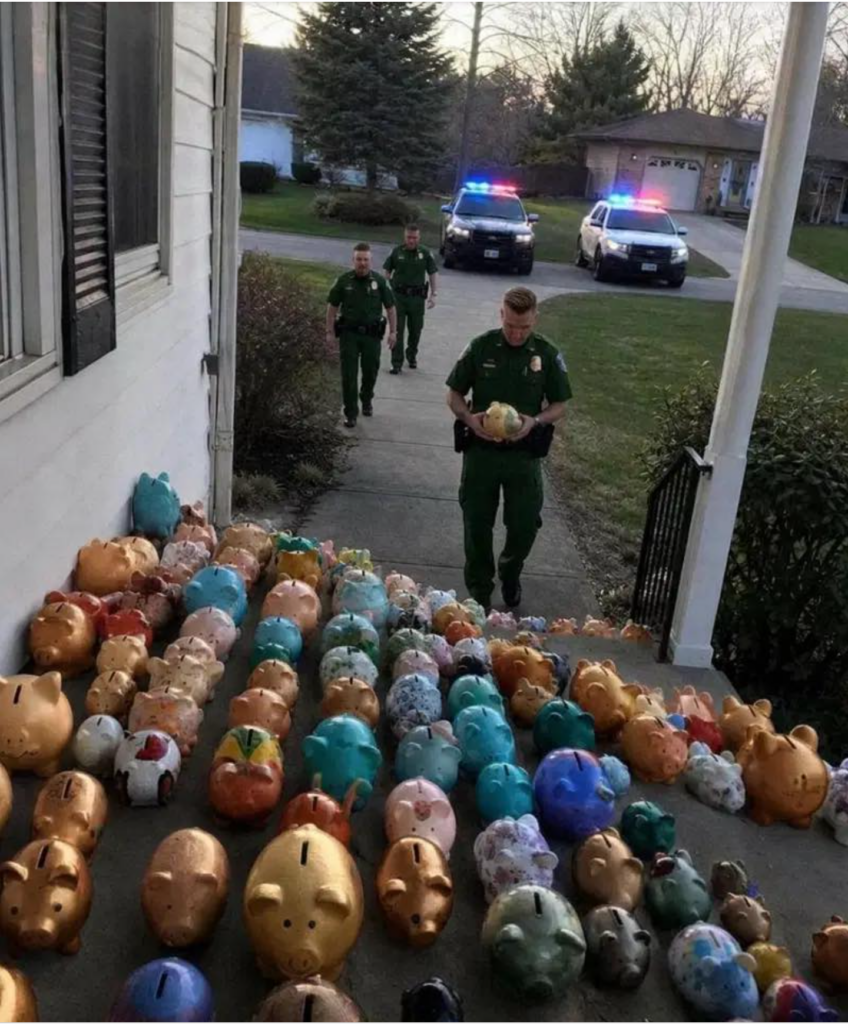
But when I opened the door, a police officer stood on my porch holding a bright red piggy bank in both hands.
Behind him, my entire yard was covered in them.
Hundreds of piggy banks.
Pink ones.
Blue ones.
Tiny plastic banks shaped like cartoon animals.
Old ceramic pigs with chipped ears.
They lined the porch steps, crowded the walkway, and covered the grass like some strange little army waiting for orders.
Two patrol cars blocked the street while neighbors gathered silently on the sidewalks.
Behind me, I heard tiny footsteps.
Oliver appeared in his race car pajamas, rubbing sleep from his eyes before gripping the side of my robe.
“Mom…” he whispered nervously. “Did I do something bad?”
I immediately pulled him close.
“No, sweetheart. No, you didn’t.”
The officer looked down at him, and his serious expression softened.
“You’re Oliver?”
Oliver nodded carefully.
The officer crouched slightly.
“I’m Officer Hayes,” he said gently. “And nobody here is angry with you.”
“Then why are the police cars here?” Oliver asked.
Officer Hayes glanced toward the small yellow house across the street.
“Because yesterday,” he said quietly, “you noticed something most adults walked past.”
Then he held out the red piggy bank.
“Ma’am,” he said to me, “I need you to break this open.”
I stared at him.
“What’s inside?”
His expression changed.
“Something worth more than money.”
Three days earlier, I had noticed Mrs. Adele standing by her mailbox clutching an envelope so tightly her knuckles looked pale.
Oliver waved excitedly beside me.
“Hi, Mrs. Adele!”
Her smile appeared a second too late.
“Well, hello there, my favorite dinosaur expert.”
“I’m still learning,” Oliver said seriously. “I mix up the meat-eaters.”
That earned a real laugh from her.
I stepped closer.
“Everything okay?”
Mrs. Adele quickly tucked the envelope beneath the rest of her mail.
“Oh, just bills, honey. They arrive whether you invite them or not.”
“Do you need help reading anything?” I asked gently.
“No, thank you. Elias handles all of that online now.”
“Your nephew?”
She nodded.
“He lives a couple hours away. He set up the bills after my eyesight got worse.”
Something in her voice bothered me.
“You sure everything’s okay?”
She gave a tired smile.
“I just hope he remembered the electric bill this month. Companies aren’t very patient with old women who lose their reading glasses.”
I should have paid closer attention.
Three nights later, Oliver froze in the hallway holding his toothbrush.
“Mom.”
“What is it?”
“Mrs. Adele’s porch light is off.”
I looked out the window.
The little yellow house across the street was completely dark.
No porch light.
No kitchen light.
Nothing.
“She probably went to bed early,” I said, though even I didn’t believe it.
Oliver disappeared into his bedroom and returned holding his green piggy bank tightly against his chest.
“She always leaves the porch light on,” he said quietly. “She says lights help people find their way home.”
Then he looked at the unpaid bills sitting beside my coffee cup.
“Are we running out of money too?”
I smiled weakly.
“No, baby. I’m just trying to make sure every dollar goes where it’s needed.”
He thought about that carefully.
“Can some of it go to Mrs. Adele?”
“We’ll help however we can.”
Oliver hugged the piggy bank harder.
“I want to help too.”
“Sweetheart, grown-up problems cost a lot.”
“Then I’ll start small.”
I saw his eyes watering, but his voice stayed firm.
“I want it to come from me.”
“Why?”
His answer nearly broke me.
“Because you already take care of us every day. You buy shoes and cereal and toothpaste with dinosaurs on it. Mrs. Adele takes care of me too.”
I had to turn away before he noticed my face.
A few minutes later, we walked across the street together.
Mrs. Adele took forever to answer the door.
When she finally opened it, she was wearing her winter coat inside her own freezing house.
The darkness behind her felt heavy.
“Oh, Carmen,” she said quickly. “You didn’t need to come.”
“Mrs. Adele… how long has your power been out?”
“It’s only a little mix-up.”
“Since when?”
She looked away instead of answering.
Oliver spoke softly.
“Three days.”
Her eyes filled immediately.
“You noticed?”
“You always turn the porch light on when Mom calls me home for dinner.”
I asked if her nephew had called back.
She admitted she had left him messages.
Yesterday morning.
And the morning before that.
Then Oliver stepped forward and held out a sandwich bag full of coins, birthday dollars, and tooth-fairy quarters.
“This is for your lights,” he said. “You need it more than me.”
Mrs. Adele covered her mouth.
“Oh honey… I can’t take your savings.”
“Yes, you can.”
“That belongs to you.”
“You told me good people don’t count what they give.”
The tears hit her instantly.
I touched her shoulder gently.
“Let him help.”
She accepted the bag like it was made of glass.
Before we left, she bent down and whispered something into Oliver’s ear.
When we got home, I asked what she said.
He grinned mysteriously.
“It’s a secret.”
That night, after Oliver fell asleep, I called the utility company, county senior services, and eventually posted in our local neighborhood group asking for help.
The comments flooded in quickly.
“That’s awful.”
“Someone should do something.”
“How can we help?”
I stared at the screen and muttered to myself,
“A six-year-old already did.”
Then a local reporter named Brooke messaged me privately.
“Can I help connect resources?”
I replied instantly.
“She is not a news story. She’s a human being.”
Brooke answered almost immediately.
“Then we protect her dignity first.”
The next morning, Officer Hayes handed me the red piggy bank.
I smashed it carefully against the porch step.
No coins spilled out.
Instead, folded notes, business cards, gift cards, and keys scattered across the wood.
Oliver crouched beside me.
“Mom… what is all that?”
I picked up the first note.
My voice shook as I read aloud.
“Mrs. Adele paid for my school lunches every Friday when my mom couldn’t. I own a grocery store now. Her groceries are covered for the next year. — Celia.”
A woman standing beside a grocery van raised her hand with tears in her eyes.
“That was me.”
Across the street, Mrs. Adele stepped slowly onto her porch.
Celia’s voice cracked.
“You used to pretend the cash register made mistakes so I wouldn’t feel embarrassed.”
Mrs. Adele gripped the doorframe tightly as she stared at the growing crowd.
I picked up another note.
“She told me smart kids can’t learn on empty stomachs. Any repairs she needs are free forever. — Ray.”
A large man in work boots stepped forward.
“You gave me books to take home every Tuesday,” he said softly.
Mrs. Adele whispered,
“Raymond?”
He laughed through tears.
“Nobody’s called me that in twenty years.”
Another note.
“She slipped breakfast into my backpack when my mom worked double shifts. I brought my construction crew. We’ll fix whatever needs fixing. — Marcus.”
One by one, more people stepped forward.
Former students.
Parents.
Teachers.
Neighbors.
People Mrs. Adele had quietly helped for decades without ever asking for recognition.
I turned to Officer Hayes.
“What is happening?”
Before he answered, he picked up an old blue piggy bank with chipped paint.
From inside, he removed a worn cafeteria token.
“You gave me this when I was seven,” he told Mrs. Adele quietly. “You said if I ever needed lunch but didn’t want to ask, I could hand this to you instead.”
Mrs. Adele stared at him.
“Hayes?”
He nodded.
“You protected my pride when I was a hungry kid. I became the kind of police officer who checks on people because you were the kind of woman who checked on children.”
The entire street fell silent.
Officer Hayes looked toward Oliver.
“And yesterday, this little boy reminded all of us what kindness is supposed to look like.”
Mrs. Adele began crying openly.
“I never thought anyone remembered.”
Celia wiped her cheeks.
“We remembered, ma’am. We just didn’t realize how many of us there were.”
Oliver hid behind my arm shyly while the crowd smiled at him.
I knelt beside him.
“You started this.”
He frowned slightly.
“I just didn’t want her to be cold.”
And somehow, that made everyone cry harder.
Later that afternoon, senior outreach workers arrived. The utility company restored Mrs. Adele’s power. We discovered her nephew had set up automatic payments years earlier, but the card on file had expired and every warning email had gone to an abandoned address.
By evening, Mrs. Adele sat at my kitchen table wrapped in warmth and the smell of cinnamon French toast.
Oliver stood proudly beside the stove.
“More cinnamon,” he instructed seriously.
“You’re six,” I told him. “You are not the head chef.”
Mrs. Adele smiled into her coffee.
“I think he’s doing an excellent job.”
Then her phone rang.
Elias.
This time, she didn’t face him alone.
And from that day forward, her porch light stayed on every single night.
Sometimes Oliver would pause before bed just to look out his bedroom window at the warm glow across the street.
One evening, I finally asked him what Mrs. Adele had whispered the night he gave her the piggy bank.
He smiled sleepily beneath his blankets.
“She said I had your heart,” he murmured, “and not to let the world talk me out of being kind.”
Outside his window, Mrs. Adele’s porch light glowed softly in the darkness.
A small light.
But bright enough to guide people home.