I bought twenty packets of flower seeds at a hardware store.
I didn’t think. I just swept everything from the display into my cart — marigolds, zinnias, lavatera, nasturtiums — and by the time I reached the checkout counter, I already knew something inside me had changed.
Because until that day, I had never bought flowers for our country house.
Never.
Only potatoes.
Thirty kilos of seed potatoes every spring. Buckets of onion sets. Mountains of zucchini and pumpkins that always seemed like a good idea in May but ended up rotting in the cellar by October.
But there I stood with those colorful little packets in my hands, and the cashier — a woman about my age — looked at me curiously.
“Big garden?”
I nodded.
“Twenty acres.”
She whistled softly.
“That’s a lot. You’ll need grass seed too if you want it to look proper.”
So I walked back into the store and bought a five-kilo bag of lawn seed.
Then I sat in my old sedan, the same car my husband and I had bought years ago before he retired, and for ten whole minutes I didn’t start the engine.
I just stared at the flower packets scattered across the passenger seat.
It was early May. The air was warm, the parking lot smelled of dust and hot asphalt, and I knew exactly what would happen in three days.
My husband would begin loading buckets and shovels into the trunk.
Like always.
Because in his mind, our country house was never a place to rest.
It was a food supply center for his entire family.
For nearly thirty years, I worked as an accountant in the city housing department. Budgets, reports, calculations, overdue payments — that was my world.
The garden was supposed to be my escape.
For the first two years, it was.
Then my husband decided that if we owned land, we had a responsibility to feed everyone.
His sister. Her husband. His cousin. His nieces and nephews. Even distant relatives from the district town whom I had met only once or twice.
Every autumn they received sacks of potatoes, boxes of onions, jars of pickles.
And I was the one who made it happen.
After a long workweek, Friday evening meant driving to the country house. I spent every weekend bent over the soil until Sunday night.
Weeding.
Hilling potatoes.
Watering with a hose that constantly twisted and tangled.
Picking Colorado potato beetles by hand because my husband didn’t trust chemicals.
By Monday morning, my back was screaming and my body felt like I had worked two shifts without a break.
My husband, Viktor Semyonovich, never said I wasn’t working hard enough.
He simply loaded everything we grew into the car and delivered it to relatives.
To him, it was normal.
“We have land. We have to share,” he always said.
He wasn’t a selfish man.
Actually, he was the opposite.
He was generous.
But somehow, that generosity was always paid for with my hands, my back, and my health.
I tried talking to him twice.
The first time, he waved me off.
“Fresh air is good for you.”
The second time, he became offended.
“What, now you’re against my family?”
So I stopped talking.
For seven years.
Then this spring, something finally broke.
Not suddenly.
Not dramatically.
I simply reached the point where I couldn’t do it anymore.
In March, my arthritis got worse. By evening, my fingers became so swollen that I couldn’t even zip up my boots.
The doctor looked at my hands and said:
“You need to reduce the physical workload.”
I nodded.
But inside, I thought:
The physical workload is exactly what happens when I dig thousands of holes for potatoes every spring.
That night, I sat at the kitchen table, opened my old checkered notebook, and took out my calculator.
I love numbers.
I wrote everything down.
Twenty acres.
Eighteen used for potatoes.
Around six hundred kilos of harvest in a good year.
Two hundred and fifty kilos went to my husband’s sister, Galina Petrovna.
Another hundred and twenty went to his brother.
Seventy more went to relatives.
Almost four hundred kilos every year went to people who had never spent a single day helping me in that field.
That was when I finally understood.
The garden wasn’t what exhausted me.
It was the fact that the garden had never truly belonged to me.
In mid-April, I made my decision.
I didn’t ask anyone.
Because I already knew what they would say.
I called a local nursery and ordered perennials.
Peonies.
Phlox.
Hostas.
Daylilies.
Astilbes.
Flowers that would stay in one place for years instead of demanding endless digging and planting every spring.
The young woman on the phone asked:
“How many plants do you need?”
“Forty.”
There was a pause.
“Are you starting a nursery?”
I smiled.
“No. I’m starting my life over.”
The hardest part was bringing everything to the garden without my husband finding out.
He left for three days at the end of April to help his brother repair a porch.
I asked our neighbor Stepan for help.
Stepan was a quiet man, a retired bus driver who earned extra money with his old delivery van.
One day, we brought all forty pots to the property.
I hid them behind the old greenhouse, covered them with fabric, and placed bricks on top.
They looked like a pile of construction debris.
Then came the hardest part.
The land.
Ten acres were already prepared for early potatoes. According to my husband’s plan, we were supposed to start planting in early May.
Instead, I dug up half of that field.
Alone.
With a shovel.
My hands trembled for two days afterward.
But I did it.
On that land, I created four large flower beds.
I bordered them with old bricks left from a demolished stove, planted my flowers, scattered grass seeds around them, and leveled everything with a rake.
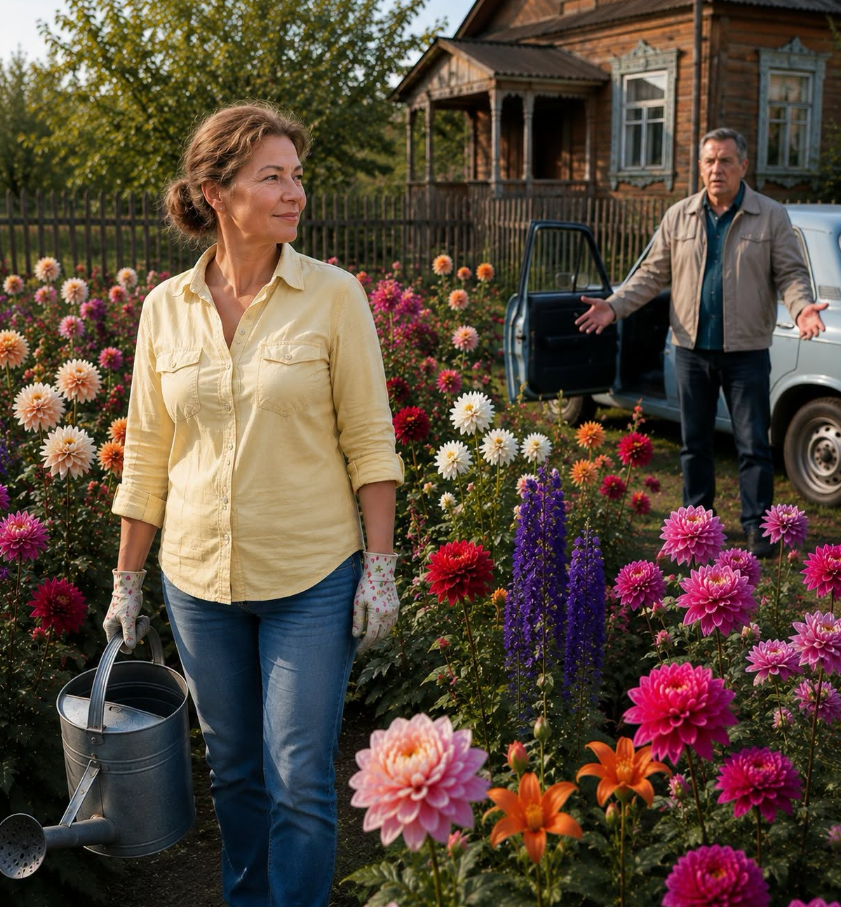
When Viktor came home, I was standing there with a watering can in my hand.
He stepped out of the car.
Looked at the field.
And froze.
For a full minute, he said nothing.
Then quietly:
“Where are the potatoes?”
I wiped my hands on my old work jacket.
“The potatoes are on ten acres. That’s enough for us.”
He pointed toward my flower beds.
“And this?”
“This is a flower garden.”
He sat down on the porch steps.
He didn’t yell.
He didn’t get angry.
He just sat there like a man who suddenly didn’t know what to do.
“Do you understand Galina will get less?” he asked.
“I understand.”
“She’s used to our potatoes.”
“Viktor… she can buy potatoes at the market. Like everyone else.”
Silence.
Then I finally said what I had been carrying inside for years.
“Have you ever noticed my hands at night? Have you ever seen how swollen they get? Have you ever understood that every spring I started feeling afraid?”
He looked away.
“I’m sixty-one years old,” I continued. “We’ve been married for twenty-eight years. And for the last seven years, I hated May. Because I knew what was coming. The field. The pain. The exhaustion. And you saying ‘we have to’ when really it always meant ‘I have to.’”
He lowered his head.
“Why didn’t you tell me?”
I looked at him.
“I did. Twice. You just didn’t listen.”
The next week was quiet.
He planted the remaining potatoes.
I cared for my flowers.
For the first time in our marriage, we worked separately on the same piece of land.
And slowly, he began to understand.
I wasn’t destroying the garden.
I was finally making a place for myself.
By the end of June, my flower garden came alive.
The peonies opened into huge white and pink blossoms.
The phlox attracted buzzing bees.
The grass became a soft green carpet.
One morning, I sat on the old wicker chair that had been collecting dust in the attic for years.
I drank tea.
And I simply looked around.
I wasn’t working.
I wasn’t counting.
I wasn’t preparing food for everyone else.
I was just there.
Peaceful.
Mine.
One Friday, Viktor walked toward the flower beds.
He stopped.
Touched a hosta leaf.
And quietly said:
“Beautiful.”
I almost dropped my cup.
In twenty-eight years, he had never described anything in the garden that way.
He always said:
“Good harvest.”
“Grew well.”
“Strong plants.”
But never:
“Beautiful.”
In July, his relatives came.
Galina saw the garden and stopped.
“Where is the field?”
“The field is smaller now,” I answered calmly.
She turned to my husband.
“Viktor, you allowed this?”
For years, he would have avoided the conversation.
But this time he looked at me and said:
“Galina, this is her garden too. She has the right.”
His sister looked at the flowers.
Then at him.
Then at me.
“Well, don’t come asking me for pickles this winter,” she said bitterly. “Since you have flowers instead of a proper garden.”
“We won’t,” I replied.
And for the first time, I realized I wasn’t losing anything.
Because the summers I had lost for seven years were worth more than any sack of potatoes.
In August, the phlox bloomed.
Pink.
Purple.
White.
I cut the first bouquet and placed it in a three-liter jar on the veranda.
When Viktor came in from the potato field, dirty and tired, he stopped when he saw it.
“These are from your garden?”
“Yes.”
He put down his bucket of potatoes, leaned toward the flowers, and smelled them.
Then he straightened.
“I think I was wrong.”
I didn’t argue.
I just poured him tea.
In September, we harvested the potatoes.
The yield was smaller than before.
About three hundred kilos.
Viktor stored them in boxes in the cellar.
Galina didn’t call.
The relatives didn’t call.
And the world didn’t collapse.
Nobody stopped speaking to us.
They simply stopped expecting us to be their personal food warehouse.
In October, I covered the perennials for winter and cleaned the flower beds.
The garden was empty, but I felt calm.
I knew that in spring, everything would grow again.
And I wouldn’t have to start from zero.
I wouldn’t have to prove anything.
My husband came outside carrying two cups of tea.
He sat beside me.
“I was thinking,” he said. “Maybe next year we could plant lilacs by the fence.”
I smiled.
“Lilacs sound nice. But you’ll plant them yourself. I’ve already done my lifetime share of digging.”
He nodded.
And for the first time in a long while, I saw him smile.
A real smile.
Sometimes I still wonder:
If I hadn’t developed arthritis, would I have ever planted those flowers?
Why did it take a painful reminder from my own body before I finally allowed myself to rest?