Denise—“Mom” since I was eight—tilted her wineglass, let out a soft, careless laugh, and said, “You’re not part of this family.”The words were light. Almost playful.
But they landed like something breaking.I raised my glass, steady. “Perfect,” I said. “Then don’t ask for money.”
Tyler’s smirk disappeared. Dad’s eyes flicked between us, like the ground beneath him had shifted. Around the table, twenty relatives froze mid-bite—forks suspended over roast chicken, conversations collapsing into silence.
This was supposed to be a celebration.Dad had just turned sixty-five. Tyler had chosen dessert to announce that he and Rachel were getting married. Everything had been perfectly staged—smiles, applause, champagne.
Then Denise made it bigger.She pulled out a blue folder and announced that the family lake cabin would be transferred to Tyler before the wedding, “to keep it in the next generation.”
Everyone applauded.Everyone except me.I set my fork down slowly. “You’re giving Tyler the cabin while the mortgage here is behind and Dad’s rehab bills still aren’t paid?”
Rachel’s smile faltered. Tyler rolled his eyes. Denise folded her napkin with precise control“That isn’t your concern,” she said.“It becomes my concern every time you text me asking for help.”
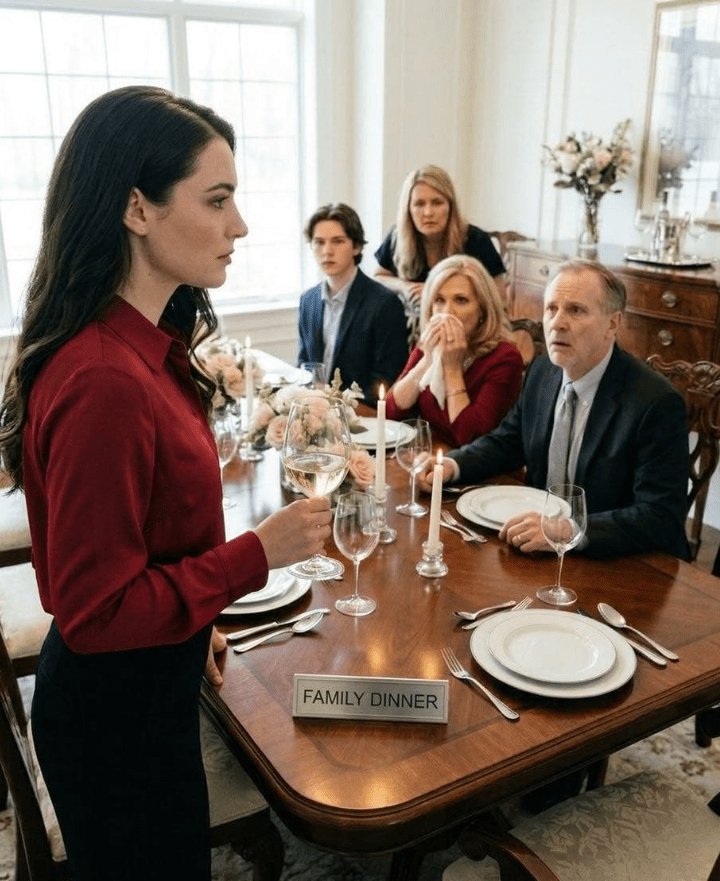
Tyler leaned back, casual. “Come on, Emma. The cabin is family property.”I met his gaze. “Then use family money.”That was when Denise laughed.
“Oh, sweetheart,” she said. “You’re not part of this family.”The room went silent.For a moment, I was fourteen again, reminded exactly where I stood. Tyler was the son. The future. The one who mattered.
I was the extra. The convenient one.Still, I had paid.Nineteen months of it. Three thousand dollars most months. More when Tyler’s truck shop started collapsing.
More when Dad’s prescriptions spiked after surgery. Denise always told me not to tell him—said it would hurt his pride.So I didn’t.Until now.I lifted my glass. “Perfect,” I repeated. “Then don’t ask for money.”
Dad frowned. “What money?”No one answered.I pulled out my phone and turned the screen toward him. “The money I’ve been sending Denise every month,” I said. “For this house. For your medication. For Tyler. All of it stops tonight.”
The color drained from Denise’s face.But the worst part was Dad.Because from the way he stared at her, I knew—he had never known where the money came from.
The next morning, Dad stood at my door with two cheap coffees and ten extra years on his face.“I need the truth,” he said.I let him in and showed him everything—nineteen transfers, month after month, stacked like receipts for a life I had been quietly funding.
He scrolled in silence.“She told me the money came from her mother’s estate,” he said.“It ran out two years ago,” I replied. “After that—it was me. And most of it went to Tyler.”By noon, we were sitting in a bank office.
The truth was worse than either of us expected.The house wasn’t just behind—it was ninety-two days from foreclosure. Dad’s rehab bills had only been paid because I covered them.
The cabin had a line of credit against it. Tyler’s business had burned through tens of thousands before collapsing under debt.I felt sick.Dad looked calm.
“I knew Denise favored Tyler,” he said quietly on the drive back. “I told myself that was normal.”He tightened his grip on the wheel. “I didn’t think she would take from you. And hide it.”
“You didn’t ask,” I said before I could stop myself.He nodded. “No. I didn’t.”That evening, Denise showed up at my door—perfect hair, perfect makeup, anger radiating off her.
“You embarrassed me,” she said.“You stole from me,” I replied.Her smile sharpened. “Families help each other.”“Families don’t tell one daughter she isn’t family after taking her money for a year and a half.”The mask dropped.
“You’ve always been difficult,” she said. “Tyler needed help. You have everything—career, condo, savings. What were you actually losing?”And there it was.
Not desperation. Not survival.Entitlement.To her, this had never been help. It had been redistribution.Tyler needed. I had. Therefore it belonged to him.
When Dad arrived, he heard enough.He didn’t yell.He didn’t argue.He simply took off his wedding ring and placed it on my table.
“Tomorrow,” he said evenly, “you and Tyler bring every document. Every account. Every loan. If anything is missing, I file for legal separation and a forensic audit.”
For the first time in my life, Denise looked afraid.The truth unraveled quickly after that.Tyler’s business had failed long before anyone admitted it.
Debt piled on debt. Denise drained her savings, then used my money, then borrowed against the cabin to keep everything afloat.And when that wasn’t enough, she had a plan.
Unsigned refinance documents—with my name listed as co-borrower.She was going to “talk me into it.”Like it was reasonable.Like I was still hers to use.Dad didn’t raise his voice.
“You used my daughter as a bank,” he said. “And planned to use her credit next.”Denise lifted her chin. “I protected my son.”“No,” Dad said. “You sacrificed one child for another.”
And just like that—The marriage ended.Within a month, everything changed.The cabin was sold to stop foreclosure. The house was saved, then listed.
Tyler filed for bankruptcy. Rachel left. Denise moved into a small apartment and told anyone who would listen that I had torn the family apart.
For a while, some believed her.Then the paperwork started circulating.Numbers have a way of dismantling lies.A year later, Dad lives in a small ranch house—no stairs, no lake view, no room for denial.
Tyler works a regular job now. We speak occasionally. He sounds smaller.Denise and I don’t speak at all.Some relationships don’t end in repair.They end in clarity.
What I learned that night is simple:People who call you “family” only when they need somethingaren’t asking for love.They’re asking for access.And real family?It isn’t proven by blood, or titles, or where you sit at the table.
It’s proven by what they protect when everything falls apart—your dignity,or their convenience.