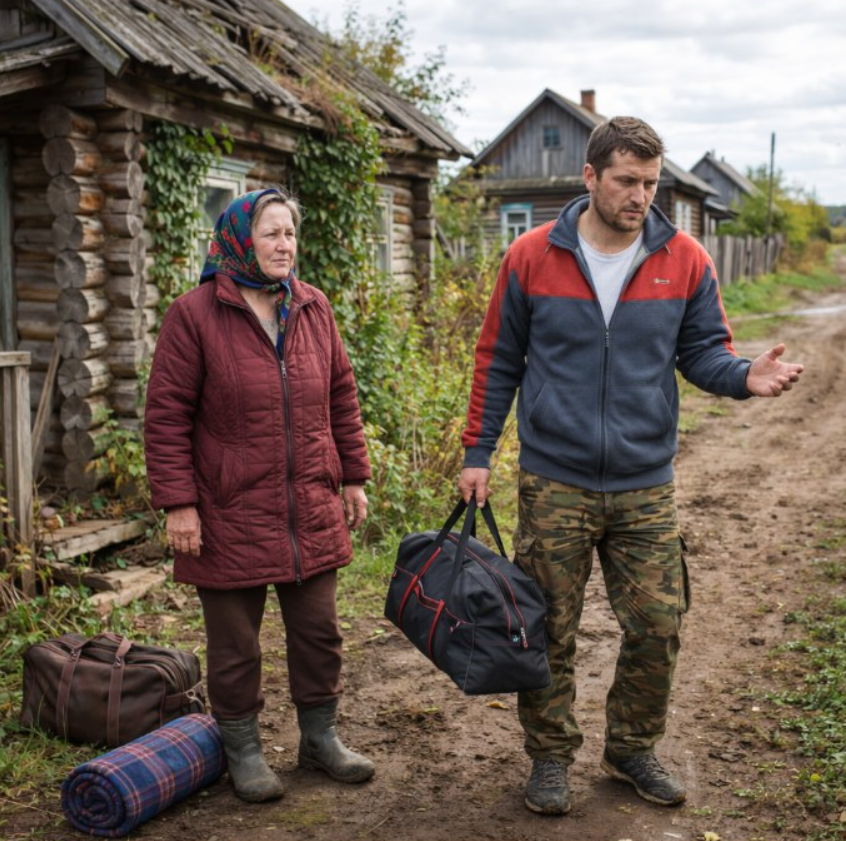
The sports bag landed with a dull thud in a patch of thistles. A rolled-up old blanket fell on top of it.
— “Live here and don’t get in the way!” Vadyim slammed the trunk shut and wiped his hands on his jeans as if he’d gotten dirty. “The air is clean, no neighbors nearby.
You’ll rest away from the city. Kristina needs peace before giving birth, and at home the workers are laying tiles—dust everywhere, up to the ceiling.”
I looked at the crooked wooden house. The porch had sunk so deep into the ground that the bottom step had completely rotted away. The windows were boarded up with gray planks.
A narrow path led from the gate to the door, overgrown with nettles taller than a person. The nearest road was fifteen kilometers away along a broken dirt track.
— “Vadik…” My mouth had gone dry; I could barely speak. “This is our apartment, mine and Dad’s. I already gave you the living room and the balcony. I could stay in my room while the repairs are going on.”
Vadyim let out a heavy sigh. The SUV window slid down. Kristina, adjusting her sunglasses, grimaced with obvious disgust.
— “Svetlana Yuryevna, we’ve discussed this a hundred times. You’re never satisfied with anything. Vadyim spent three days finding a place with clean air and arranging everything, and you’re making a scene again. Let’s go, Vad, my back hurts.”
Vadyim didn’t meet my eyes. He walked around the car, got behind the wheel. The engine rumbled briefly, the wheels crushed the tall grass, and the black vehicle drove off quickly.
Dust lingered in the still air, settling on my hair and shoulders. I remained standing by the rotting fence. Inside, everything felt dull and heavy.
For ten years I had lived in my own apartment like a piece of convenient furniture—making pancakes in the morning, washing their clothes, putting my pension into the shared pot, and trying not to be seen when Kristina’s guests were around.
When Vadyim needed a car, I sold my dacha. I had completely forgotten about myself, just to keep them comfortable.
I bent down and unzipped the cheap bag. Vadyim had packed it in a hurry: a worn-out robe, a piece of tar soap, two packs of pasta, a box of tea. At the very bottom was my old push-button phone.
Kristina always insisted it be hidden so it wouldn’t embarrass them in front of their friends. But she overlooked one thing: that phone’s battery lasted a week and a half, and its contacts included people I had known since my late husband’s time.
There was no signal. The screen showed a crossed-out antenna.
It was getting dark. I had to pry the boards off the door—they were barely held by rusty nails. Inside, there was a stale, heavy smell of dust and mouse droppings. In the corner I found a sagging iron bed with a bare mattress.
I curled up on it, covering myself with the blanket. At night the temperature dropped sharply. Lying there, staring at the dark ceiling and listening to mice scratching under the floor,
I realized something clearly: if I gave up now, they would leave me here forever, under that same thicket of nettles.In the morning I went outside with a bucket I found in the shed.
The boards near the fence creaked. An elderly, tall, thin man in rubber boots and a rain jacket stepped out from behind the lilac bushes.
— “New residents, I see?” he looked me over carefully, then at the bucket. “I’m Ilya Kuzmich. Third house from the well. Give it here—the chain’s broken, you won’t manage it alone.”
He took the bucket, left, and returned ten minutes later filled to the brim with water, placing it on the porch.— “Your son brought you yesterday? In a jeep?”
— “Yes…” I lowered my eyes.He didn’t ask further. Instead, he placed a matchbox on the windowsill.— “The stove works fine here. Good draft. If you want to light it, there’s dry firewood in the shed.”
I thanked him. After washing with the icy water, I put the phone in my pocket and walked behind the gardens. A hill rose there, covered with sparse pines.
I climbed it, grabbing branches and breathing heavily. At the top, the phone suddenly beeped—a single bar of signal appeared.I dialed a number.
— “Hello,” came the deep voice of Boris Eduardovich, a bank manager and an old friend of my late husband.
— “Boris Eduardovich, hello. It’s Svetlana. I need a favor right now. Revoke all powers of attorney under Vadyim’s name. Block all additional cards.
Transfer my pension and all remaining funds to the account I previously specified. Access must be only with my passport.”— “Svetlana?” he paused. “Are you sure? He won’t be able to withdraw a single cent or even log into online banking.”
— “Cut the ties, Boris.”Next, I called Nikita, a young, meticulous lawyer who had handled my inheritance three years earlier.
— “Nikita, hello. Check my apartment in the registry. And impose a ban on any transactions without my personal presence at the public service center.”
Keys clicked on the other end of the line.— “Svetlana Yuryevna…” his voice grew serious. “There’s a lien on your apartment. A mortgage encumbrance.
A commercial loan taken eight months ago. It’s already two weeks in arrears. The bank has issued a demand for full repayment.”I sat down on a fallen pine trunk. Eight months ago.
Last autumn. I had been very ill then—barely able to stand. Kristina suddenly became unusually caring, bringing drinks, brewing herbal teas.
One evening, when I felt especially unwell, she slipped some papers in front of me. “Just sign here, there are inspection marks, or they’ll fine us.” I signed without reading, just so she would leave me in peace.
They hadn’t cared about my health. They mortgaged my only property and spent the money on their own renovations and comforts. And when the bank sent notice of foreclosure, they quickly hid me here so I wouldn’t go to the authorities.
— “Nikita,” I swallowed the lump in my throat. “I wasn’t of sound mind. Pull my medical records for November. Prepare a police report for fraud. We’ll challenge the contract.”
The next day, the phone came to life. Vadyim’s name flashed on the screen. I let it ring three times before answering.— “Mom! Where are you?!”
— “I’m breathing fresh air.”— “Kristina has been at the checkout for half an hour! The card doesn’t work! The app shows a decline! What did you do? Call the bank now!”
In the background, Kristina was shouting: “Tell her not to be stupid! I can’t be stressed right now!”— “I’m not calling anyone, Vadyim,” I replied calmly.
— “Are you trying to ruin us?!”— “You ruined yourselves. The loan you took eight months ago with forged signatures is now your problem.”
Silence followed. I hung up.Five days later, they arrived—two cars. Vadyim got out, pale and tense. Kristina followed, holding her belly. From the second car, my sister and my nephew stepped out.
The plan was simple: declare me incompetent in front of witnesses and gain control over everything.— “Look at her condition,” Vadyim began theatrically. “She’s completely confused.”— “Enough.”
Ilya Kuzmich entered the gate, carrying an axe. He calmly set it into a chopping block and stepped forward.— “Lower your voices. I’ve been observing this woman all week.
She works from morning till evening, keeps the place in order. That’s not how an unstable person behaves.”The tension shifted. The act collapsed. The relatives exchanged glances. In the end, they left in silence.
A year and a half later, the court annulled the mortgage. The fraud was proven. I sold the apartment and used the proceeds to rebuild the old house.
Now I sit on a sturdy wooden porch. The sun sets behind the pine forest. Ilya Kuzmich brings fresh tea, and a large striped cat purrs beside me.
And for the first time in a long while, I understand: peace begins the moment you stop being afraid to lose those who have already lost their conscience.