“Say no to me one more time, and I swear you’ll regret bringing me into this world.”My son’s voice cut through the kitchen like something sharp enough to split the air itself.For a moment, I couldn’t move.
My hands were still in the sink, water dripping slowly from my fingers. For months I had told myself it was a phase. A breakdown. A rough patch. Something temporary I could survive without confronting the full truth.
But that night, I understood something I had been avoiding for too long: this wasn’t a boy lashing out anymore. This was a twenty-three-year-old man who had learned to turn anger into a weapon.
In a small town outside Monterrey, my son had become someone I no longer recognized.
Ethan was never always like this. He was tall, strong, with a presence that filled a room without effort. As a child, he was warm, affectionate, quick to laugh. Hugging him used to feel as natural as breathing.
Then something in him began to fracture.First came his father leaving after the divorce. Then he dropped out of college. Then the jobs he couldn’t keep. The friendships that faded. The relationships that collapsed. Every failure didn’t stop him—it hardened him.
And I… I kept covering for him.I told myself it was just a difficult period.That he would grow out of it.I gave him money to avoid conflict.
I ignored the shouting, the slamming doors, the smell of alcohol when he came home late at night.
Until love stopped feeling like love and started feeling like survival.That evening I came home exhausted from the library. He asked for money.
I said no.Simple. No explanation.His face went still.“No?” he repeated. “And who do you think you are?”“Your mother,” I said. “And the one paying for this house.”The air between us shifted immediately.
“Don’t talk to me like that,” he said.“I will talk the way I need to,” I replied, my voice shaking but holding.And then it happened.One strike.Fast. Sudden. Impersonal.
I didn’t fall. I didn’t scream. I just stood there, holding onto the counter while the silence in the house turned deafening. He walked upstairs without looking back, as if nothing had changed.
But everything had.That was the moment I understood I was no longer safe in my own home.At 1:20 a.m., I called Michael, his father.“Ethan hit me,” I said.Silence.
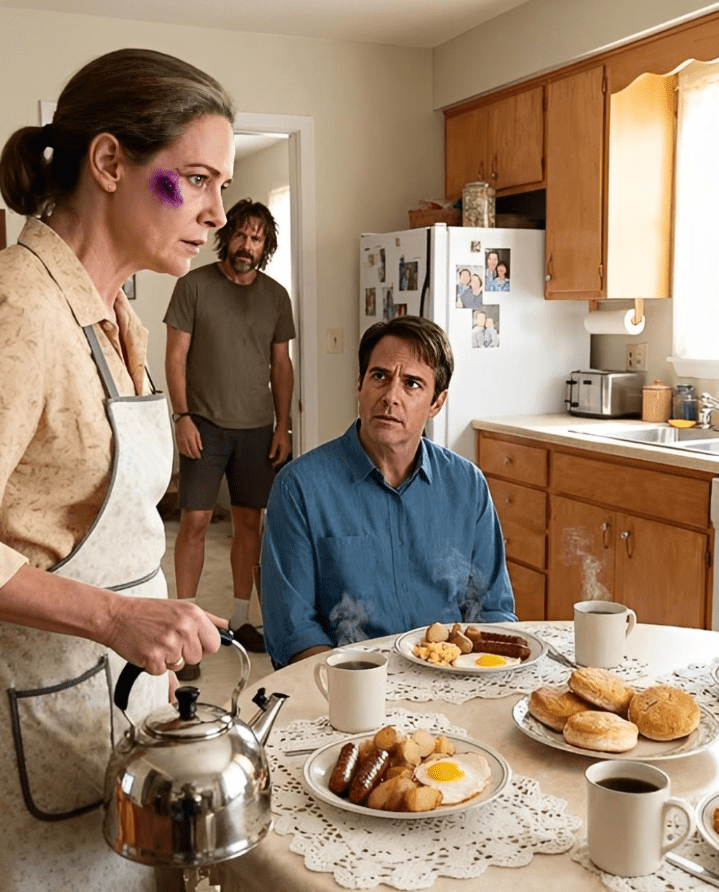
Then: “I’m coming.”I didn’t sleep that night. I cooked breakfast as if it were a normal day. I set the table with the good cloth. The special plates.But it wasn’t a celebration.
It was a turning point.Michael arrived early in the morning. He didn’t need details. One look at my face told him everything.“Is he upstairs?” he asked.
“Yes.”“Today this ends,” he said quietly.Ethan came down later, acting as if nothing in the world had changed.“Nice breakfast,” he said sarcastically, sitting down.
Then he saw him.His father.The chair scraped against the floor.“What is he doing here?”“Sit down,” Michael said.It wasn’t a request. It was final.
Ethan sat.The air tightened instantly.Michael opened the folder.“This is a temporary restraining order.”Silence.“This cuts off your access to your mother’s money.”
Another page.“And this means you don’t come back here if things continue like this.”Ethan laughed, but it was hollow.“You’re kicking me out?”“We’re stopping this,” I said.
For the first time, he looked directly at me.“Are you afraid of me?” he asked.My silence answered before my words did.“Yes,” I said finally. “I am.”Something in his expression cracked—just for a second. Then it hardened again.
“Of course,” he said. “I’m always the problem.”“No,” I replied. “But what you’re doing cannot continue.”The silence stretched.“And if I don’t go?” he asked at last.“Then you leave,” Michael said. “And it ends here.”
He went upstairs.When he came back down, he carried a bag.For a moment, I saw the boy he used to be.But it vanished quickly.“I’m not doing this for you,” he said.
“You don’t have to,” Michael replied.He looked at me.Not with anger.But something heavier.Shame.“Will you ever let me come back?” he asked.
I took a breath.“I don’t know,” I said. “That depends on what happens next. And whether I can feel safe again.”He nodded slowly.And he left.No shouting.
No final explosion.Just silence closing a chapter that had lasted too long.In the weeks that followed, I changed the locks. I started therapy. I learned words I had avoided for years: boundaries, abuse, dignity.
Then a letter arrived.“I don’t expect forgiveness yet,” he wrote. “But I’m trying to take responsibility.”I cried—not because everything was fixed.
But because the truth had finally entered the house.And I realized something I should have understood much earlier:Love is not endurance without limits.Love is knowing when to stop disappearing inside someone else’s destruction.