I Can Live Perfectly Well Without You
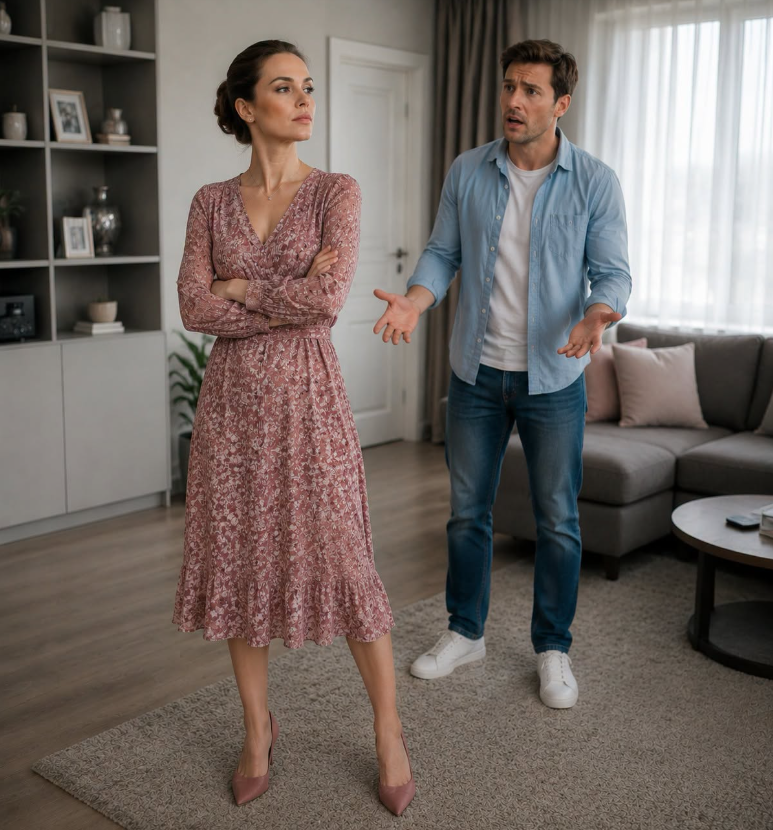
“I can live perfectly well without you. But you try living without the apartment, the car, and the money that were actually mine,” Marina replied so calmly that Oleg felt the air catch in his throat.
He had expected something completely different. Shouting. Tears. Accusations. Maybe even a shattered mug on the kitchen floor. He had already chosen where to stand beside the kitchen island, far from the heavy cookware, and placed his phone face down so nothing would interrupt the carefully rehearsed scene.
But Marina simply closed her laptop and looked at him as if he had merely said, “It might rain tonight.”
Hot July air drifted through the open windows. The yard smelled of freshly cut grass, currant leaves, and sun-warmed wood. Somewhere behind the tall fence, children squealed under a garden sprinkler. Inside, the air conditioner hummed softly, making the silence feel even heavier.
Oleg straightened slowly.
In his mind, this departure was supposed to be elegant. For months he had imagined himself announcing his decision, Marina falling apart, and himself walking out with dignity. He had convinced himself that he had outgrown this family, this house, and this quiet woman who planned grocery shopping six months in advance.
Next to Marina, he no longer felt like a husband. He felt like a component in a perfectly tuned machine. Every morning the coffee was ready, the car insurance renewed, the bills paid, the vacation arranged, and every important document filed neatly in labeled folders.
Only with **Lika** did he feel like a man again — someone admired, anticipated, and never reminded that one of his previous “brilliant ideas” had once cost the family a fortune.
Lika was a sales director at one of his suppliers. She was polished, energetic, and possessed the rare talent of listening to a man as though every sentence he spoke deserved to be printed in a business textbook. Their affair had lasted almost eight months.
Oleg did not consider himself an unfaithful husband. He preferred to call it “a new stage of life.” In his mind, his marriage to Marina had ended long ago; she simply had not been informed yet.
A week earlier, he had already rented an expensive apartment overlooking the bay, complete with panoramic windows and stylish gray-and-beige furniture. Lika had chosen the coffee machine and even sent him photos of the light fixtures she wanted.
Oleg imagined himself being generous. He planned to give Marina time to adjust to the idea of divorce and had even decided that he would continue paying the utilities for a while.
But Marina’s composure destroyed his entire carefully constructed performance.
“I don’t think you understand,” Oleg said, his voice tightening. “I’m not joking. I’m leaving.”
“I understood.”
“I’m selling the apartment near the metro. I’ll take the car at the end of the week. We’ll sort out the bank account with the lawyers.”
Marina simply nodded.
Ten years earlier, she had taught Oleg that it was pointless to interrupt people who had not yet finished making their mistake. Sometimes they volunteered information no one had intended to ask for.
Oleg continued speaking. He explained that the house was technically marital property, but had been built mostly with his income. The apartment had been purchased during the marriage. The car was registered in his name. And because his business was going through a difficult period, Marina would have to learn to live more modestly.
That last sentence pleased him especially.
The truth, however, was very different.
His company had been struggling for two years. It supplied equipment to cafés and small restaurants, but poor expansion decisions, an unnecessary warehouse, and a line of unsellable machines had buried the business in loans and unpaid invoices.
Marina had never openly interfered in his business. Because of that, Oleg assumed her work was merely a tidy little supplement to his real enterprise.
What he did not know was that Marina had been earning more than he had for the past three years.
She stood, poured herself a glass of water, and returned to the table.
“When are you moving out?”
“Tomorrow. I’ve already taken most of my things.”
That did not surprise her either. Months earlier, she had noticed that a travel bag had disappeared from the closet, then a box of tools from the garage. Later, Oleg stopped taking one shirt at a time and began removing several at once. He had been careful, but far too consistent.
Marina never searched his phone. She disliked collecting evidence for something she already understood perfectly well.
Instead, she opened the family archive and began reviewing documents. Not because she was afraid of being left without money, but because she wanted to know how far Oleg was willing to go in defending the reality he had invented for himself.
A few minutes later, she placed a thin folder in front of him.
Inside were the ownership documents for the apartment, the house, and the car.
Marina had purchased the apartment near the metro two years before she met Oleg. The house stood on land her father had given her as a gift, and most of the construction had been financed with money from the sale of property she had owned before the marriage. The car, although registered in Oleg’s name, actually belonged to Marina’s company and had been assigned to him for business use.
Every payment had been documented with contracts, bank statements, invoices, and official records. Marina had kept everything.
Oleg flipped through the papers quickly at first, then more slowly. The confidence began to drain from his face.
“What is this?” he asked hoarsely.
“he things you were so confidently planning to discuss with your lawyer.”
He tried to protest.
“he house was built during the marriage!”
“On my land and with my money. All the proof is there.”
“I contributed too.”
“Yes. You paid for the kitchen appliances, part of the fence, and the irrigation system. I’m not denying that.”
She even named the exact amount.
In Oleg’s memories, he had managed the construction, negotiated with contractors, and controlled every detail. Now it turned out that Marina had signed most of the contracts, while he had mostly appeared on weekends with loud opinions about decisions that had already been made.
But the worst shock was still waiting.
And the joint account? The money there is shared property,” he insisted.
Marina turned the laptop toward him.
“The joint account is almost empty.”
Oleg immediately opened his banking app. For several seconds he simply stared at the screen.
“Where’s the money?”
“Paying your debts.”
She showed him the transfers. Two weeks earlier, one of his suppliers had sent a formal demand for payment, and the bank had reported overdue obligations on his credit line. Because Marina had signed as a guarantor years ago, her own assets were at risk as well.
She had not hidden the money.
She had paid the most dangerous debts and moved the remainder into an account used for taxes and employee salaries. Every dollar was fully documented.
At that moment, Oleg understood for the first time that he was not facing a devastated abandoned wife. He was facing a woman who had prepared for this day months in advance.
The following weeks brought lawyers, contracts, and negotiations. Oleg attempted to claim a share of the house and the apartment, but Marina answered every argument with documents.
In the end, he had little choice but to accept the settlement: he gave up his claims to the house and the apartment, returned the car, and Marina agreed to postpone collection of his company’s debts.
When the papers were finally signed, Oleg looked tired rather than victorious.
“I thought it was all mine,” he said quietly.
Marina studied him for a long moment before answering.
“That was exactly the problem, Oleg. At some point you stopped being able to tell the difference between what you actually built yourself and what you were simply allowed to use because someone loved you.”
After the divorce, Marina changed the locks, organized the house, and took her first real vacation in years. She did not move away or dramatically reinvent her life. She simply learned what it felt like to live without pretending to be weaker so that someone else could feel indispensable.
At the end of August, Oleg’s first repayment arrived.
Marina entered the amount into her spreadsheet, closed the laptop, and stepped out onto the terrace.
Dark storm clouds were gathering above the pines.
The first heavy raindrops struck the warm wooden boards.
Marina locked the door with the new key, and for the first time in a very long while, she did not wonder whether someone would be coming home late that night.