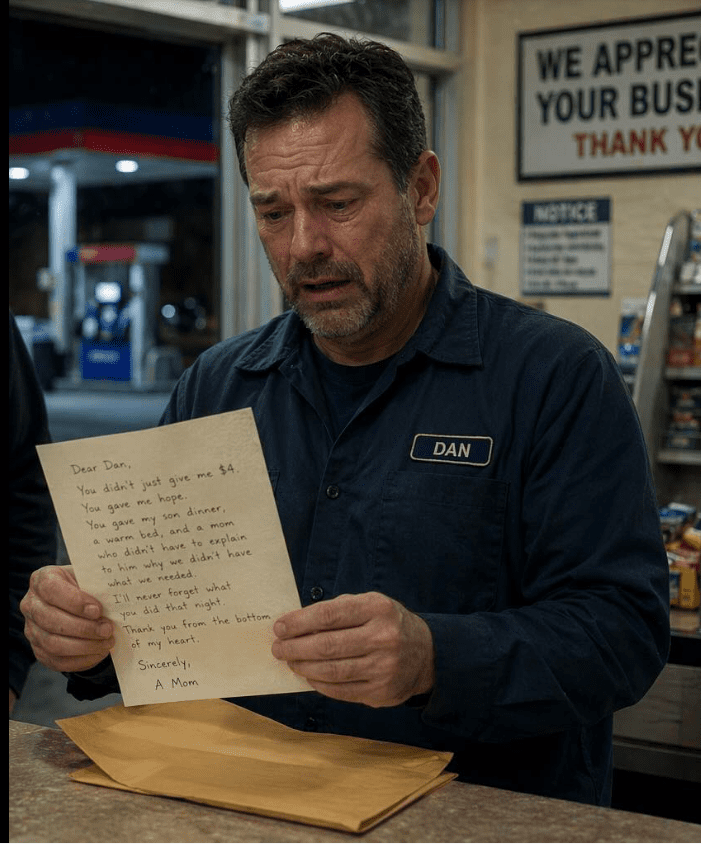
A week after I gave four dollars to a tired young mother at a gas station, a strange envelope arrived at my workplace. It was plain—just a simple white envelope with no return address, no markings, only my name written neatly across the front in careful handwriting.
Still, the moment I held it in my hands, something about it felt different, almost heavy, as if it carried more than just paper inside.
My name is Ross. I’m forty-nine years old. I’ve got a wife, Lydia, who’s steadier than I’ll ever be, two kids who seem to outgrow everything faster than I can keep up, and a mortgage that still feels too big for a house that’s definitely too small.
But it’s ours—and that counts for something.
A few years ago, everything changed overnight. The factory where I’d worked for twenty-three years shut down without warning. No farewell, no transition—just one day of normal work and the next, locked gates and a single sheet of paper announcing bankruptcy.
Twenty-three years of my life, gone just like that.Since then, I’ve been working night shifts at a gas station off Highway 52. Nights there have a certain emptiness to them. The fluorescent lights hum and flicker,
the smell of burnt hot dogs lingers in the air, and the same three songs play on repeat until they blur into background noise. Time stretches differently at night—it slows down, drags, settles in your bones.
That night started like any other. A few truckers came through earlier, a teenager grabbed energy drinks, and then it went quiet. Around 11:30 p.m., the bell above the door chimed, and she walked in.
She was young, but exhaustion clung to her like a second skin. A small child slept on her shoulder, his arms dangling loosely, his face tucked into her neck. She moved carefully, each step measured, like she was trying not to disturb the fragile balance holding her together.
Her hair was tied back in a messy ponytail, strands falling loose around her face. Her gray T-shirt was wrinkled, slightly stained at the sleeve. But it was her eyes that stayed with me—hollow, distant, worn in a way that went far beyond just being tired.
She didn’t say a word at first. She moved slowly through the aisles and picked up only what she needed: a small carton of milk, a loaf of white bread, and a pack of diapers. Nothing extra. Nothing unnecessary.
At the counter, she set everything down gently, adjusting the weight of the sleeping child on her shoulder. He stirred slightly but didn’t wake.
“Fourteen dollars and seventy-two cents,” I said.She dug into her bag with one hand, pulling out crumpled bills, smoothing them as she counted. Once. Then again. Her shoulders tensed, and I saw the moment it hit her.
She looked up, her eyes glistening.“I’m four dollars short,” she whispered. “Can I… put the diapers back?”There was something about the way she said it—not just the words, but the quiet defeat behind them.
I didn’t think.“It’s okay,” I said. “I’ve got it.”She froze, staring at me like she hadn’t heard right. I pulled four one-dollar bills from my wallet and placed them in the register.
“Just get home safe,” I added softly.For a second, I thought she might cry right there. Instead, she nodded quickly, whispered a thank you, and hurried out into the cold night.
Through the window, I watched her reach an old sedan that had clearly seen better days. She opened the door carefully, holding her child close, and before getting in, she paused—just for a moment—wrapping her arms around him a little tighter.
Then she was gone.The station fell quiet again, like nothing had happened.A week passed. Same shifts, same routine. I’d almost forgotten about that night when my manager called me into his office and handed me that envelope.
My name was on it.I opened it slowly. Inside was a check.Five thousand dollars.I stared at it, reading the number over and over, certain I had it wrong. But I didn’t.
There was also a letter.“Dear Ross,Thank you for your kindness to our daughter, Emily. You have no idea how much it meant. Because of you, she made it home safely. Please accept this as a small token of our gratitude.
We would also be honored if you joined us for lunch this Sunday.”That Sunday, I went.Their house stood in a quiet, well-kept neighborhood—large, calm, almost too perfect.
An older couple greeted me at the door, their smiles warm but their eyes carrying something deeper.They invited me in, and over lunch, they told me the truth.
Emily had been in a bad marriage—controlling, isolating, painful. That night, she had finally found the courage to leave. She packed what little she could, took her son, and drove away with almost nothing. She was scared, ashamed, and unsure where to go.
“When she stood at your counter,” her mother said, her voice trembling, “she felt like she had already failed. Like she couldn’t even take the first step toward a new life.”
Her father looked at me steadily.“But you helped her,” he said. “You didn’t question her. You didn’t make her feel small. You just helped.”Her mother wiped a tear from her eye.
“She told us you said, ‘Just get home safe.’ She said it was the first time in years someone treated her like a person instead of a problem.”I sat there, unable to find words.
Four dollars. That’s all it had been to me.But to them… it had been something else entirely.On the drive home, I kept thinking about that moment. How small it had felt at the time—and how much it had meant to someone else.
Yes, the money helped us. We caught up on bills, fixed the car, bought new shoes for the kids without worrying about the price.
But that wasn’t what stayed with me.What stayed with me was the realization that the smallest acts of kindness—the ones we do without thinking, without expecting anything in return—are often the ones that matter most.
I still work the night shift at that gas station. The lights still flicker. The same songs still play.But now, when someone walks in looking worn down by life, I pay a little closer attention.
Because you never know when four dollars and a few kind words might be exactly what someone needs to make it home.