Saturday morning stretched over the highway in a dull grey haze, the sky still half-asleep while traffic already poured out of the city in long, restless streams, engines humming together in a constant mechanical rhythm,
tires whispering across damp asphalt as everyone rushed somewhere without really thinking about it. In the right lane, an elderly man drove alone in an old Volga, steady and unremarkable, neither fast nor slow,
simply consistent, as if time and pressure had no influence on his decisions, his hands resting firmly on the wheel, his posture calm and disciplined.
He stayed in his lane, obeyed the rules, kept distance, and moved with patience while other drivers changed lanes aggressively, cut into gaps, and treated the highway like a contest instead of shared space,
but he remained unchanged, focused only on the road ahead. Then, in his rearview mirror, he noticed a black SUV appearing behind him, closing in too quickly, too aggressively, not settling into traffic but pushing through it, its glossy body reflecting the grey sky like something sharp and deliberate.
It didn’t behave like normal traffic. It hovered too close, adjusted constantly, and pressed forward in a way that felt intentional rather than careless, and the elderly man observed it quietly,
already understanding the kind of driver it was. The SUV slipped behind a truck, hesitated for a brief moment, and then suddenly changed lanes without warning, cutting directly into his path, no indicator, no caution, no regard for distance or safety.
The old man reacted smoothly, easing his position, maintaining control, refusing to escalate, but the SUV didn’t stabilize, instead it began to apply pressure from the side, narrowing space,
forcing him closer to the edge of the lane where a heavy truck moved on one side and a metal guardrail stood on the other, turning the road into a tightening corridor. The elderly man’s grip tightened slightly,
not out of panic but awareness, as he quietly told himself he was driving correctly and did not need to respond to arrogance on the road.
Then the SUV suddenly dropped back, creating a brief moment of relief that felt deceptive in hindsight, because in the next instant it crossed a solid line into the opposite lane, accelerated past the truck,
and cut sharply back into his lane directly in front of him. It braked hard. Red brake lights flared instantly, and space disappeared in a fraction of a second.
The elderly man slammed the brakes with full force, but physics does not obey intention alone, the tires skidded, the car shook, and despite his effort the impact still came,
a heavy dull collision of metal against metal that echoed across the lane. For a moment everything went still. He leaned back in his seat, breathing slowly, hands trembling slightly from shock but his expression remaining controlled, observant, and steady.
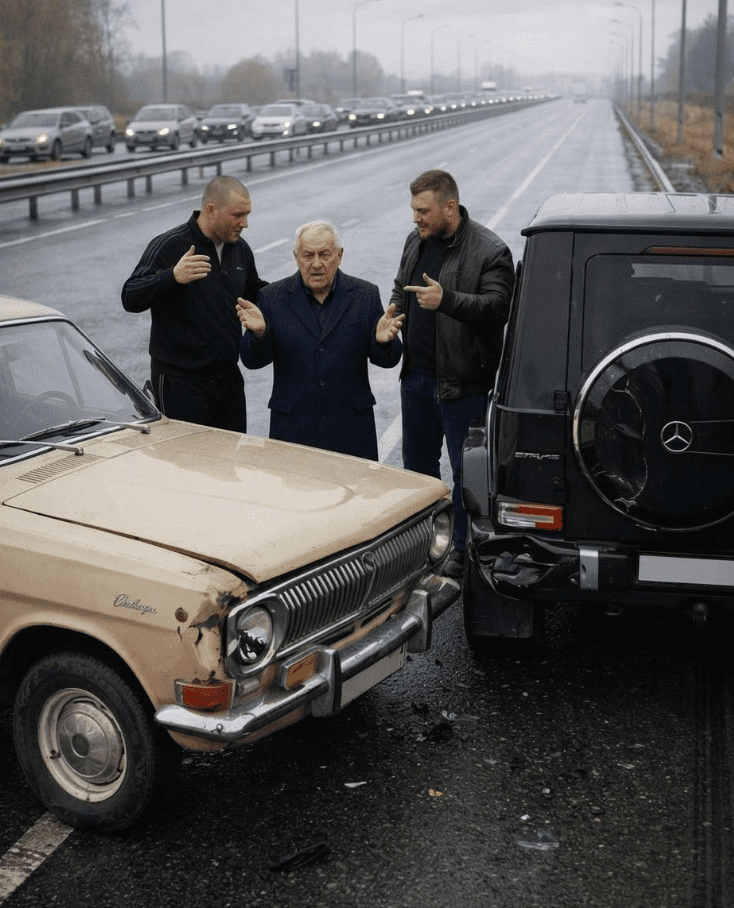
Then the SUV doors opened abruptly and two men stepped out quickly, their movements sharp and aggressive, one shaved-headed in a tight sports jacket, the other larger in a leather jacket,
both already shouting before assessing anything. They did not look at their own vehicle first, they looked immediately at him, as if the outcome had already been decided.
“What are you doing?” the first man shouted, slamming his hand onto the hood. “Are you blind?” The second pointed toward their rear bumper, raising his voice as well, “Look what you’ve done!
Do you understand what this costs?” Their tone was not confusion but accusation, carefully shaped, as if they were performing a role rather than reacting to an accident.
The pressure increased immediately. “This is expensive damage,” the shaved man said, stepping closer. “We don’t need police, we settle it now.” The larger one added coldly, “Cash. Quickly. And we go.” It wasn’t negotiation, it was demand, structured and deliberate.
The elderly man slowly lowered his window. His voice was calm and even. “You braked suddenly without reason and cut lanes dangerously. I kept my distance and followed the rules.”
The shaved man laughed shortly, shaking his head. “Listen to him,” he said, “he’s giving lessons now.” Then he leaned closer. “Do you even know who you’re talking to?”
But the elderly man did not react to the provocation. He simply looked at them, studying them quietly, as if confirming what he already understood, then reached for his phone and made a call.
His tone was simple, direct, and unhurried as he gave the location and requested assistance.
The men exchanged glances. The shaved one smirked. “Who did you call? Your family?” There was no reply. Only silence from the elderly man.
Several minutes passed. The highway continued flowing around them as if nothing important had happened, cars passing, wind moving, life continuing, until flashing lights finally appeared in the distance.
A traffic police vehicle arrived and stopped behind them, followed shortly by another, and the atmosphere changed immediately.
An officer stepped out, tall and composed, scanning the scene carefully, the positions of the vehicles, the marks on the road, the spacing, the angles, everything speaking before anyone did. He turned first to the elderly man.
“Father, are you alright?” he asked quietly. “I’m fine,” the old man replied simply.
The aggressors tried to speak immediately. “Officer, he hit us—he didn’t keep distance—” but the officer raised a hand without even fully turning toward them. “Cameras recorded everything,” he said firmly.
Then he continued, “Illegal lane crossing. Dangerous maneuver. Intentional brake behavior. It is all documented.”
The confidence of the two men collapsed in stages, their posture shifting, their voices fading, their certainty dissolving as additional officers arrived and began reviewing footage from nearby cameras,
frame by frame, leaving no room for argument or performance. The truth was no longer something to debate.
As the report was being written, the officer stepped slightly aside with the elderly man. “You didn’t need to handle it alone,” he said quietly. The old man adjusted his grip on the wheel and replied calmly,
“I wasn’t doing anything special. I was just driving the way I should.” He looked briefly toward the men being processed, now silent, no longer shouting, no longer demanding anything.
“And I don’t change that,” he added, “just because someone else decides to break the rules.”Behind them, the highway kept moving without pause, indifferent, endless, and unchanged.