Michael Thompson had long stopped fighting against the inevitability of his fate. For twelve unrelenting years, each morning had been a carbon copy of the one before—an agonizing, gray repetition of confinement within the cold, unfeeling walls of cell B-17.
Time in that prison didn’t pass; it lingered like a suffocating fog, pressing down on him, wearing him down. He was condemned to death for a murder he had always insisted he did not commit, yet no one had believed him.
The world outside had turned a deaf ear. Lawyers abandoned him, appeals stalled, and his voice, once firm and human, had dwindled to a faint, almost imperceptible echo. Sleep was a stranger; his hair had prematurely silvered,
his eyes hollowed from endless nights of restless despair. Michael no longer sought to survive life; he sought only brief moments of peace in a world that had already taken everything. Within those gray walls and under constant surveillance,
he had perfected detachment—from hope, from rage, from injustice. Everything faded… except one memory.Bella.She was more than a pet. She was his family, his sanctuary, the gentle thread that tied him to joy in the harshest moments.
He had found her abandoned, a trembling bundle of fur, and had raised her with unwavering tenderness. She had been his shadow on bright days and his solace in the darkest hours. Even as the world forgot him, he never forgot her.
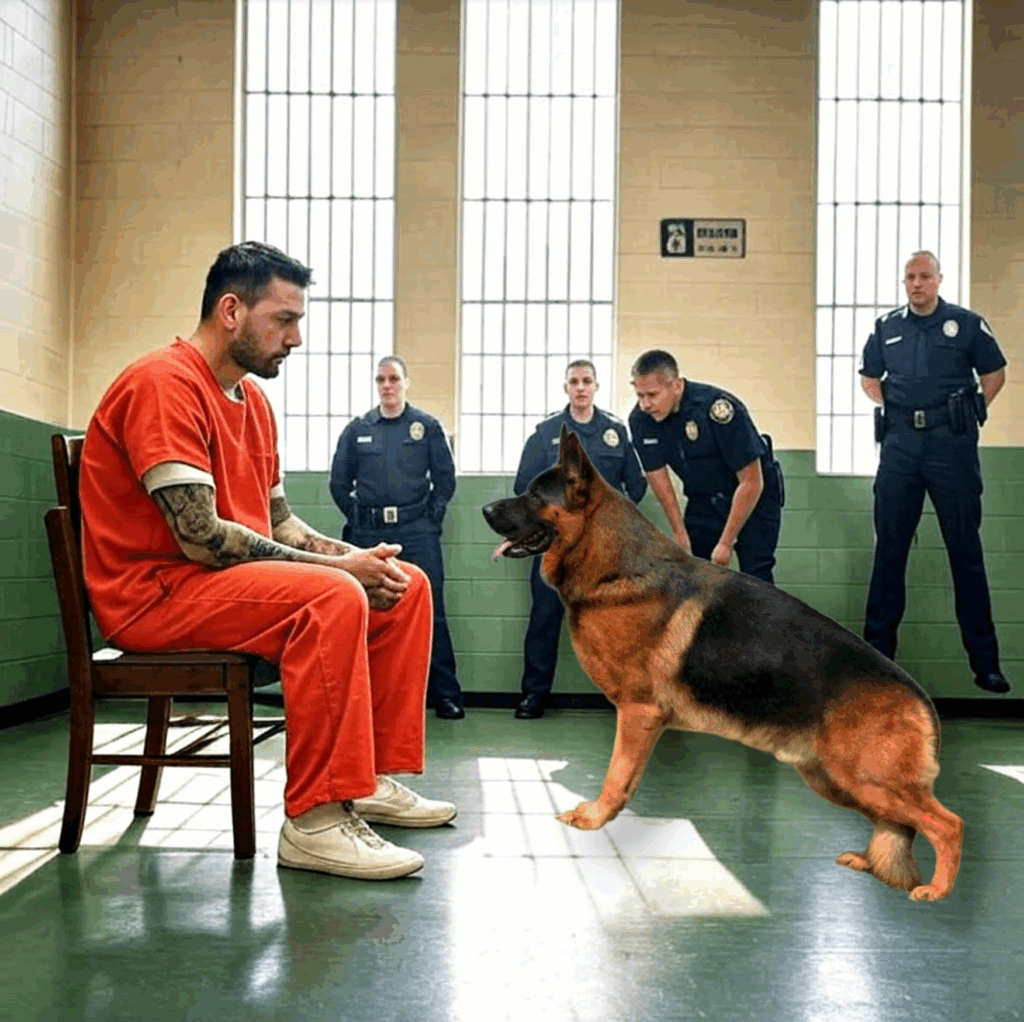
Every night, he imagined her, wondering if she still lived, if she remembered, if she waited.So when the prison warden approached with the official form, asking what he wished for as his last request, Michael did not hesitate.
He did not ask for indulgence, for comfort, for even a single luxury. With a quiet, sorrowful calm, he said, “I want to see my dog.”
At first, the staff dismissed it as a whim, a melancholic fancy of a broken man. Yet there was a sincerity in his eyes, an unspoken emptiness no indulgence could fill. Even hardened guards lowered their gaze before the raw humanity that still lingered in this condemned man.
No one knew then, but this simple wish would trigger a chain of events that would alter everything.Bella had been taken to the county shelter the very day Michael was arrested. She had no understanding of the chaos that morning—the sudden arrival of patrol cars,
the shouts, the rough hands that tore her from his side. Michael had been handcuffed in front of her, and when she tried to run, an officer yanked her by the collar and stuffed her into a car. From that moment, her world fractured. In the shelter, she did not bark, did not eat, barely even moved.
Days turned to weeks, then months, then years. She lay quietly with her head down, an embodiment of grief and longing. Volunteers whispered that she might not survive her heartbreak. Yet she never lost the routine of sitting by the shelter door at the day’s end,
as though she knew, deep in her instincts, that the man she loved would one day return.
Then came Sophia. A volunteer with a unique gift for reaching traumatized animals, she noticed Bella immediately: calm yet sorrowful, an aura of quiet suffering radiating from her small frame. Sophia approached gently, asking to walk her, speak to her,
simply exist alongside her without demanding attention. Slowly, day by day, Bella let her in, first with tentative steps, then finally curling onto her lap—a fragile trust forming between human and dog.
Even then, the sadness in Bella’s eyes lingered. She slept near doors, flinched at sirens, whimpered in her sleep. One night, while stroking her fur, Sophia noticed the tag on her collar and read the name aloud: “Michael Thompson.”
Curiosity led her to search online, and she stumbled upon old news articles detailing the case—a man convicted of murder, sentenced to death, separated from his beloved dog.
Weeks later, the impossible call arrived: the state prison. Michael Thompson, they said, had requested to see his dog as his final wish. They had located Bella via her microchip. Sophia froze, torn between the fear of what might happen and the undeniable sense that this reunion was destined.
Bella, sensing something profound, grew restless in the car, her golden eyes fixed unwaveringly on the road ahead.
The prison staff awaited them with cautious curiosity; nothing like this had ever been requested. Sophia held the leash tightly as they entered the inner courtyard. Bella sniffed the air, and in a heartbeat, recognition ignited. She tore free and ran to Michael, all years of separation condensed into a single, explosive leap.
Michael fell to his knees as Bella hurled herself at him. She pressed her head against his chest, licked his face, clawed gently at his cuffed hands, and filled the air with mournful, joyous cries. All at once, twelve years of suffering, isolation, and despair poured out in trembling sobs.
The guards, hardened by decades of witnessing pain, watched in silent reverence. Even the warden, accustomed to endings of all kinds, felt his throat tighten as he observed the purity of that reunion.
Time seemed suspended. For Bella and Michael, the prison courtyard became a private world. She lay against him, calm now, while he clung to her, seeking the piece of himself that had lain buried in those years of injustice.
And then, instinct flaring, Bella stiffened, growled at the nearest guard. Sophia recalled the dog’s rare, protective response years ago—it was not fear but a warning. Something was amiss.
The incident compelled the warden to review Michael’s case files. Inconsistencies surfaced: conflicting testimony, overlooked traffic camera footage, emergency call times that did not match reports, and partial forensic evidence misaligned with the verdict.
Driven by conscience and a creeping sense of awe at Bella’s intuition, he contacted a young lawyer, Ethan Carter.
Ethan spent nights unraveling the tangled threads of negligence, incompetence, and perhaps malice. He assembled a team of law students, volunteers, and journalists. Slowly, painstakingly, they reconstructed a truth that had been buried under years of indifference.
Bella had ignited the spark; her loyalty and unerring instincts had set a chain of justice in motion.
Meanwhile, inside the prison, Michael felt the faint stirring of hope for the first time in over a decade. Letters arrived—support, encouragement, stories of dogs who had saved their humans in their own ways. Michael began keeping a diary, recording memories of Bella,
the smallest details of her fur, her scent, the sound of her paws. Hope, once extinguished, flickered anew.
The appeal hearing arrived. Public attention surged. Ethan presented the evidence: juror testimonies, traffic camera footage, contradictory police reports. Michael testified, his voice breaking but firm. “Bella doesn’t know laws,” he said.
“She knows the truth. She waited all these years because she knew I was innocent.”The court ordered a retrial, suspending the death sentence indefinitely. Officer Patel faced perjury and obstruction charges. Michael, for the first time in twelve years,
felt the world shift beneath him—not with luck or miracle, but because of a dog’s unwavering devotion. Bella had not just waited for him; she had preserved truth itself.
Michael and Bella moved to a quiet home, far from the noise, where time flowed freely again. He wrote a book in her honor, chronicling their life and reunion. Together, they walked, slept, and lived, enveloped in the peace they had long been denied.
When Bella’s time came, Michael was at her side, whispering thanks and love as she slipped into rest.
It was a perfect ending: not defined by courts or verdicts, but by the undeniable power of love, loyalty, and the quiet courage of a dog who refused to forget. Michael had been lost, but Bella brought him back—to life, to love, and to humanity.