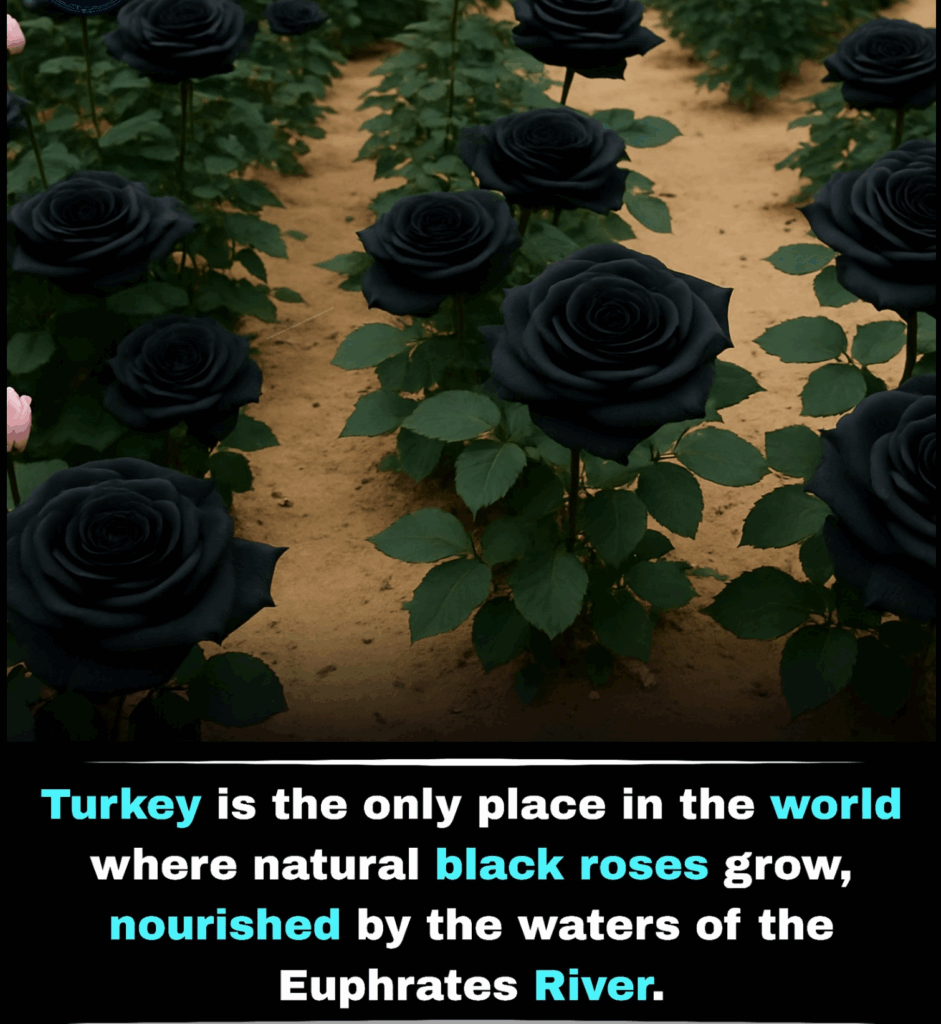
In the hidden corners of southeastern Turkey, along the meandering banks of the mighty Euphrates River, lies the small, unassuming village of Halfeti—a place where nature has quietly performed one of its most extraordinary feats:
the creation of the legendary black rose. Known locally as “Karagül,” these roses are not just flowers; they are a rare natural marvel, found nowhere else in the world. Yet, their fame comes with a subtle mystery.
Despite the name “black rose,” these blossoms are not jet black throughout the year. They first unfurl in a deep, velvety crimson, a color so rich it almost seems to pulse with life. As summer stretches on and the sun casts its golden heat across the region,
the petals gradually deepen into a shadowy hue so dark it appears black, a transformation shaped by the village’s unique soil and the subtly alkaline waters of the Euphrates.
To gaze upon a Halfeti black rose is to witness nature’s artistry in its most profound and secretive form. The petals hold the elegance of twilight itself, a darkness tempered by hints of red and burgundy that glimmer when touched by sunlight.
It is a flower that seems to exist on the edge of reality, a botanical phenomenon that captivates both the heart and the imagination. Yet what makes the Karagül truly extraordinary is not merely its color, but its intimate connection to its environment.
These roses thrive in a rare combination of climate, soil, and river-fed nutrients that cannot be replicated anywhere else. Each blossom is a delicate balance of nature’s forces, a living testament to the subtle power of place, time, and elements coming together perfectly.
The Karagül is more than a visual marvel; it is woven into the very identity of Halfeti and its people. For centuries, the roses have inspired local culture, art, and tradition. They appear in perfumes, delicacies, and crafts,
transforming the village into a living homage to its most enigmatic treasure. Every rose is a symbol of resilience, flourishing against the odds in a region shaped by both natural beauty and the harsh realities of the world around it.
Visitors to Halfeti find themselves mesmerized, wandering narrow streets with the scent of roses in the air, as if the village itself whispers the story of this rare flower—its creation, its endurance, and its beauty that defies expectation.
Botanists, travelers, and dreamers alike are drawn to the Karagül, compelled to witness a flower that is at once familiar and impossible. Its dark, almost mystical hue sparks curiosity and wonder, leaving a lasting impression on anyone who sees it.
The Halfeti black rose is more than just a flower; it is a living symbol of nature’s ingenuity, a reminder that some of the world’s most profound beauty emerges from precise conditions, hidden corners, and the quiet persistence of life.
In the summer heat, when the petals darken to their almost-black shade, the roses seem to hold the essence of the Euphrates itself—the river that nurtures them, shapes them, and gives them life. They are a botanical masterpiece,
a living poem, and an emblem of Halfeti’s enduring spirit. To witness a black rose in bloom is to encounter a mystery wrapped in petals, a symbol of rarity and elegance, and a reminder that even in the smallest corners of the world,
nature can produce wonders that feel almost magical. The Karagül of Halfeti is not just a flower; it is an experience, a story, and an unforgettable treasure of the natural world.