“— That’s it. We’re done…” the truck driver muttered as he jumped out of the cab, angrily grinding his cigarette into the concrete and spitting to the side.The engine shuddered for one last second, as if gathering its strength, then coughed hoarsely and fell silent.
The quiet after the roaring motor felt almost deafening. Beneath the tarpaulin of the semi-trailer lay twelve tons of ripe tomatoes—delicate, temperamental cargo that tolerated no delays. In four hours, they were supposed to be cooling in the refrigerated warehouses of a major retail chain.
One failure meant penalties, a broken contract, blacklists.The truck had died right on the loading ramp of the produce depot, blocking the exit for everyone else. Drivers leaned on their horns, cursed loudly, stuck their heads out of windows demanding explanations.
Boris Arkadyevich, the owner of the depot, paced around the open hood like a trapped animal. One moment he clutched his head, the next he slammed his palm against the fender, as if hoping the engine might come to its senses and come back to life. His forehead was slick with sweat, his shirt collar long unbuttoned.
Nearby stood the depot’s mechanic, two drivers, and the invited “specialist”—Sergey. Leather jacket, heavy gold chain around his wrist, a calm, almost bored expression. He looked like a man used to being listened to.
“Sergey, well? What is it?!” Boris Arkadyevich grabbed him by the shoulder, his voice cracking. “Talk!”The mechanic lazily wiped his hands on a greasy rag.“Engine’s seized. Electronics aren’t happy either. Needs a tow truck. Full teardown. Ten hours at least.”
“Ten hours?!” the director almost howled. “My contract is burning! One slip—and it’s over!”He looked around as if hoping for a miracle, but saw only irritated faces, glowing phone screens, and indifference.
Sergey shrugged and reached for his tobacco. The truck driver stared at his phone, already rehearsing excuses for his bosses. Boris Arkadyevich finally snapped—started yelling at the mechanic, the drivers, everyone at once, accusing them of negligence, of not watching anything, of everything always falling on his shoulders alone.
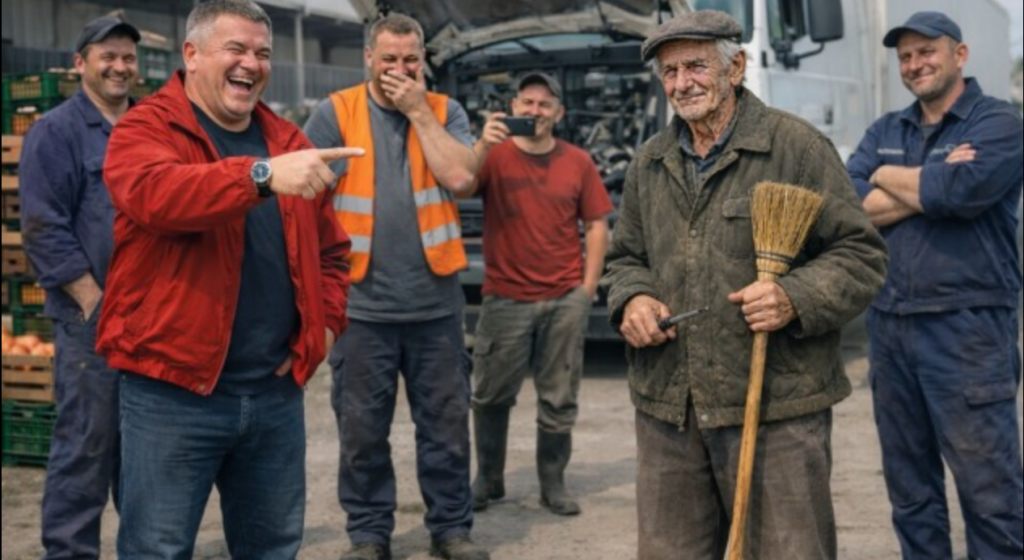
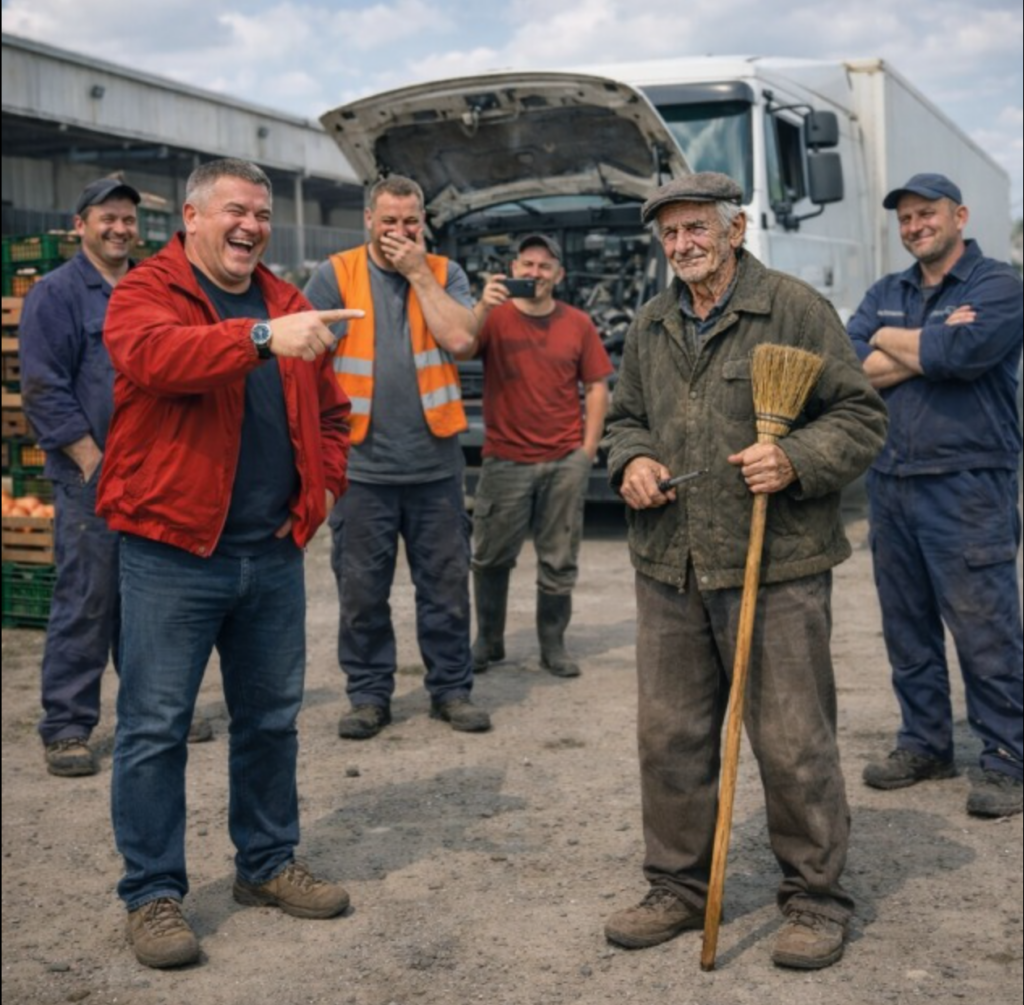
And at that moment, from the far end of the warehouse, Petrovich was walking toward the ramp.An old padded jacket, rubber boots, a broom in his hands. His face looked like an ancient map—deep wrinkles, scars, the marks of a long life.
All day he’d been hauling crates, sweeping the yard, doing the jobs younger drivers mocked, calling him “the professor of the mop.”Petrovich stopped at the edge of the crowd and calmly looked under the open hood. He didn’t rush. Didn’t fuss. He looked as if he wasn’t seeing a pile of metal, but a familiar mechanism.
“Arkadyevich,” he said quietly, “let me take a look. Five minutes, tops.”The words hung in the air.For a second it was silent. Then Sergey burst out laughing. The drivers followed.“What are you doing, old man?” one snorted. “Gonna fix it with your broom?”
“Now the professor’s giving a lecture!” another shouted.Boris Arkadyevich frowned at first. Then something snapped inside him—anger, desperation, fear of losing everything at once. He needed a way out, even an absurd one.
He straightened up and said loudly, deliberately loudly, so everyone could hear:“Alright, Petrovich. If you fix it in five minutes—the truck is yours. This one. I’ll transfer the papers. My word.”The crowd fell quiet for a beat, then exploded with laughter.
“And if you don’t,” the director continued, “I’ll deduct every minute of downtime from your salary. All of it. Deal?”Phones came out.“Film it! Grandpa’s about to become a millionaire!”“Go on, professor, show us!”
Petrovich nodded. No emotion. He set the broom against the wall, wiped his hands on his jacket, and pulled an old screwdriver from his pocket, its handle cracked with age.“Disconnect the battery terminal,” he said simply.
Boris Arkadyevich was still smirking when Petrovich leaned under the hood. Sergey stood nearby, squinting through cigarette smoke. The drivers exchanged looks—some already pitying the old man, others waiting for the failure.
Petrovich worked in silence. Without hurry. His scarred, oil-stained hands moved confidently, as if they knew exactly where to go. He tightened a contact, blew out a hose, ran his fingers along the wiring, listened.
“Turn the key,” he said over his shoulder.The driver snorted but obeyed.The engine coughed. Then again. And suddenly it came alive—smooth, powerful, steady.Silence fell over the ramp. Even the horns stopped. Somewhere on the warehouse roof, a crow cawed.
A minute later, no one was laughing.Sergey dropped his cigarette. Boris Arkadyevich stood with his mouth open, unable to say a word. The driver stared at the dashboard as if seeing it for the first time.“Done,” Petrovich said, wiping his hands on his jacket. “Oxidized contact. Clogged hose. One-minute job.”
He picked up his broom and turned to leave.“Wait…” the director said hoarsely. “How did you… where did you learn that?”Petrovich stopped without turning around.“Thirty years at a military plant. I calibrated missile systems. Then the plant closed.
The nineties came. My wife died. Scammers took my apartment—I signed papers I didn’t understand. That’s how it went.”He took a step.Boris Arkadyevich rushed after him and grabbed his shoulder—firmly, but without anger now.
“Stop. I’m serious.”He took a breath.“I won’t give you the truck. That was stupid. But I’ll give you a bonus. Just tell me—what do you need?”Petrovich turned and looked him in the eyes for the first time.“I don’t need money. But build a proper workshop. So equipment doesn’t break down. Everything here is held together with wire.”
The director nodded.A week later, the workshop appeared. Not luxurious, but real. With equipment Petrovich chose himself. From then on, they addressed him by name and patronymic. Young drivers lined up with questions.
Sergey never came back.And Petrovich kept wearing the same padded jacket and rubber boots. Only instead of a broom, he carried a set of tools.Sometimes, five minutes are enough for a person to stop being invisible. Not loudly. Not theatrically. He just started the engine.