Irina didn’t notice that the money was missing on the day she opened the jewelry box. The suspicion had already settled in her earlier — at the moment when Oleg’s voice changed during a phone call with his mother, taking on that familiar, soft, guilt-soaked tone he used only with her.
Not as a man. Not as a husband. Not as an adult who pays rent, utilities, groceries, and winter tires himself. But like a boy who has been caught doing something small and shameful, and is now trying to smooth things over.
Irina was standing in the hallway, fastening her boots, when she overheard the conversation from the kitchen:
— Mom, I understand. Don’t worry. Of course I’ll help… No, Irina doesn’t need to know anything. I’ll take care of it.
The last sentence was almost a whisper. Yet it struck her the hardest.
“I’ll take care of it.”
As if the money in their shared life was his personal pocket. As if Irina wasn’t a partner, but an inconvenience to be bypassed until things were “sorted out.”
She didn’t go into the kitchen. She stepped into the stairwell and looked at herself in the cracked mirror by the elevator. A thirty-six-year-old woman stood there in a dark coat, tired eyes, and a kind of exhaustion that neither makeup nor sleep could erase.
An accountant. Someone who could spot other people’s mistakes in spreadsheets at a glance. But in her own life, she still tried to believe explanations.
That evening, she opened the box.
She kept her saved money in an old shoebox hidden behind the bedding. Not for luxury. Not for whim. But for dental treatment and a short trip to the seaside she had been saving for months for. Little by little: from overtime, reimbursements, and from skipping lunch at the cafeteria more than once.
The box was in its place. The bag was there. The rubber band lay neatly wrapped.
But the money was gone.
Irina didn’t call Oleg immediately.
She just sat on the edge of the bed and stared at the empty box. The apartment was quiet, except for the kettle humming in the kitchen and the dripping faucet in the bathroom — the one Oleg had been “meaning to fix” for a month.
The dripping was steady. As if counting postponed decisions.
Oleg eventually came into the room on his own. He had a mug of tea in his hand, and that familiar cautious guilt on his face.
— Ir… just don’t start, okay? — he said from the doorway.
Irina held up the box.
— Did you take it?
The man placed the mug down too carefully.
— Mom needed it urgently.
Irina let out a quiet laugh. It was more tired than amused.
— Of course.
— Her fridge broke… and the repair guy said it’s better to buy a new one… and until then she…
— Oleg — Irina cut in — your mother has been saying since October that her fridge is empty.
He looked away.
— Maybe she just refilled it now.
— Maybe. Maybe the repair guy said it. Maybe the fridge talked to her. Maybe the curtains asked for help too.
— Don’t mock me.
Irina set the box on the bed.
— And what am I supposed to do? Thank her for at least leaving the rubber band?
Oleg rubbed his face. He was a large man, working in logistics, used to handling other people’s chaos. With strangers, he was firm.
At home, one sentence was enough to break him: “I don’t know what I’ll do, son.”
— She’s my mother — he said finally. — She’s alone.
— She isn’t alone. She has a pension, income, and you fixing everything for her.
Silence.
Then Irina said:
— I’m going to the bank tomorrow.
Oleg tensed.
— Why?
— To see what happened to our money.
— Everything is fine with us.
Irina looked at the box.
— Then where did my money go?
At that moment, the phone vibrated. “Mom” flashed on the screen.
Oleg didn’t answer. But a message appeared:
“Son, just don’t tell her about the authorization. She’ll twist everything.”
Irina read it twice.
— What authorization?
Oleg sat down on the edge of the bed.
— In the summer… I gave her access. A card. Authorization. The bank said it was necessary.
Irina closed her eyes.
— You gave her access to your account.
— I didn’t think…
— You didn’t think — Irina repeated slowly.
The next day, everything at the bank became clear. Too clear.
Card. Authorization. Permissions.
And the transactions lined up in long, precise rows: cash withdrawals, furniture store, pharmacy, unknown transfers.
The bank clerk’s voice was neutral:
— A total of approximately two hundred forty thousand.
Oleg went pale.
They left the bank in silence, under a gray, rainy sky. Oleg made phone calls; Irina only caught fragments:
— Mom… no, not Irina… we’ll talk later…
Then he turned to her:
— She says you’re turning me against her.
Irina simply nodded.
— Of course.
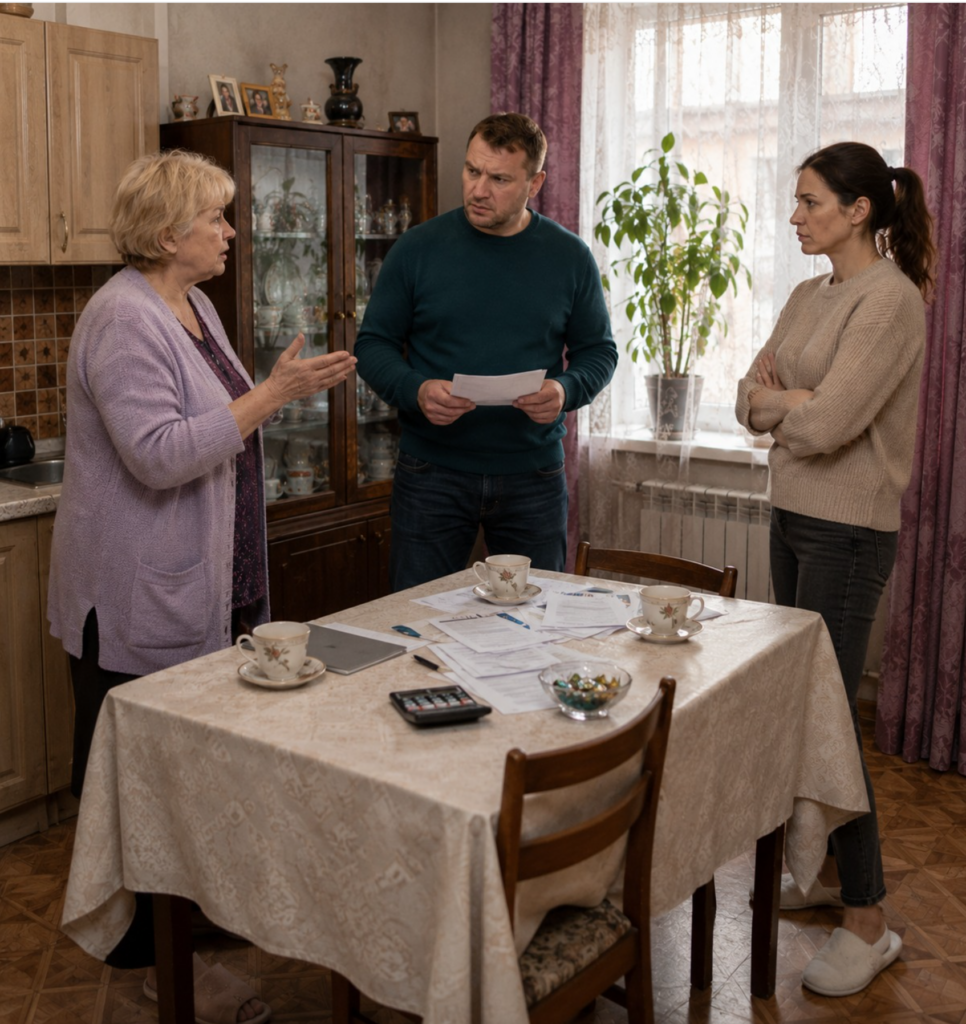
The next day, they went to Tamara’s together.
The door was defensive from the moment it opened.
— Are you two here to judge me? — the woman asked.
The argument was tense, sharp, exhausting. In the end, Oleg said:
— I won’t give money without discussion anymore.
His mother’s face hardened.
— Then you’re a bad son.
Oleg paused for a moment.
Then:
— No. Just an adult.
The word seemed to gain weight in the air.
The following months were difficult. Calls, resentment, withdrawal. But something slowly shifted.
Oleg started saying no.
Not dramatically. Not heroically. But uncertainly — yet consistently.
One evening, they sat in the kitchen together writing a budget. After two hours of calculations, a new line appeared:
“Parental support — shared, from a set budget.”
— That’s fair — Oleg said.
By spring, they were shopping together. Tamara still grumbled, but the drama slowly faded from her words.
Once she even asked Irina:
— Have you taken care of your teeth yet?
It wasn’t an attack. Not a jab. Just a question.
On the way home, Irina walked in silence.
She no longer waited for calls. No longer counted missing money.
At home, she took out the box.
— I was going to throw this away — she said.
Oleg looked at it.
— Why didn’t you?
Irina thought for a moment.
— Because loss doesn’t happen in a single moment.
Oleg sat down beside her.
The box went back into the drawer.
Not hidden.
But in its place.
And for the first time, it was no longer holding loss.
It was holding the fact that a boundary had finally been drawn.