A young woman was brought into the maternity ward. Her husband had already unpacked and repacked their large, overflowing hospital bag three times—carefully taking items out, sighing heavily, then putting them back again, only to start over moments later.
“Where did we put those slippers?” he kept muttering. His face had turned the color of overripe plums from his garden.
The doctor paused for a moment at the door. Without asking, she simply reached into the bag and, in a single practiced motion, pulled out a pair of bright, cheerful light-green slippers.
“Experience,” said the midwife with calm seriousness, then leaned toward the patient and whispered: “There’s someone waiting for you outside. He asked to speak with you for just one minute when you’re free.”
In the hallway stood a man. Interesting, elegant, with a slightly worn but stylish coat, well-kept hands, and hair lightly touched with gray. His eyes carried a deep, restless sadness. Nervously, he slipped a small folded piece of paper into the doctor’s pocket.
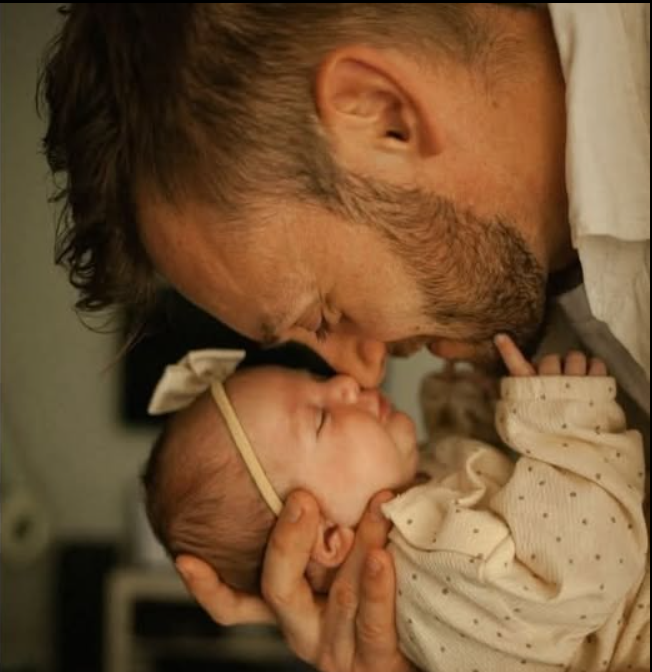
“Please… I’m not asking you to do anything illegal,” he said quickly. “I’m not asking you to violate anyone’s rights. Just call me and tell me two words. Just two words—that everything is fine. My number is on the paper. I’m not a criminal. I’m her father.”
His face twitched, and the three deep lines on his brow made him look almost like a hurt child holding back tears.
The doctor had about ten minutes. Not as a physician, but as a human being—and that kind of time is rare in a maternity ward.
Slowly, his story unfolded.
He had married young because of an unexpected pregnancy. The child had been born, and he loved his daughter deeply. But the marriage collapsed under pressure, addiction, and emotional exhaustion. He stayed only for the child, until eventually he left.
Later, the mother died suddenly. The daughter grew up and cut him out of her life completely. For eight years, he had been trying to find a way back into her world—collecting small fragments of her life from afar.
And today… she was giving birth.
The man’s expression tightened again, as if he was holding back a wave of emotion.
The next hours in the ward blurred into urgency and exhaustion.
A woman with advanced cervical cancer and heavy bleeding. A high-risk HIV-positive pregnancy requiring emergency cesarean section. A fifteen-year-old girl whose mother angrily confronted the doctor for simply explaining reality. Another unexpected surgical case due to a fibroid tumor discovered during delivery.
Hour after hour, life and crisis intertwined.
Then, after six exhausting hours, a baby boy was born.
Healthy.
The young mother, still overwhelmed with emotion, smiled at him with pure joy. She asked if he looked like her, and promised she would do everything in her power to make him happy forever.
The doctor hesitated. She chose her words carefully.
“Do you think,” she said softly, “that if your son grows up and makes a very serious mistake… you would still want him to be given a chance at happiness?”
The woman looked confused.
The doctor continued even more quietly:
“When you were admitted, a man approached me. A man who looks a little like your son. He gave me his phone number and asked me to call him. I cannot do that. I will not. But…”
She placed the small piece of paper on the bedside table.
“I will leave this with you.”
Two hours later, as the doctor walked through the postpartum ward, she slowed down near a slightly open door.
The nurse reported that everything was fine: uterus contracting normally, baby feeding well, stable vital signs, no complications.
From inside the room came soft laughter.
“Dad, you really are hopeless! Diapers aren’t just diapers—you have to check the weight range on the package!”
The voice was warm now. Light. Forgiving.
And somewhere in the hallway, the doctor kept walking, carrying the quiet understanding that sometimes healing doesn’t happen in operating rooms—but in small moments when someone finally chooses connection over silence.