My name is Marcus Webb. I’m sixty-three years old, and I’ve spent most of my life on two wheels. I’ve ridden with the Road Warriors MC for thirty-seven years. Before that, I worked construction—steel beams, concrete dust, long days that ended with aching hands and a quiet kind of pride. I’m a widower now. My wife, Sarah, used to say that a man’s real measure isn’t in what he takes from life, but in what he gives when no one is watching.
For most of my life, I thought I understood what she meant.
I didn’t.
It started on a cold November night. The kind of cold that doesn’t just sit in the air—it crawls under your clothes and settles in your bones. I was riding alone through downtown just after eleven, my engine echoing off empty buildings, streetlights smeared across wet asphalt. I wasn’t in a hurry. Nights like that on the road feel like a kind of meditation—just you, the machine, and the wind.
Then I saw her.
At first she looked like a pile of discarded fabric in a doorway. But as I slowed down, I realized she was a person. A woman, folded in on herself so tightly it looked like she was trying to disappear. Her arms were wrapped around her chest, her shoulders shaking uncontrollably. Even from a few feet away, I could see she wasn’t just cold—she was losing the fight against it.
She looked to be in her fifties. Her hair was thin and unwashed, her face pale and cracked from exposure. She wore a faded summer dress that didn’t belong in this weather and a cardigan full of holes that offered no real protection. Bare legs. No coat. No gloves. Nothing.
And yet she kept apologizing to everyone who passed.
“I’m sorry… I’m sorry… I’ll move.”
As if she were an inconvenience for existing.
People walked past her without slowing down. Some didn’t even look.
Something about that stopped me harder than the cold ever could.
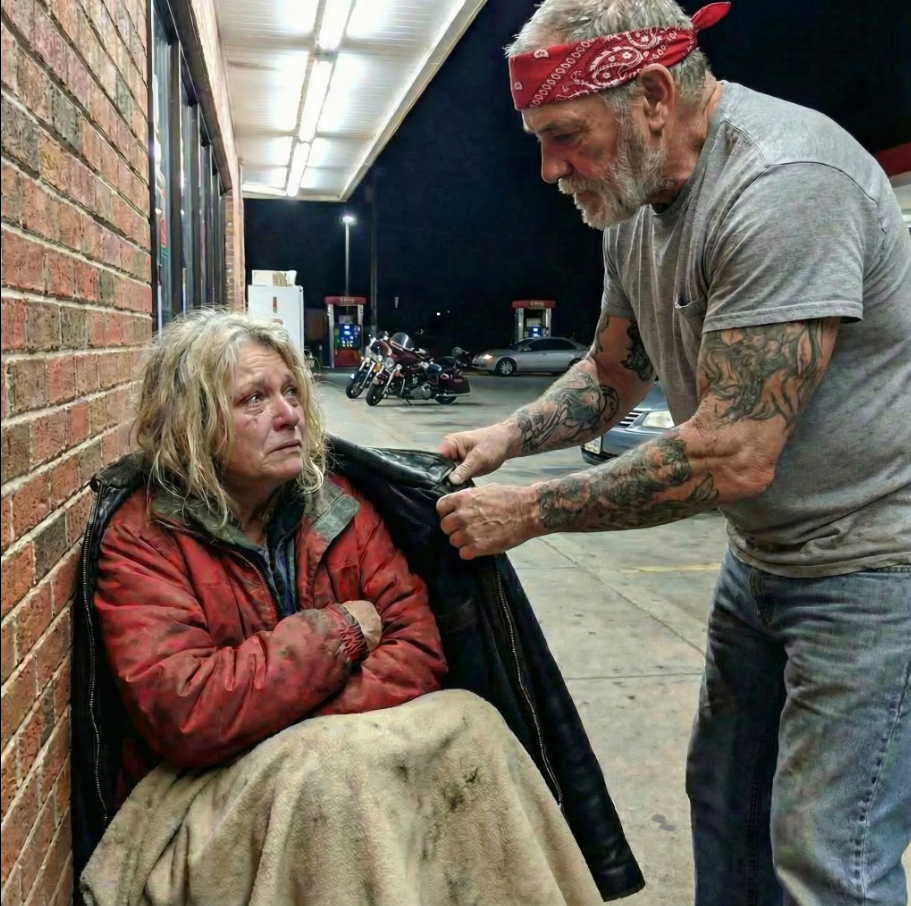
I pulled over, killed the engine, and walked back. My boots echoed on the sidewalk as I approached slowly so I wouldn’t scare her. Up close, I could see how hard she was trying not to cry, how her teeth chattered like she was biting down on fear itself.
“Ma’am,” I said gently, “you’re going to freeze out here.”
She flinched immediately, eyes darting like she expected trouble. “I’m sorry. I’ll move. I didn’t mean to bother anyone.”
“You’re not bothering anyone,” I said. I started taking off my jacket.
It was my MC cut. Heavy leather, broken in by decades of riding. Patches on the front and sides, my road name—“Ironside”—stitched across the back. It wasn’t just clothing. It was history. Identity. Brotherhood. Memory.
I hesitated for half a second.
Then I placed it over her shoulders.
The jacket swallowed her whole. She blinked in disbelief, like warmth was something she’d forgotten existed. Then she pulled it tight around herself and broke down crying.
“I can’t take this,” she said between sobs. “This is yours. It must mean something.”
“It does,” I said quietly. “That’s why you need it more than I do.”
Her name was Linda Morrison.
Before I left, I gave her directions to a shelter a few blocks away and some cash. She kept promising she’d return the jacket. I told her not to worry about it. I didn’t think much more of it after that.
I went home thinking I had just done something small but decent.
I was wrong about “small.”
Three days passed. Life went on. Then my phone rang late on a Friday night. Unknown number.
“Hello?”
A woman’s voice answered, shaky and urgent.
“Is this Marcus Webb?”
“Yes.”
“You gave me your jacket,” she said. “I’m Linda. I found something inside it. I need to see you. It’s important.”
My chest tightened without warning. “What did you find?”
“I can’t explain it on the phone. Please. St. Mary’s Shelter. It might be a miracle.”
That word stuck in my mind long after the call ended.
I went.
When I arrived, she was waiting in the lobby wearing my jacket. She looked different—cleaned up slightly, hair brushed back—but her eyes still carried the exhaustion of the streets. In her trembling hands she held a photograph.
My breath stopped before I even understood why.
It was my daughter, Rebecca. Sixteen years old in the picture, taken before everything fell apart. Before arguments became silence. Before she ran away six years ago and vanished from my life.
“How did you get this?” I asked.
Linda shook her head. “There’s more. Please listen.”
And then she told me everything.
Years ago, she had been addicted to heroin. She had lost everything—family, home, herself. She had been pregnant and alone, living in shelters, surviving day to day. When she gave birth, it happened in a shelter bathroom. No medical help. No support. Just pain and fear.
She had held the baby for only a moment.
Then she made a choice.
She left the newborn at a fire station, wrapped in cloth, hoping someone else could give her what she couldn’t.
As she spoke, she pulled out documents from my jacket pocket—papers I had forgotten I’d stored there. Adoption records. Dates. A location I knew too well.
Fire Station 23.
The timeline matched too perfectly to ignore. Rebecca had been adopted at three days old. No known birth certificate. No listed mother.
Linda’s voice broke as she said it.
“I think I’m her mother.”
The room tilted slightly, like the world had lost its balance.
I told her about Rebecca’s disappearance. About the years I had spent searching. About the silence that followed my daughter into the world when she ran away at seventeen.
Linda collapsed into a chair, whispering, “I lost her twice.”
We did a DNA test.
Three days later, the result confirmed it: 99.9% match.
Linda Morrison was Rebecca’s biological mother.
After that, something changed. We weren’t strangers anymore. We were two people tied to the same missing piece of life.
She moved into my home. It wasn’t planned, just necessary. We searched together—shelters, hospitals, rehab centers. We followed false leads and dead ends. We posted Rebecca’s photo everywhere. We refused to stop.
Then, months later, a call came from Portland. A woman matching her description had checked into a detox center voluntarily. She was trying to get clean.
We drove there in silence.
When they brought her out, I almost didn’t recognize her. She looked worn down by life, thinner, guarded—but alive.
“Dad?” she said softly.
I stepped aside.
And Linda stepped forward.
Rebecca listened to everything. Didn’t interrupt once. When it was over, she stood still for a long time, like her entire life was shifting under her feet.
Then she walked into Linda’s arms.
“I don’t know what I’m supposed to feel,” she whispered.
“You don’t have to know,” I said. “Just stay.”
That was the beginning of something new.
Now, Rebecca is eleven months sober. She’s studying to become a counselor, determined to help people who are where she once was. Linda is recovering too, rebuilding her health and her life. The cancer she’s fighting is in remission for now, and she’s working again, slowly reclaiming stability.
And me—I still ride. But everything feels different now.
Rebecca got a tattoo recently. Three words on her wrist:
Found by a jacket.
Because that’s what it was. A simple act on a freezing night that somehow unraveled decades of loss and brought three broken lives back together.
People ask me if I regret giving up that jacket.
I tell them no.
Because that jacket didn’t just keep someone warm.
It brought my daughter home.