Victor Monroe had always been a man who kept his distances—emotionally immaculate, physically composed. He did not carry bags; he carried decisions, reputations, and the careful architecture of a life that required fewer attachments.
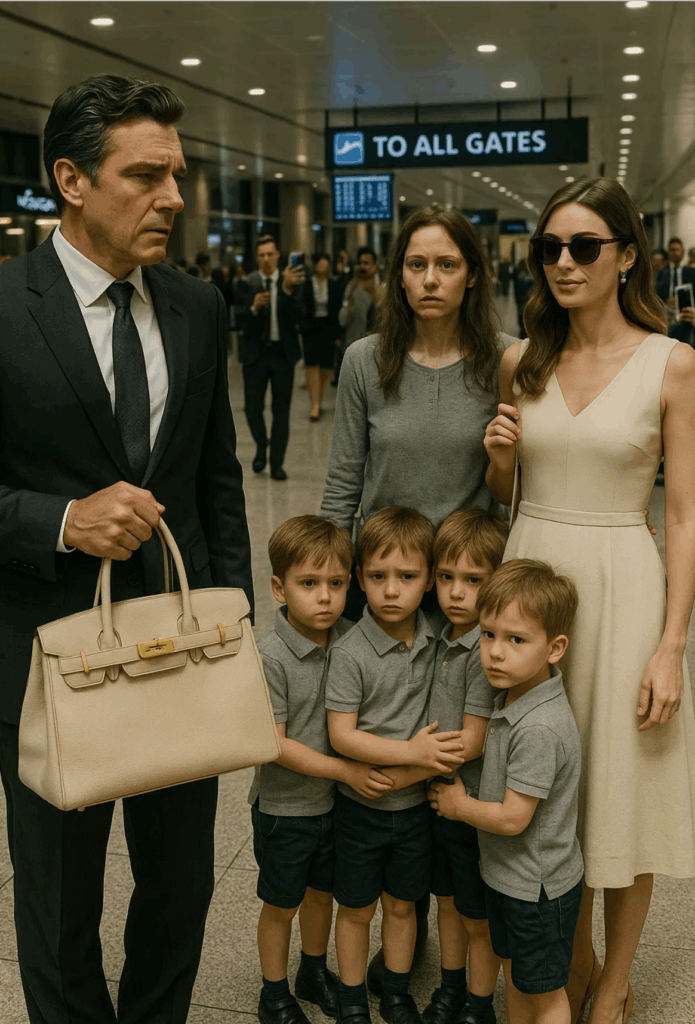
So when he looped Nadia’s slim designer handbag over his arm that morning beneath the airport’s cold cathedral of light, the action felt almost trivial: an elegant convenience, an accessory to the performance they were both staging.
The terminal gleamed like polished glass. The marble underfoot returned each step as a soft, precise echo, and the overhead lights flattened faces into porcelain. Nadia glided beside him in a cream dress that caught the air with every stride—sunshine folded into silk.
Her sunglasses hid her eyes but could not hide the small exultation at the corner of her mouth: the private, dangerous smile of someone who believes she has been chosen. She wanted the world to notice. She wanted, foolishly and perfectly, to be the visible proof of his appetite.
Victor did not look at her. He did not need to. The purse slung on his arm told the story he wanted told. It was proof that he could be generous, attentive, even gallant. It was a small lie with a public face. He enjoyed the control of it—how appearances could be edited, rehearsed, made to read like truth.
The terminal thrummed with its usual low orchestra: boarding calls muffled beneath jazz from a distant lounge, the impatient shuffle of briefcases, the rustle of magazines. A private jet waited beyond the glass—an immaculate promise of anonymity
—yet Nadia had insisted on moving through departures, on being seen. Victor had indulged her. Why not? For once he felt the story was his to direct.Then everything altered in the space of a single, impossible moment.

It began with a hush that peeled through the air like a dropped glass. Conversations froze mid-sentence; a child’s laugh stuttered and died. People turned, as if some magnet had pulled the world toward a single point. Phones lifted like a constellation of small, blinking stars—less to call than to capture.
Victor followed that collective gaze, curious in the instinctive way only a man accustomed to spectacle could be. At the far end of the hall stood Evelyn—pale under the terminal lights, face stripped of makeup and pretense, the map of sleepless nights
and grief etched around her eyes. The sight should have been ordinary, domestic even; instead it cleaved through Victor as though it were a verdict.
Around Evelyn clustered four small bodies—four boys, impossibly identical in the sharp geometry of early childhood. Each clung to the hem of her skirt with hands that had known too many absences. They were his. The recognition came not as news but as a kind of physical force that pried open his chest.
The handbag slipped from his arm. It thudded onto the marble and sounded too loud—an accusation that bled into the sudden silence. Sound returned in shards: a camera’s click, the rustle of gossip like wind through leaves. Victor’s mouth opened; no words formed.
For the first time in a long while, he felt less like a man who wrote his life into headlines and more like a character caught by an author mid-sentence, betrayed by his own plot choices.
Evelyn did not move at first. She did not mount an assault or break into lament. She stared—through him, not at him—her gaze a flat, clear thing that measured all the ways he had failed without offering him the soft cruelty of anger.
There was pity there, a tender horror that stung more than any shout could have.The crowd became a lens, people framing the scene, hungry for the narrative that would fit their own appetites. Cameras multiplied; the terminal,
which had been a stage for Victor’s small performance, suddenly became an amphitheater for his undoing. Nadia’s hand went to her mouth. The confidence that had been her outfit dissolved into raw, exposed fear.
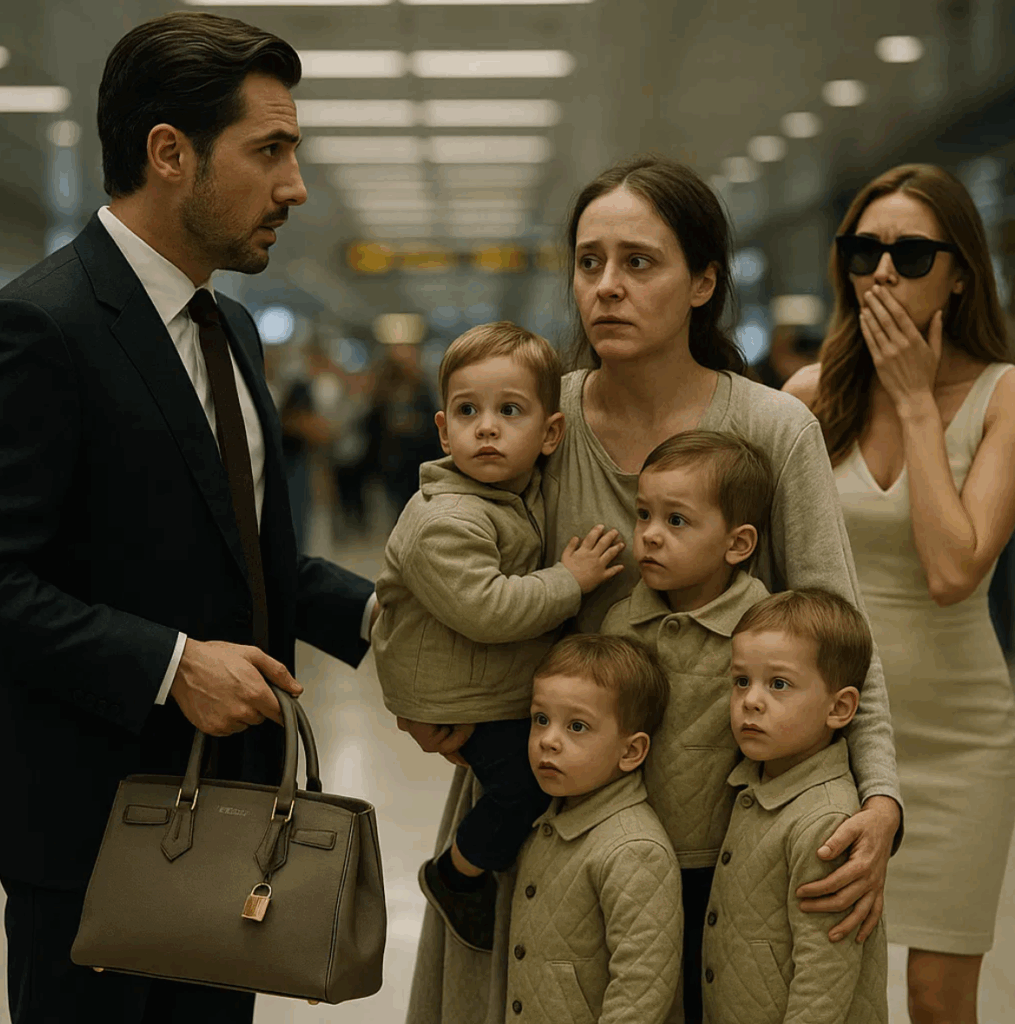
One of the boys, with a premature seriousness that made Victor’s breath catch, pointed a chubby finger and asked, “Daddy?” The question hung in the air like a glass bead—so fragile and so precise that Victor felt it cut him.
He tried to speak. His voice turned to grain. He moved as if through water, each step sticky with denial, with an internal catalogue of excuses and convenient truths that now seemed useless beside the clarity of a woman
holding what mattered to him more than any arrangement, more than any boardroom victory.
Evelyn’s steps toward him were small, almost ceremonial. She came close enough for him to hear, but not so close that she allowed tenderness. Her tone was low and steady, shaped into something that did not plead but delivered a sentence like a blade: “This is what you carried her for?”
It was not an accusation in the archaic, theatrical sense. It was the statement of a woman who had cataloged daily humiliations and found them all conspiring toward this one crystalline moment. She bent down, gathered the smallest of the boys to her chest,
and turned away—not out of cruelty, but because she knew what his presence would do. She led her children through the press of bodies, each step away a sentence in a declaration he could not rewrite.
Reporters surged, their microphones thrust like torches. “Victor Monroe—care to comment?” The world wanted a tidy explanation for a messy life. He had none. He had only the echo of his choices and the sudden, devastating recognition that his performance had been mistaken for reality.
Nadia’s face crumpled into lines Victor finally saw only then. The cream dress and lacquered smile could not shield her as the truth burned through the social film: she was not the woman he belonged to. She was, painfully and finally, proof of his inelegant duplicity.
Evelyn stopped near the exit, turned to the waiting flash of lenses and the millions of invisible viewers beyond them, and introduced herself with a voice absolutely composed: “I’m Evelyn Monroe. These are Victor’s forgotten children.”
The words landed like a bell. They made headlines not just because they were dramatic, but because they carried the weight of truth: a life kept private, a history neglected, a pain finally given a voice.
Where Nadia and applause had been the symbols of his small, salacious successes, Evelyn’s simple presence revealed what power had not purchased him—family, memory, the quiet, ruinous cost of absence. She asked only for the guards to escort her and the children out.
Even the security’s obedience felt like an exoneration of her dignity and an indictment of his.
Later, in a quieter room that smelled faintly of antiseptic and litigation, Evelyn sat with a lawyer and the children sleeping in the shallow peace of a rare night without interruptions. The retelling came slow and bitter: roses that meant nothing,
empty consolations wrapped in the gloss of wealth, and the one wound that refused to scab over—the day he abandoned her while she lay vulnerable and bleeding with their children. The memory of doctors’ faces, the sterile,
clinical orders, the absence of a hand to hold: it all pooled into a cold reservoir of rage and sorrow.“He told the doctor it’d be simpler if they didn’t survive,” she said, words like small stones dropping into a still well. The silence afterward was enormous.
Evelyn did not want spectacle for spectacle’s sake. She wanted truth to exist where silence had once reigned. She wanted her sons to have a history that did not teach them that absence was a man’s right. “We go public,” her lawyer said.
“Not for revenge. For history.” Evelyn nodded. It was not vengeance she sought but reclamation.When, a day or two later, she knocked at Nadia’s door—no cameras, no lawyers, only two women alone in the flat gray light of a high-rise—she did so with a strange,
weary compassion. Nadia’s breath came in ragged sobs. Evelyn held none of the scorn Nadia expected. Instead she offered a map she had learned the hard way.
“You’re not my enemy,” Evelyn told her. “You’re the next version of me.” The confession was a kind of absolution. It was also a plea: Do not be seduced into the quiet of his convenience.
Nadia wept. Evelyn’s words—hard-won, unadorned—cut into the place where regret and hope mix. She left the apartment with no public theatricality, only the small, deliberate act of trying to rescue another woman from the same soft doom.
Back in his penthouse, Victor faced the detritus of the life he had designed. A drink untouched. A photo-frame that should have been ordinary—a strip of portraits of four premature babies—sat stubbornly on a mantle like a tiny, accusing altar. He had ignored it for years. Now, it was all he could see.
His hands trembled when he whispered, not a plea but a confession: “They’ll forget me.”From somewhere beyond the skyline—beyond glass and press and the brittle glitter of the city—Evelyn began a work that would make forgetting impossible.
She would write her children into a public memory, into a legacy of names and faces and rights. And Victor, surrounded by glass, money, and an absence more eloquent than any apology, finally felt the full measure of what his wealth could not purchase:
the years he had missed, and the faces he would no longer be able to shape.