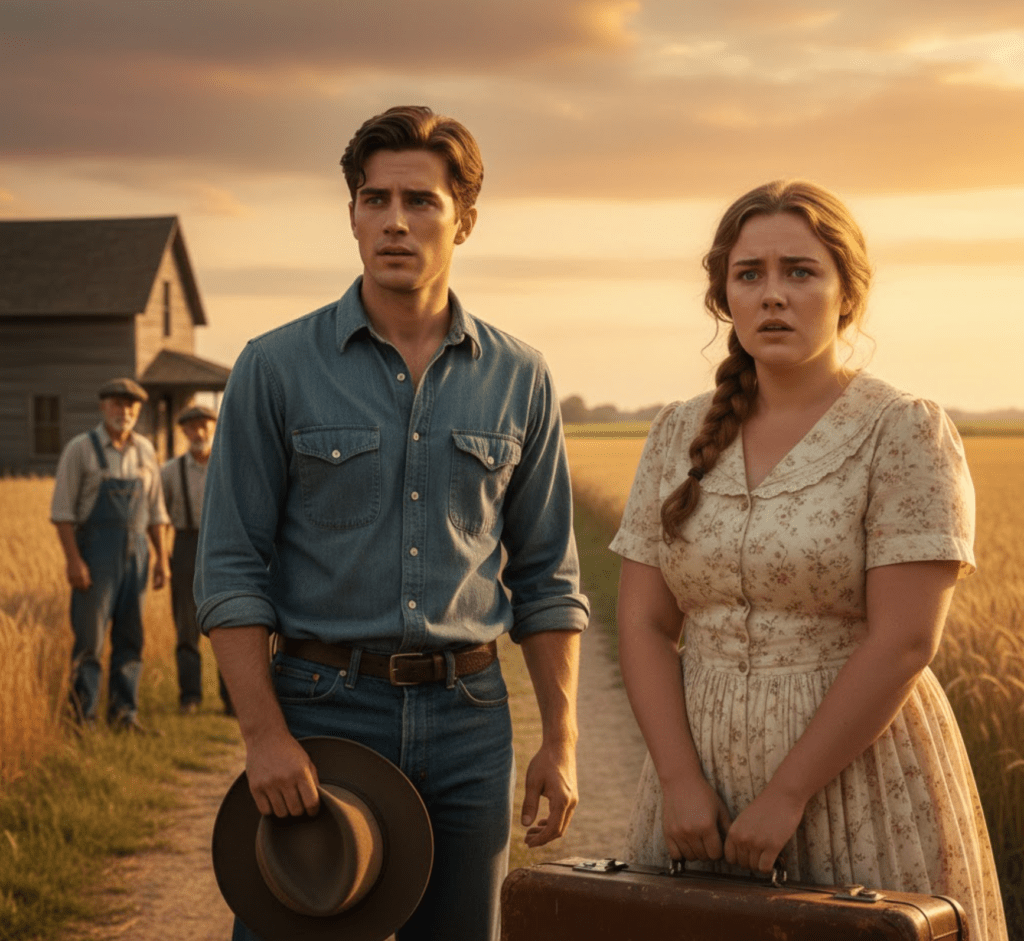
Dust swirled around the worn tires of the old Chevrolet as it rumbled to a stop in front of a modest farmhouse, bathed in the warm glow of the late afternoon sun. Margaret, twenty-four, clutched her battered leather suitcase in the passenger seat, her hands trembling despite her efforts to stay composed.
Her long blonde hair, braided simply, framed a face that had grown accustomed to disappointment. Her floral dress, though clean and carefully patched, hinted at years of wear, much like herself.
Margaret had always been bigger than the other girls, a fact her family never let her forget. Her father’s voice from that morning echoed relentlessly in her mind:”Margaret, this arrangement will solve our financial problems and get you settled. Thomas Brennan needs a wife for his farm, and at this point, we cannot be picky.”
The words had pierced her like a blade, leaving no room for hope. She had been a burden, a daughter whose appetite exceeded her contributions, and her parents had made that crystal clear. When the local bank had threatened to foreclose on their tiny general store, her father had eagerly accepted Thomas Brennan’s offer.
“He’s just a poor dirt farmer,” her mother had sniffed, disdain dripping from every word. “But he’ll pay off our debts in exchange for your hand. Consider it your contribution after all these years of taking from us.”
Now, stepping out of the truck, Margaret felt less like a human being and more like a parcel being delivered. Her father barely glanced at her as he offloaded her scant belongings.”Thomas should be around somewhere,” he muttered, clearly eager to return to the town that had freed him from his debts.
“Remember, Margaret,” he added, his tone cold and final, “you are his responsibility now. Do not embarrass our family name.”At that moment, two men emerged from behind the farmhouse.
The first, unmistakably Thomas Brennan, was in his early thirties, with kind brown eyes and hair like autumn soil. He wore a simple blue plaid shirt and worn jeans, his body lean and strong from years of labor. He moved with the quiet confidence of someone entirely at ease in his own skin.
Behind him walked an older man, his full gray beard and gentle expression radiating warmth—a reflection of honesty and kindness. This was clearly Thomas’s father, Samuel Brennan.”Miss Margaret,” Thomas greeted, hat in hand, his voice soft yet confident. “I am Thomas Brennan. This is my father, Samuel. Welcome to our home.”
Margaret’s heart, still bruised from a lifetime of rejection, softened at the warmth in his tone. Unlike the men who had stared at her with pity or disgust, Thomas looked at her with genuine kindness.
“I know this situation isn’t what you would have chosen,” he continued carefully, “but I want you to know you will be treated with respect here. This is your home now, for as long as you choose to stay.”
Her father, satisfied, wasted no time in driving away. As the truck disappeared down the dusty road, Margaret felt the crushing weight of isolation settle upon her. Thomas’s voice broke through the silence:
“Come, let me show you the house… You must be tired and hungry after your journey.”Margaret followed him, surprise flickering in her eyes as the farmhouse revealed its hidden charm. Though modest in appearance, the property stretched far beyond what she had imagined.
Fences extended toward the horizon, cattle grazed lazily in distant fields, and the house itself, though simple, was immaculate. Inside, the kitchen welcomed her with a massive wood-burning stove and a sturdy oak table that could seat eight comfortably.
“It’s not fancy,” Thomas said apologetically, “but we’ve tried to make it comfortable. Your room is upstairs, first door on the right. Locks on all doors for complete privacy.”Margaret had expected little respect, yet here it was, freely given. Samuel Brennan’s warm voice joined them, echoing like a grandfather’s blessing:
“Margaret, my dear, Thomas is a good man. He will never make you feel unsafe or unwelcome. We hope that in time, you might come to see this place as your true home.”
That evening, as Margaret shared a simple yet hearty meal of pot roast and vegetables, she began to realize that life here might not be the punishment she had feared. Thomas and his father treated her with dignity, curiosity, and genuine interest. They asked about her passions, listened attentively, and valued her thoughts.
When she mentioned her love of books, Thomas’s eyes lit up. “We have a small collection in the parlour. Feel free to borrow anything that catches your interest. I’d love to hear your thoughts on them.”
Weeks passed, and Margaret slowly settled into the rhythms of farm life. Thomas worked from dawn to dusk, yet always ensured her comfort. He never demanded her time, allowing her space to find her footing in this unfamiliar world.
Gradually, she uncovered the truth about the Brennan farm: it was no ordinary homestead. Thomas owned thousands of acres of prime farmland, hundreds of cattle, and held profitable contracts across three states.
“Why didn’t you correct my father’s assumptions about your wealth?” she asked one evening, watching the sunset paint the sky in fiery shades.Thomas’s gaze met hers, steady and honest. “Your father wanted a solution to his financial problems, not a husband who would cherish his daughter.
I didn’t correct him because this farm has been empty. Lonely. When I heard about you, I thought… perhaps we could help each other.”As autumn gave way to winter, Margaret found herself embracing this new life with a surprising sense of belonging.
Her talents shone, managing household finances and assisting Thomas with business correspondence. Both men recognized her value, and for the first time, Margaret felt truly appreciated.
Time transformed her outwardly as well. Regular meals, outdoor work, and genuine happiness gave her posture strength and a sparkle in her eyes. She was still curvier than most, but she carried herself with newfound confidence.
One snowy December evening, as they sat by the fire reading, Thomas set his book aside and spoke with unusual gravity:”Margaret, I need to tell you something… I hope you won’t be offended.”
Her heart tightened, fear gripping her.”When this began, I thought we’d have a partnership of convenience,” he continued carefully. “But my feelings have changed. I have come to love you—not as a business partner or helper, but as the woman I want to spend my life with. You bring joy, warmth, and intelligence to everything you touch.”
Tears welled in Margaret’s eyes. “Thomas, I—””No need to answer now,” he said gently. “But if you ever choose to make this marriage real in every sense, it would make me the happiest man alive.”
Margaret looked at this man who had shown her more respect and love in six months than her own family had in twenty-four years.”I love you too,” she whispered. “You’ve given me something I never thought I’d have—a place where I am valued for who I am, not judged for who I am not.”
The following spring, they celebrated their love with a second wedding, this time as a joyous declaration rather than an obligation. Margaret had blossomed into a confident, radiant woman, managing both home and farm business with intelligence and grace.
Her family, now aware of Thomas’s true wealth and status, attempted to reconnect. Margaret declined politely but firmly, having learned that true family is forged through love and respect, not convenience.
Years later, watching their children play in the same farmyard where she had once stood with a suitcase and a broken heart, Margaret reflected on life’s unpredictability. Thomas had given her more than wealth or security—he had given her the gift of seeing herself through loving eyes. She realized her worth had never been defined by appearance or parental expectation.
At last, she had found her home—not just in the sprawling fields of the Brennan farm, but in the heart of a man who loved her exactly as she was.