THE WALL BETWEEN US: The room was small—too small for a life, yet just large enough for grief. Sixteen square metres of forgotten space sat behind a decaying building, where light barely reached and time seemed to have given up.
The plastered walls were uneven and damp, holding a constant smell of moisture and old paint. Livia no longer noticed it. The single bed pressed against one wall creaked softly whenever she shifted, though she rarely moved anymore.
Since losing Alice, sleep had become rigid and careful. Livia lay still every night in the dark, as if even the smallest movement might loosen her grip on memory. It felt like stillness was the only way to keep her daughter close.
Her life had collapsed quickly. One moment there had been a warm house in the suburbs filled with light and sound. The next, there was this room, hidden away where no one looked and no one asked.
That was what she wanted—anonymity. No pitying eyes. No gentle voices asking how she was surviving. No reminders of what she had lost.Not even Daniel.Especially not Daniel.
Daniel, with Alice’s eyes. Daniel, with that crooked half-smile that used to make their daughter run into his arms. Daniel, who had stood beside her in a hospital corridor while doctors spoke in careful, empty words. Daniel, who now existed only as a signature on divorce papers she barely remembered signing.
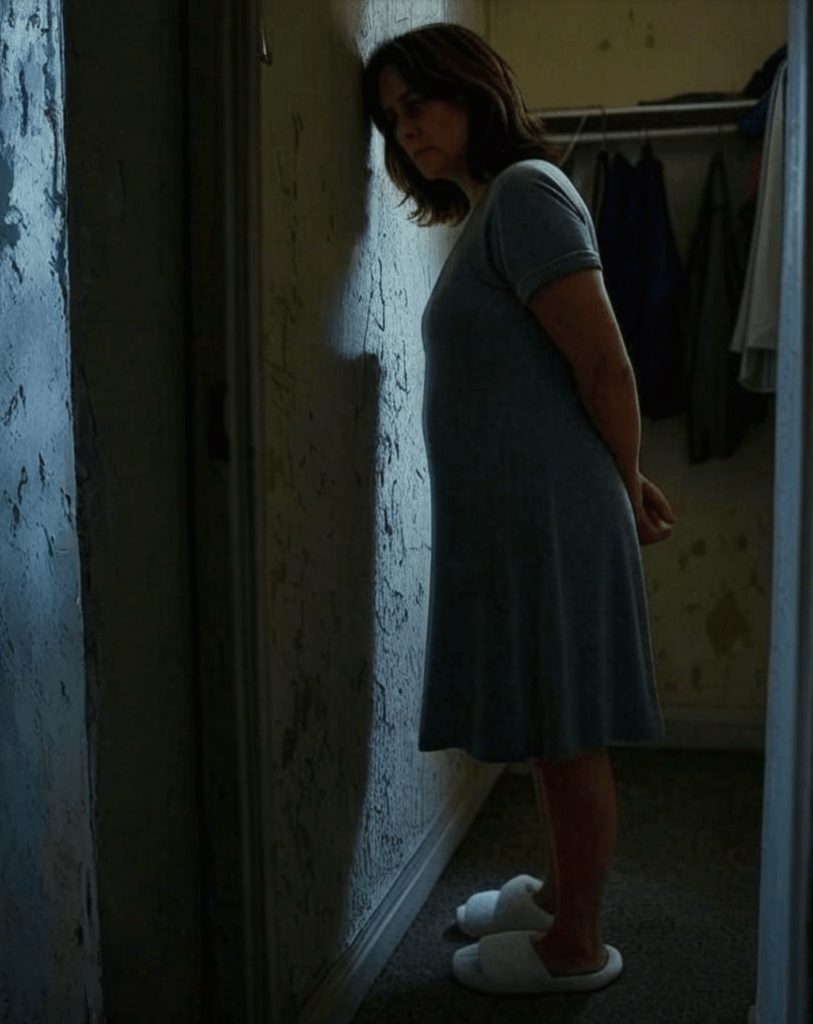
On the first night, she didn’t sleep. She lay in silence and cried into her pillow, pressing her face down to contain the sound of breaking. On the second night, the silence changed.Her sobs came harder. She tried to stop them, but they escaped anyway. Then—
Knock. Knock. Knock. Livia froze. The sound came from the wall her bed leaned against. It was not random. It was precise. It felt deliberate, like someone had been waiting for that exact moment. She held her breath. Nothing followed.
On the third night, grief returned stronger. She had seen a little girl in the market earlier—blonde braids like Alice—and something inside her broke open again. That night she didn’t try to stay quiet. She sank to the floor with her back against the wall and let everything come out.
Knock. Knock. Knock . Same rhythm. Same place. Same presence. At first, anger rose in her. Who would interrupt grief like this? But the rhythm didn’t feel cruel. It felt attentive. Almost gentle. Like someone saying, I’m here.
On the fourth night, she waited for it. When the crying started, she knocked first—three hesitant taps. A pause followed. Then came one knock in return.I know.That was how it began. Three knocks: I’m here. One knock: I understand. A language built from silence.
Livia found herself waiting for it. Not for answers, but for proof that she wasn’t entirely alone.
Days passed. Then weeks. She began writing on scraps of paper found in the building’s hallway. At first she wrote a simple question: Who are you? She slipped it under the wall. Three knocks came back, and the paper returned with a single line: Someone trying to start over.
No name. No identity. Just that.It should have felt strange. Instead, it felt safe. The messages grew. On bad nights she wrote, It hurts too much today. The reply came, Then survive one hour at a time. When he wrote, I can’t sleep, she answered, Count stars that don’t exist until your mind lets go.
They never shared names. Never asked for faces. Never crossed into anything that felt too real. And somehow, that made it easier to speak honestly.
Then came Alice’s birthday. Six years old. No cake. No candles. No laughter in a house that no longer existed.
That entire day felt like drowning. That night, Livia wrote everything she had been holding back. She wrote about Alice’s laughter, her small footsteps, the weight of memory that never left. She wrote about guilt, about love, about survival feeling like betrayal.
She slid the paper through the crack and knocked three times.The wait felt endless. When the reply came, her hands trembled. Thank you for telling me about her. Grief doesn’t erase love. It proves it existed. Celebrate her for what she was, not what was lost.
Livia cried differently that night. Not quietly. Not brokenly. Just fully. And for the first time, the room didn’t feel like it was closing in on her.
Weeks turned into months. The stranger began to reveal fragments of himself. Mistakes. Addiction. A family lost through silence and shame. A life he had hidden from until there was almost nothing left.
Two broken people speaking through a wall neither had chosen but both needed.Then came the storm.Rain slammed the city. Wind shook the building. Thunder rolled through thin walls. The lights flickered once, then died.
Darkness filled everything.Livia moved instinctively to the wall. She knocked—three sharp taps. No answer. She knocked again, harder. Still nothing.Her chest tightened. He always answered. Always.
She grabbed a flashlight and stepped into the hallway. Water dripped from the ceiling. The building groaned under the storm’s weight. She reached the next door and knocked. Silence. She tried the handle. Locked.
Something inside her shifted. Not fear exactly—but absence. A space where something used to be.For the first time since it began, the wall was empty.The next morning, there were no knocks. No notes. No rhythm. Only silence.
It stretched into days. Livia waited anyway, but each night felt heavier than the last. Eventually, she wrote one final note: Thank you for reminding me I was still here. I hope you found your way too.
She slid it through the crack and knocked three final times.No answer came.That evening, something inside her changed. Not suddenly, but quietly, like letting go of something she had been holding too tightly for too long.
She picked up her phone. Daniel’s number was still there. Her hand shook as she pressed call.One ring. Two. Three.“Livia?”His voice cracked something open inside her.A long silence passed.Then she said, “Can you come find me?”
Another pause. Then—“I never stopped.”Six words. Enough. They met at the café where Sundays used to belong to them, where Alice once laughed over spilled drinks and sticky fingers. Daniel arrived first, older and worn, but still familiar in ways that hurt and healed at the same time.
They didn’t rush. They talked. About grief. About guilt. About how love doesn’t end—it just changes shape when it has nowhere to go.“I thought looking at you would hurt too much,” Livia said quietly.Daniel nodded. “And now?”
“Now it reminds me we didn’t lose everything.”Outside, the sky softened into warm colours, as if the world itself was finally breathing again.They walked out together. Not holding hands. Not healed. But no longer alone.
That night, Livia returned to the storage room. It no longer felt like a cage. It just felt like a place she had passed through.She sat by the wall where everything had begun. She raised her hand. Knock. Knock. Knock.
No answer came.Of course not.But she didn’t wait this time.Because sometimes healing doesn’t reply. Sometimes it simply teaches you to stop knocking—and start living.