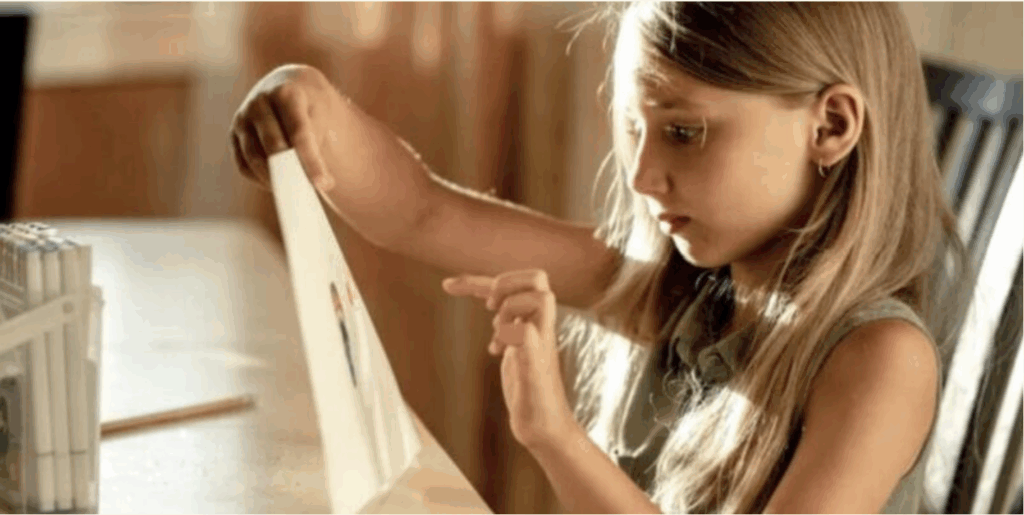
The apartment door slammed with a crack like a gunshot, rattling the old frame and sending a framed photograph tumbling to the floor. Glass splintered into a thousand tiny shards at the girl’s small feet, yet she didn’t flinch.
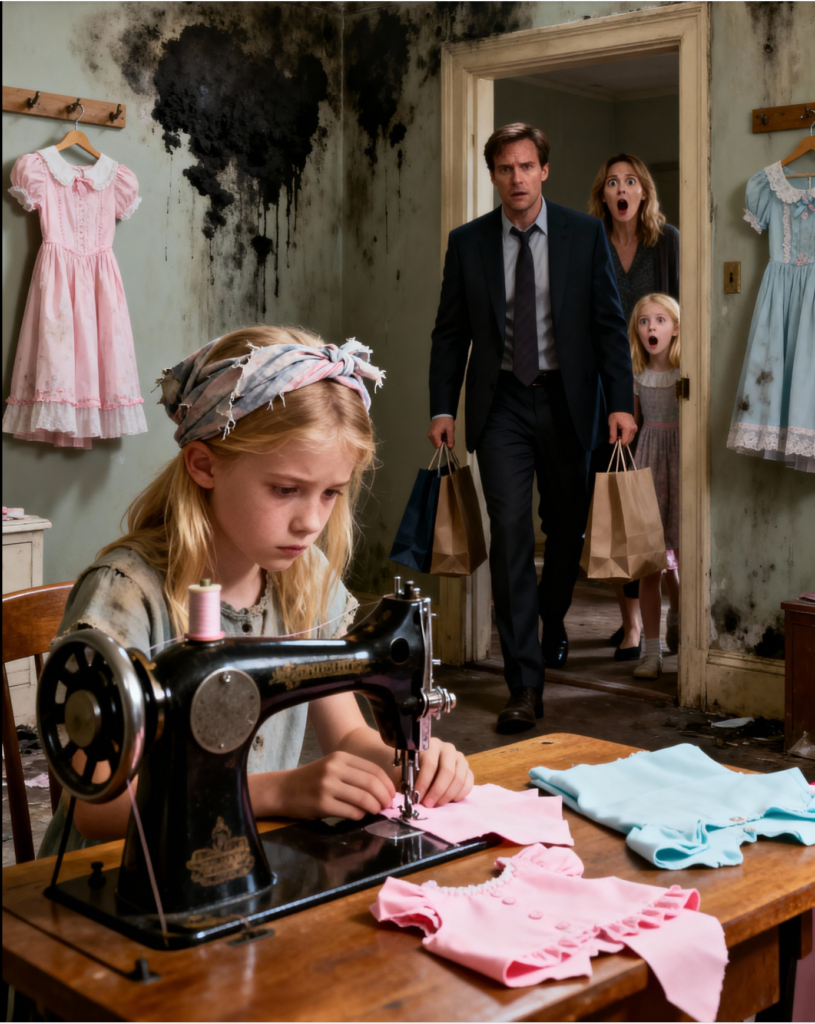
Her fingers moved with careful precision, guiding a strip of faded blue fabric under the needle of a battered sewing machine. Each stitch was deliberate, her jaw clenched so tight it looked as if the weight of the world rested on her thin shoulders.
“Where’s your mother?” Daniel asked before realizing he had spoken aloud.The girl startled, and the machine stuttered to silence. Slowly, she lifted her eyes—eyes dulled by exhaustion, too knowing for one so young.
“She’s sick,” she said quietly, her voice barely above a whisper. “Please… I just need to finish this seam.”Daniel’s gaze swept the room. A lumpy mattress lay on the floor, sheets threadbare and stained. A single pot sat on a stove that hadn’t been used in days.
No toys cluttered the corners. No television flickered in the gloom. Only neatly stacked scraps of fabric, each a different shade and texture, lined the table beside the machine. The faint smell of oil and dust hung in the air, mingling with the faint, metallic tang of blood from a strip of cloth tied around her wrist.
“What are you making?” he asked softly, trying not to startle her.“Dresses,” she replied. “For a shop on Maple Street. They pay by the piece.”
Rain had streaked down Daniel’s windshield as he drove from downtown, drumming against the glass like it was trying to scrub him clean of something, though he didn’t notice. Weather never bothered him—numbers did.
Rent collection was a precise, mechanical ritual: signatures, nods, ink, and currency. But this room was no ledger, no neat sum of figures—it was something else entirely.Something tightened in his chest. “You shouldn’t have to do this.”
Her small hands clutched the fabric, knuckles white. “If I don’t, we won’t eat.”A cough echoed from the back room—deep, wet, and weak. Daniel hesitated. He had known hardship in theory, as a statistic, a margin on a spreadsheet, but not like this.
Not the quiet, grinding necessity of survival forced upon a child.“I’m here for the rent,” he said, his voice formal, sharp, and almost cruel in its bureaucratic precision.Emily slid a trembling envelope across the table. “It’s all there. I counted it three times.”
Daniel didn’t reach for it. Instead, his gaze returned to the sewing machine. It was old, worn, familiar. His grandmother had owned one just like it. He remembered sitting beneath her table, listening to the rhythmic rise and fall of the needle while she hummed.
That memory hit harder than he expected, more poignant than he would have admitted.“What’s your name?” he asked.“Emily,” she replied.“How old are you, Emily?”Nine,” she said softly. “Almost ten.”
He noticed the dark stain on the cloth tied around her wrist. “What happened?”“The needle slipped,” she murmured. “I’m okay.”Daniel glanced toward the back room. “May I?”Emily hesitated, then nodded.
The bedroom was dim, almost suffocating. A woman lay beneath thin blankets, her skin pale and waxen, lips cracked and dry. She stirred weakly when Daniel entered.“I’m sorry,” she whispered. “I’ll pay. My daughter… she helps.”
Daniel returned to the main room, chest tight. He typed a brief message on his phone and slipped it back into his pocket. Then he crouched to meet Emily’s gaze.“Stop sewing,” he said gently.Her eyes widened, incredulous. “I can’t—”
“You can,” he said softly. “Just for today.”He picked up the envelope and returned it to her, untouched. “You don’t owe rent this month.”Her mouth fell open. Words failed her.“I’m not finished,” he added.
“Tomorrow, a doctor will come for your mother. Groceries too. And the machine stays—but not like this.”Tears spilled at last, sliding down her cheeks. “Why?”Because he had ignored too many doors like this.
Because he had convinced himself struggle was laziness. Because he had never imagined a child working to keep her family alive.“Because you’re a kid,” he said softly. “And I forgot what that’s supposed to mean.”
He left before she could reply. That night, Daniel couldn’t sleep. Emily’s small hands, so deliberate, so careful, moved fabric beneath the relentless needle in his mind. By morning, a decision had crystallized. Apartment 3C was only the beginning.
He quietly launched a program: rent relief tied to medical care, school support, and childcare assistance. He partnered with local businesses to enforce fair wages and labor protections. He reopened the old garment factory on Maple Street,
this time with strict safeguards to ensure no child would ever work under those machines again.Emily’s mother recovered. Emily returned to school, her days once more filled with learning and laughter rather than the constant thrum of the sewing machine.
Months later, Daniel returned—not as a landlord, but as a visitor.Emily opened the door, her hair brushed, her smile shy but radiant.“I made you something,” she said, holding out a small, folded square of fabric—a hand-stitched handkerchief, blue with tiny white flowers.
Daniel accepted it carefully. “It’s beautiful.”She shrugged. “I like sewing. Just… not when I’m scared.”He nodded, understanding more than he had ever understood before.As he walked away, Daniel realized something profound had shifted—not just the building, not just Emily’s life, but his own.
The numbers might change, but his perspective had already transformed. All because one rainy afternoon, he knocked on a door—and truly saw who answered.