Sloan Mercer was a mechanic in a small town – and she was used to being mocked. She had inherited an old hangar that nobody wanted, and people laughed behind her back. “Junk,” they had said. “Just a forgotten pile of rust from an old war.” But Sloan knew better.
She knew that this hangar was more than decaying metal. It was the last legacy of her father, Walter Mercer, a quiet Air Force veteran. And that final wish would soon silence everyone.
The wind tugged at her worn flannel jacket as Sloan sat in her rusty Jeep outside the lawyer’s office, staring at a pair of heavy brass keys. Cold and weighty in her hand, precise as if forged for the military, perfectly preserved.
She felt the history in them, as if they had been waiting decades to finally rest in the right hands. Since her father’s death, she had hardly spoken, hardly laughed. Losing him felt like the closing of a chapter she would never be able to open again.
Her mother had passed away early, and now, at forty-one, she felt lonelier than ever.
The country road wound through the golden autumn forests of North Carolina, past the silence of a crisp fall day, as if the world itself was holding its breath for what Sloan was about to discover. Her lawyer had told her it was worthless: an old hangar,
a patch of scrubland, a few unpaid taxes. But Sloan could feel that these keys, passed down by her father, were more. Something that had to be preserved.
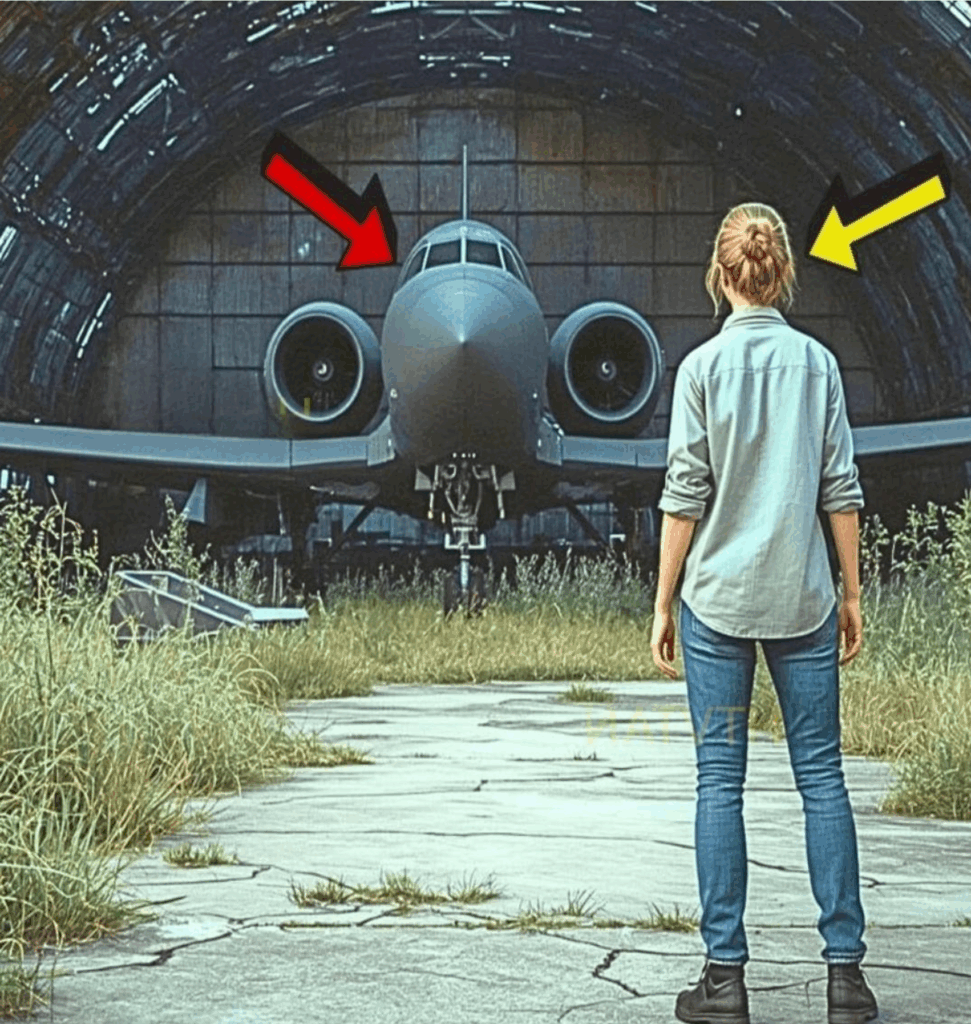
When she reached the clearing, her breath caught. Before her rose the hangar, enormous and arched, like the back of a sleeping giant. Rust gnawed at the edges, but the structure was solid and steadfast, as if it knew its importance.
The cold bit, and the wind carried the faint creak of the metal doors, as though they were welcoming her.
With trembling hands, Sloan turned the keys in the lock. The deep click echoed like a gunshot in the stillness, and as the heavy doors swung open, a rush of cold, dry air poured out, mingled with the scent of machine oil and polished metal – familiar, yet strange.
Beneath the tarp lay several aircraft, immaculately maintained, each a testament to precision and discipline. Sloan pulled the tarp aside, revealing the XJ42A Nighthawk – a sleek, twin-engine marvel, painted black with military markings.
Her fingers traced the cool metal skin. Her father had preserved it for decades, and now the legacy was in her hands.
That night, Sloan could hardly sleep. The radio in the corner buzzed again, as if testing her. “Control One… status report… integrity…” The voice was alive, current. Her heart raced. Someone expected her to continue this mission.
She opened the brown envelope she had found on the kitchen table and read the handwritten note: “Sloan, if you’re reading this, I’m no longer here. You’ve always had the heart to take on this task. Listen closely. – Dad.”
Tears streamed down her cheeks, yet she felt pride and determination at once. Her father had never been distant; he had protected a legacy greater than herself.
The next morning, she returned to the hangar with Logan, her eighteen-year-old godson. Together, they explored the facility, uncovering more encrypted documents, protocols, and schematics that revealed her father’s true mission.
The jets were not merely military experiments. They had been designed for humanitarian missions – rapid evacuations, medical aid, supply drops to remote regions. The XJ42A Nighthawk was not just a plane; it was a lifeline.
Weeks passed in focused labor. Sloan restored the aircraft, studied the protocols, and coordinated with former engineers and technicians who had worked on Project Nexus. Logan learned at her side, as Sloan showed him that knowledge and discipline were just as vital as courage and resolve.
They worked in the quiet of the hangar, every turn of a wrench and every careful adjustment a step toward preserving something greater.
Finally, the day came when the XJ42A Nighthawk rose into the sky for the first time in decades. Sloan sat in the cockpit, her heart hammering. The engine roared to life, the turbine vibrated, and the hangar trembled. It was a moment of triumphant silence
– her father’s work, and her courage, had achieved the impossible. She looked at Logan, who nodded in reverence. The aircraft, hidden in the shadows for decades, had come alive. It was ready to save lives.
From that moment on, Sloan was no longer just a mechanic. She became the guardian of a mission greater than any bureaucratic mandate, greater than any criticism. Together with volunteers, she transformed the hangar into a hub for humanitarian flight operations.
She led training programs for veterans and young women who, like herself, were often overlooked. Under Sloan’s guidance, the Mercer Project became a beacon of hope, a place where technology, knowledge, and courage saved those in need.
On the first anniversary of her father’s death, Sloan mounted a simple brass plaque: “For Walter Mercer – you were right to believe we could do better.” She looked at the Nighthawk, proud and flawless beneath the hangar roof, ready for its next mission.
Sloan knew: sometimes, one does not inherit money or land. One inherits responsibility, purpose, and hope. And she would never betray that charge.
As the sun set behind the Carolina hills, Sloan laid down her wrench and began a new chapter. Not to repair engines, but to inspire young mechanics and veterans. The hangar was no longer just an inheritance. It had become a lighthouse for all those once mocked,
striving to make the world better. Sloan Mercer had proven that a man’s final wish could be more than words – it could change a life.