One ordinary Tuesday morning, when I paid for a stranger’s bus ticket—a little over two dollars—I had no idea I was about to become part of a small miracle. What happened next reminded me that even the tiniest acts of kindness can open the door to extraordinary moments and change your life in ways you never expected.
My name is Isabelle, and I know how most mornings feel like one long, monotonous routine: coffee. Toast. The same playlist on repeat, as I rush to the 7:42 a.m. bus downtown.That Tuesday morning started no differently. My thermos scalded my fingers through my sleeve, my coat was only half buttoned,
and I was already mentally sifting through the flood of emails waiting for me at the office.I work as a marketing analyst at a tech company in the city center. When people hear that, they automatically think glamour: a corner office, free lunches, maybe a company car.
The reality? I take the bus every day because parking costs more than my weekly grocery shopping. And honestly, those twenty minutes of quiet before the morning chaos are worth more than any leather seat. I can tune out, skim the news,
and pretend I won’t spend the next eight hours in endless meetings that could have been solved with a single email.The morning air was sharp and biting—enough to make you tighten your scarf—but at the same time, it promised that maybe, just maybe, spring would come.
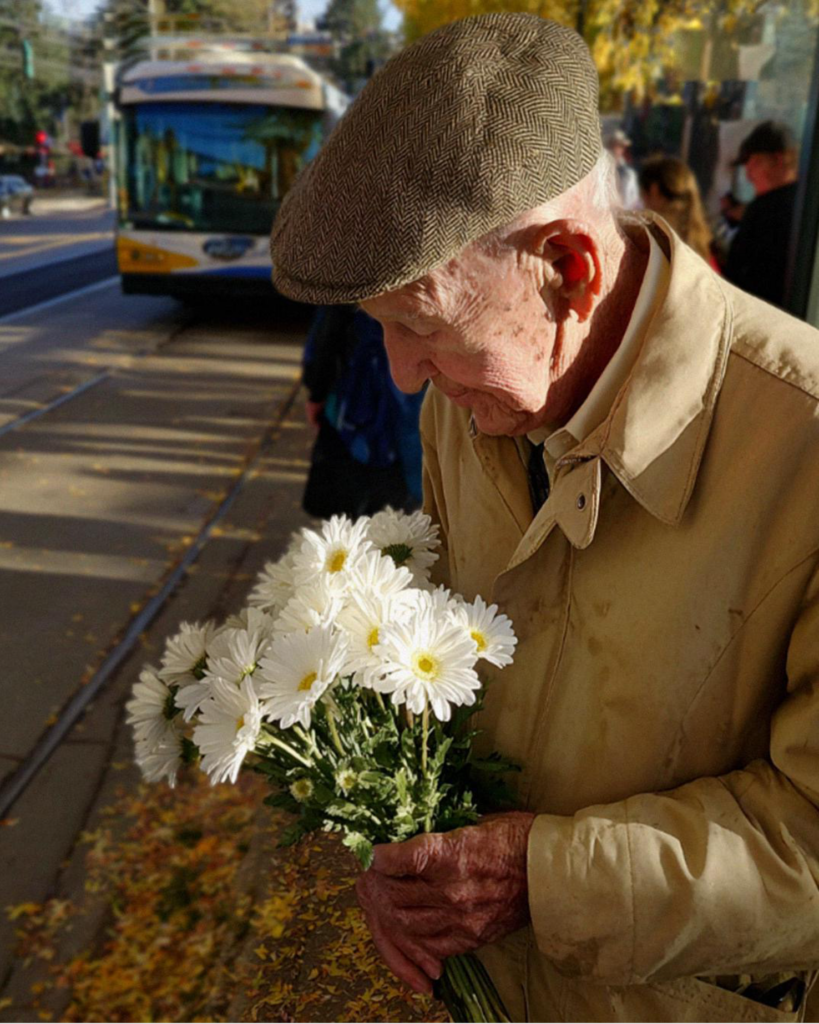
The sky was a heavy gray, impossible to tell whether it would rain or just remain overcast and indecisive all day.Then I saw him.An older man stood at the curb, slightly hunched, holding a small bouquet of daisies wrapped in clear plastic.
His coat hung loosely on his thin frame, worn, faded, a dark blue turned into a sad, muted gray.But what truly caught my attention were his hands. They rifled nervously through every pocket: front left, front right, back right, inside the coat. Over and over. A frantic, almost desperate pattern.
His face tightened with each movement, his forehead creased with confusion and growing panic.The bus screeched to a stop, and the usual morning crowd pushed inside. I swiped my card and moved toward the back. Just as I clutched a railing, I heard the driver’s voice over the quiet murmur of passengers:
“Sir, you need to pay or leave the bus.”The old man froze at the front, daisies still in his hands. His voice was soft, trembling:“I… I think I left my wallet at home. Please, I just need to get to the next stop. I have an appointment. It’s important.”
“I can’t let you ride without payment. Rules are rules,” the driver replied flatly.I watched his shoulders slump. He stared at the flowers as if they might offer him some comfort.A woman behind me in business attire sighed in irritation. “Always drama in the morning,” she muttered.
Someone else groaned. “Great, now we’re all going to be late.”A young man in the middle called out, “Just get off, old man. We have work.”The man’s face flushed with embarrassment. “I’m sorry… I didn’t mean to…”I don’t know what made me act.
Maybe it was the way he held the flowers, as if they were fragile glass. Maybe it reminded me of all the times I’d desperately searched for my own card while people behind me huffed in impatience. Or maybe I just couldn’t stand watching people be cold any longer.
I stepped forward and swiped my card again.“It’s okay,” I said, meeting the driver’s annoyed gaze. “I’ll pay for him.”The driver looked at me as if I had personally ruined his day, but finally waved the old man through impatiently.“Thank you,” he whispered. His eyes glistened. “Thank you so much, young lady.”
“You’re welcome,” I replied.He followed me to a few empty seats and sat carefully, as if his bones could punish any sudden movement. He placed the daisies gently on his lap so they wouldn’t get crushed.We sat in silence for a while as the bus moved again.
I reached for my phone, ready to dive into the routine of scrolling—but then he spoke.“You didn’t have to do that.”I looked at him. “It’s really no big deal. Just two dollars.”“For you, maybe. But for me today… that meant everything.”“For someone special?” I asked, pointing at the flowers.
His expression softened. Worries melted, and something gentle and bittersweet emerged. “My wife. Her name is Lilia. She loved daisies… she always said they reminded her of summer days and lazy afternoons.” He glanced at the flowers. “I bring her some every week.”
“That’s really sweet.”He nodded slowly. “Today, I couldn’t miss it. I… I just couldn’t.”Before I could ask what he meant, he looked at me directly. “Please, may I have your number? I’ll pay you back, I promise. It’s important to me.”“Oh, that really isn’t necessary…”
“Please.” His eyes were sincere, almost desperate. “It would mean so much.”I hesitated. Giving my number to a stranger? Strange. But he seemed so determined. And honestly, what could happen? I recited my digits as he pulled a small spiral notebook from his coat pocket.
“Isabelle,” I said when he looked at me questioningly.He wrote it down and underlined it. “Ivan,” he said. “That’s my name.”The bus slowed at his stop. He put the notebook away, stood up, and gave me one last grateful smile. “You’re a blessing, Isabelle. I hope you know that.”
Then he disappeared into the morning crowd, his oversized coat and careful bouquet of daisies in tow.The next morning, my phone buzzed in the kitchen. An unknown number. I almost didn’t answer. Probably spam. But something made me pause.The message was long. Too long for a scam:
“Ms. Isabelle, the person who helped me on the bus. You can’t imagine how much you helped me that day. I want you to know what you did.”My heart skipped a beat. I sat down, still holding my empty coffee cup.The next message came before I could respond:
“My wife, Lilia, has been in a coma for six months. The doctors say she may never wake up. I bring her daisies every morning, the same flowers I gave her on our first date. I was seventeen, too nervous to speak. The flowers spoke for me.”I stared at the screen. Another message followed:
“Yesterday, when I forgot my wallet, I thought I’d miss visiting her. Hospital rules are strict. If you hadn’t helped me, I wouldn’t have made it. But I did. I placed the flowers as usual. I told her about you… the kind young woman who helped the forgetful old man.”
My hand shook. I set the cup down before it slipped.“And then she moved her fingers,” the message continued. “First just the pinky. I thought I was seeing ghosts. Then her whole hand twitched. The nurses came running. Isabelle… she opened her eyes. After six months of silence, my Lilia was back.”
I couldn’t breathe. I sat there, the cold morning light streaming through the window, reading the message over and over.The final message:“The doctors call it a miracle. I call it you. If I could, I would thank you in person, even for a few minutes. We are at the City Hospital.
Please… I know it’s strange, but you are now part of our story. Would that be possible?”Honestly, my first instinct was “No.” It was too intimate, too overwhelming. I had done something small, and now I was drawn into a huge, life-changing event.
But all day at work, I couldn’t stop thinking about it. At lunch, I wrote to Ivan:“I’d like to come. When would be convenient?”He replied immediately: “Anytime after four. We’re here. Thank you, Isabelle. Thank you for everything.”So that evening, I got off the bus three stops early and walked into the City Hospital.
The lobby smelled of disinfectant and the familiar scent of hospital food. I found Ivan at the main entrance, in the same coat, but his face was radiant. Next to him stood a man, about my age.“Isabelle,” Ivan said as if my name were precious. He shook my hand with both of his.
“This is my son, Denis. We both wanted to properly thank you.”Denis extended his hand; his grip was warm and firm. “Dad told me everything. What you did… ‘thank you’ isn’t enough.”“I only paid for the ticket,” I said, feeling my face flush. “It’s not…”“You gave him time,” Denis interrupted gently. “That’s everything.”
We talked for a while in the lobby. Ivan told stories about Lilia—how they met at the fair, how she laughed at his terrible jokes, how they built a life from love and perseverance.Denis shared memories of his childhood, family dinners, Sunday rituals, and how his mother made everyone feel like the most important person in the room.
Before I left, Denis handed me a package wrapped in brown paper and string.“I paint,” his father said, almost shyly. “Not very well, but it helps me think. This is for you.”“Ivan, this really wasn’t necessary…”“Please,” he said. “Allow an old man to thank you in his own way.”
At home, I carefully opened the package. Inside was a canvas: a forest bathed in morning light, the sunlight filtering through tall trees and casting patterns on the ground.It was beautiful, in that innocent way that only comes from someone who paints what they love,
not what they think others should love.I hung it above my sofa that very evening.A week later, Ivan wrote: “We’re having a small birthday dinner this Saturday. Lilia comes home tomorrow. Please come. You are family now.”I almost said “no” again. Almost.
But I went.Their home was small and tidy, everything in place for decades, nothing needing change. Everywhere were photos, years of memories, aging faces—but intertwined hands that had endured time.Lilia sat on the sofa, propped up with pillows like a fortress.
Fragile, almost translucent, but her eyes were alive. She smiled as I entered.“You’re the girl from the bus,” she said softly. “Ivan told me about you. He said an angel paid his ticket.”“I’m certainly no angel!” I said, sitting beside her.“To us, you are an angel,” she said. She held my hand,
fragile but with astonishing strength. “Thank you for giving me another chance to tease my husband.”Ivan laughed from the kitchen. “Too late! You’ve already perfected that at the hospital.”Dinner was simple: roast chicken, mashed potatoes, green beans. Nothing fancy.
But warm, full of laughter, and that familiar teasing only possible between people who have loved each other long enough to know exactly which buttons to press.Denis sat across from me. Throughout the evening, he kept glancing my way, as if he wanted to say something,
but the words didn’t come. When dessert was done, he offered to walk me to my car.We stood on the driveway for over an hour.“I’m glad you came,” he finally said. The streetlamp above flickered slightly, casting strange shadows. “I think… it did my parents good too.
To see that there are still good people in the world.”“Your father is a good man,” I said. “He loves your mother more than anything. That’s devotion.”“Love!” Denis grinned.That night, when I got home, I received a message from him:
“I know this is sudden, but would you like to have coffee sometime? Not out of thanks. Just… coffee.”I stared at the message for a long time, then typed: “I’d love to.”Four months have passed since that morning on the bus.Ivan’s painting still hangs above my sofa. Every time I look at it,
I think about how strange life is, and how a forgotten wallet and two dollars can set off a wave that changes everything.Lilia is doing better. She continues therapy twice a week, likely with some permanent limitations—but she’s home. She woke up. And yes, she can tease Ivan in person again.
And Denis?Well, he’s the reason I don’t take the bus alone anymore.His parents still invite me over for dinner. Last Sunday, Lilia showed me her secret for the perfect pie crust while Ivan painted at the kitchen table and Denis did the dishes. It felt like family. Like home.
It’s amazing how the smallest acts of kindness can open the biggest doors—and how sometimes the best things in life cost only two dollars.