The motorcyclist who raised me was not my father. When I first saw him, he looked like someone you should run from, not ask for help — nearly two meters tall, with heavy, grease-stained hands, a beard thick like a steel brush, and tattoos disappearing beneath the sleeves of a leather jacket. His workshop smelled of gasoline, metal, and strong coffee, and the whole place hummed with the constant growl of engines.
I was fifteen then, already at the end of everything. I had run away from my fourth orphanage after another year where “care” meant shouting, indifference, and fear. I slept behind his workshop, in a container full of bags and scraps, curled up so tightly it felt like it might protect me from the world. I didn’t expect anyone to notice me. No one ever had before.
But at dawn, the workshop door creaked open.
Light spilled onto the asphalt — sharp and yellow. I heard footsteps: heavy, steady, certain. I froze.
“Are you hungry, kid? Come inside.”
That was it. No questions, no “who are you,” no “where did you come from.” Just a low, rough voice, worn by cigarettes and exhaustion, but not aggressive. As if he had simply invited me in, not decided my fate.
Twenty-three years later, I stand in a courtroom in a tailored suit, wearing a watch that could support someone for a year. Yet I feel like that same boy behind a dumpster.
We are in a case about shutting down Big Mike Custom Cycles. The city speaks of “noise,” “declining property values,” and “undesirable elements.” Elegant, cold, polished words — the kind used when someone wants to erase others without getting their hands dirty.
None of them saw what I saw.
Those days began with coffee in a plastic cup that burned more than hunger. Mike placed it in front of me like it was the most natural thing in the world.
“You know how to hold a wrench?” he asked, pointing to a heavy steel tool on the table.
I didn’t.
“You will learn.”
There was no softness in it in the usual sense. There was structure, rhythm, order. Wake up at dawn, clean the workshop, pass tools, listen to engines being taken apart. Oil worked its way under your nails and refused to leave, and your hands hurt so much you could barely sleep at night.
But for the first time, I wasn’t a “problem.” I was useful.
There were others in the workshop. Motorcyclists who looked like living warnings — leather, chains, skulls on jackets, voices like thunder. But no one broke me there. Instead, one of them, Snake, would sit beside me and teach me numbers, drawing them on pieces of metal.
“The engine doesn’t lie,” he said. “It either works or it doesn’t. People should be the same.”
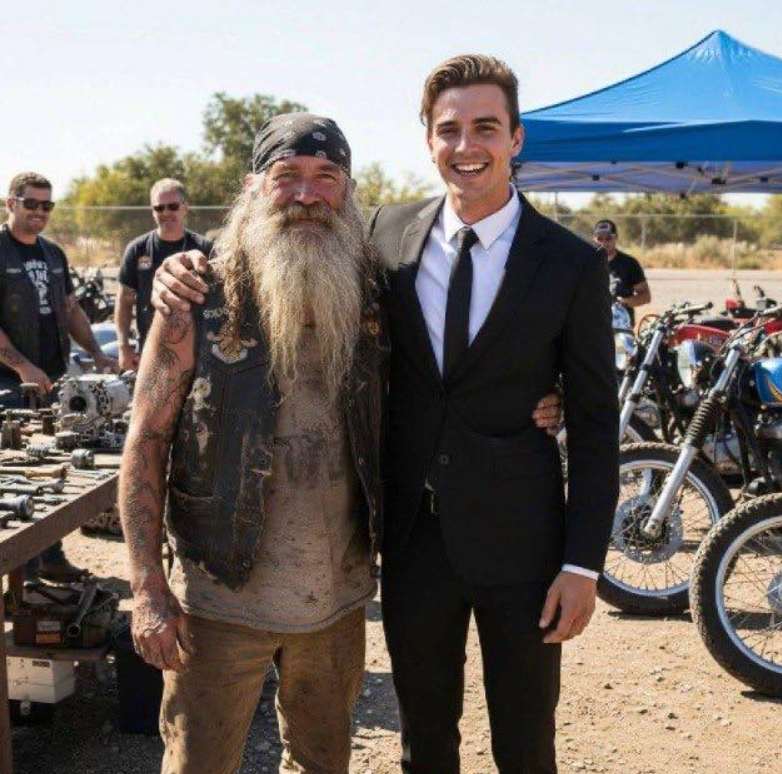
Preacher always had dirty hands and a voice like a prayer spoken by someone who no longer believes in heaven, but still believes in people. He made me read aloud, and when I made mistakes, he didn’t shout — he simply repeated the words with me until they sounded right.
Bear’s wife… she brought clothes. Sometimes they smelled like detergent, sometimes smoke, sometimes a home I had never known. “From my son,” she said. But her eyes said something else: that she knew exactly who they were for.
Mike was not soft. He never pretended the world was safe.
“Anyone can let you down,” he told me once, leaning on an oil-stained counter. “That’s why you need to stand on your own feet. But as long as you’re here — you’re not alone.”
And he kept that promise.
He drove me to school on a Harley that vibrated in my chest like a second heart. People stared — some with contempt, some with curiosity. I looked down, ashamed that someone like him was my world.
And yet he was the only adult who never broke me.
When I got into university, the club celebrated like they had won something bigger than me. Engines roared late into the night, lights reflected off chrome, and the laughter of those hard men rolled through the street like something unreal.
Mike stood to the side. He didn’t say much. Just watched, as if trying to memorize that it was real.
At university, I learned to pretend. A suit replaced leather and grease. I avoided the word “home” like fire. When they asked about my family, I said there wasn’t much to tell.
It was easier to erase them from my world than to explain that my father wore grease under his nails and believed everyone deserved a second chance.
Then Mike called.
His voice was different — heavier, like something was pressing down on him.
“They’re going to shut us down,” he said. “They say we’re a problem for the city.”
I should have gone immediately. But I didn’t. I stayed silent too long, afraid my new world would see the old one.
Then I saw a photo: Mike sitting on the workshop steps, the door marked in red letters: “EVICTED.”
And then I went back.
The trial smelled of perfume, paper, and power. Their witnesses spoke of “noise,” “danger,” and “declining quality of life.” They had never been there, but they spoke with the certainty of people who believe money replaces truth.
I had something else.
I had memories of oil and coffee. I had faces of people who were once children like me. I had proof that this “dangerous workshop” was the only place that didn’t reject the ones the world threw away.
When Mike took the stand, the room changed.
“Do you admit to harboring minors?” the prosecutor asked.
Mike looked calm.
“I admit I fed hungry kids and gave them a place to sleep.”
“Without permission from authorities?”
“Without permission from indifference.”
Then he looked at me.
“He’s my son. Not by blood. By what you become when no one else does anything.”
I stood up.
And I told the truth I had been ashamed of for years — that I was the boy behind the dumpster, and everything I am began with a man who didn’t look away.
The court lost against a story that could not be contained in paragraphs.
Today, the workshop still stands. In the mornings, the air still smells like gasoline and coffee. Mike still opens the doors at five. Still checks the dumpster.
“You hungry? Come inside.”
And sometimes someone does.
Dirty, lost, quiet.
And Mike doesn’t ask questions.
Because he knows that sometimes a single sentence can save a whole life.