They Laughed at an Elderly Woman at the Door. Minutes Later, the Entire Room Fell Silent
The laughter hurt more than the sound of my cane striking the rain-soaked sidewalk.
“Ma’am, the retirement home is two blocks away.”
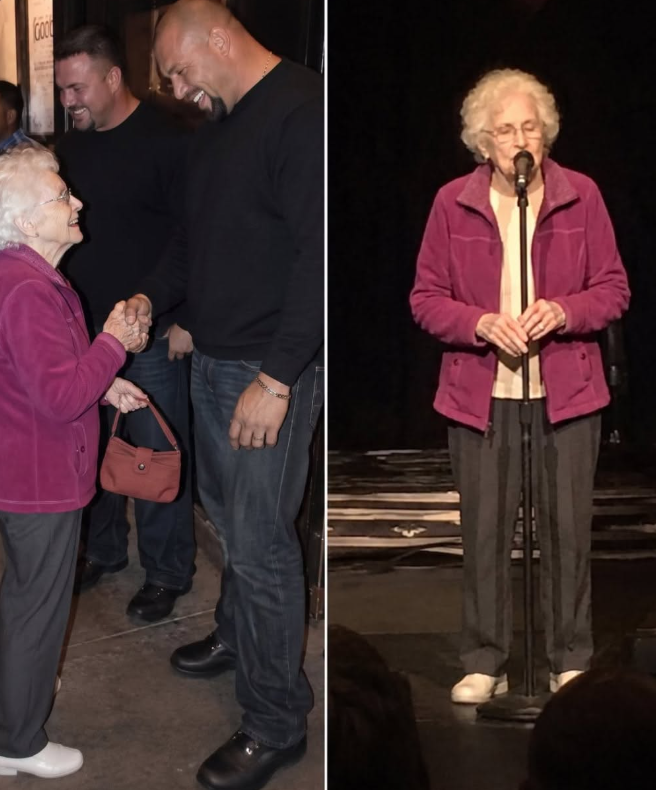
The first bouncer said it with a broad grin, as though he’d just delivered the joke of the night. The second, tall and bald, looked me up and down. His eyes lingered on my white orthopedic shoes, my purple fleece jacket, and the little red handbag hanging from my shoulder.
“Or maybe you’re here looking for your grandson?” he sneered. “We only let guests inside.”
I looked past them.
Above the entrance glowed a new sign:
“The Black Lantern.”
It used to read “Helen’s Lantern.”
My husband had fastened those first letters to the wall with his own hands, and for fifteen years I had stood on that stage every Saturday night, singing my heart out. Now, all that remained were faded photographs on the walls and memories that no one standing at the door recognized anymore.
On the poster beside the entrance was a photograph of me taken forty years earlier.
“Founders’ Memorial Evening. Special Performance: Helena Zawadzka.”
It never crossed their minds that the young woman smiling from the poster and the elderly lady leaning on a cane were the same person.
“I’m performing tonight,” I said calmly.
They burst into laughter.
“You? On stage?”
It wasn’t my age that hurt.
Growing old is honest.
It arrives slowly, taking away strength little by little.
What hurt was their certainty that wrinkles erased an entire lifetime.
“My name is Helena Zawadzka.”
The first bouncer checked the guest list.
“You’re not on it.”
“I should be.”
“Everyone says that.”
The doors opened.
A group of elegantly dressed young people walked inside. No one checked their invitations. They were welcomed with smiles and jokes.
I remained standing on the sidewalk.
“Please call Michał Zawadzki,” I said quietly. “He’s my grandson. He’s organizing tonight’s event.”
The bald guard laughed.
“Sure. And I’m the King of England.”
At that moment, my son, Paweł, stepped out of the club.
I hadn’t seen him in months.
“Mom? What are you doing out here?”
“I’m trying to get inside.”
The bouncers instantly became serious.
“Mr. Paweł, we didn’t know…”
“It’s fine,” he replied indifferently.
He didn’t ask them to apologize.
He didn’t even say,
“She’s my mother.”
He simply acted as though the matter was already settled.
“Michał was supposed to pick me up,” I said softly.
“He’s busy with the sponsors. You could’ve waited at home.”
I sighed.
“You haven’t been answering my calls either.”
Paweł glanced nervously at the growing line of guests.
“Mom… please don’t make a scene.”
A bitter smile crossed my face.
“For my entire life, you begged me to walk onto a stage. Now you’re afraid I’ll finally tell the truth from one.”
He said nothing.
Inside, the club sparkled beneath elegant lights.
Old photographs covered the walls.
In one of them I stood at the microphone while Henryk sat at the piano beside me.
The caption underneath read:
The Legacy of the Zawadzki Family.”
The words felt like mockery.
A few moments later, Michał approached me.
Tailored suit.
Expensive watch.
Perfectly practiced smile.
“Grandma! I’m so glad you’re here.”
He kissed my cheek, but his eyes immediately drifted back toward the guests.
“You’ll go on stage in a minute. Say a few words about Grandpa, then we’ll sign the foundation papers.”
“What papers?”
For a brief second, he froze.
“We talked about this. The club is being transferred to the foundation.”
“I don’t remember that conversation.”
“Maybe you forgot.”
He said it far too calmly.
Like someone who had rehearsed that answer long ago.
Suddenly everything fit together.
The unanswered phone calls.
The documents they kept asking me to sign.
The constant suggestions that my memory was getting worse.
What they didn’t know was that two weeks earlier, my former dressing-room assistant had brought me copies of the emails and the draft agreement.
I already knew the foundation planned to take control of the club only to sell it to a property developer.
I also knew they intended to portray me as mentally incapable.
The lights dimmed.
The host announced my performance.
I walked slowly across the room.
Every tap of my cane echoed through the silence.
I stopped at the microphone.
“Good evening.”
The room fell silent.
“Fifteen minutes ago, someone at the entrance asked whether I’d mistaken this place for a retirement home.”
A few nervous laughs rippled through the audience.
“I don’t blame those young men. It’s much worse when your own family makes the same mistake.”
The room became completely still.
Behind me, the screen displayed documents instead of the planned tribute video.
Emails.
Contracts.
Messages.
One message read:
“If Grandma starts protesting, remind everyone about her memory problems.”
A murmur swept through the crowd.
Paweł turned pale.
Michał jumped to his feet.
“Grandma, turn that off!”
I looked at him calmly.
“No.”
“Tonight, everyone is going to hear the truth.”
I told them how Henryk and I had sold our wedding rings to open this club.
How we fought for every single dollar.
How this place had been our home—not an investment.
Then I lifted an envelope.
“My husband left a second will.”
“If anyone in our family ever attempts to sell this club without my consent, ownership immediately transfers to an independent arts foundation.”
Gasps echoed across the room.
“The clause was activated this morning.”
Michał looked as though the ground had disappeared beneath his feet.
I asked the pianist to play our old song.
The first notes filled the room.
I closed my eyes.
And I began to sing.
My voice was no longer as powerful as it had once been.
But it carried my entire life.
Every loss.
Every victory.
Every tear.
When I finished, absolute silence filled the room for several long seconds.
Then the elderly wardrobe mistress stood up.
After her came our old saxophonist.
Then another guest.
And another.
Within moments, the entire audience was on its feet, applauding.
Not for the legend on the poster.
But for the woman who had been laughed at only minutes earlier.
A few weeks later, the foundation restored the club’s original name:
“Helen’s Lantern.”
Once again, it became a home for artists instead of a business opportunity.
One day, the same bald bouncer walked up to the bar.
He held his cap tightly in both hands.
“Mrs. Helena… I’d like to apologize.”
I looked at him.
“For believing my wrinkles were my entire story?”
He nodded.
I smiled gently.
“Next time, get to know the person before you judge their age.”
Today, when I walk into the club, no one asks if I’ve come to the wrong place.
My cane still taps against the floor.
My purple jacket still keeps my shoulders warm.
And a new photograph now hangs beside the entrance.
It doesn’t show a young woman from decades ago.
It shows an elderly woman standing on stage with her eyes closed, a microphone in her hand.
Beneath the photograph is a single sentence:
A voice never grows old when it has the courage to speak the truth.”