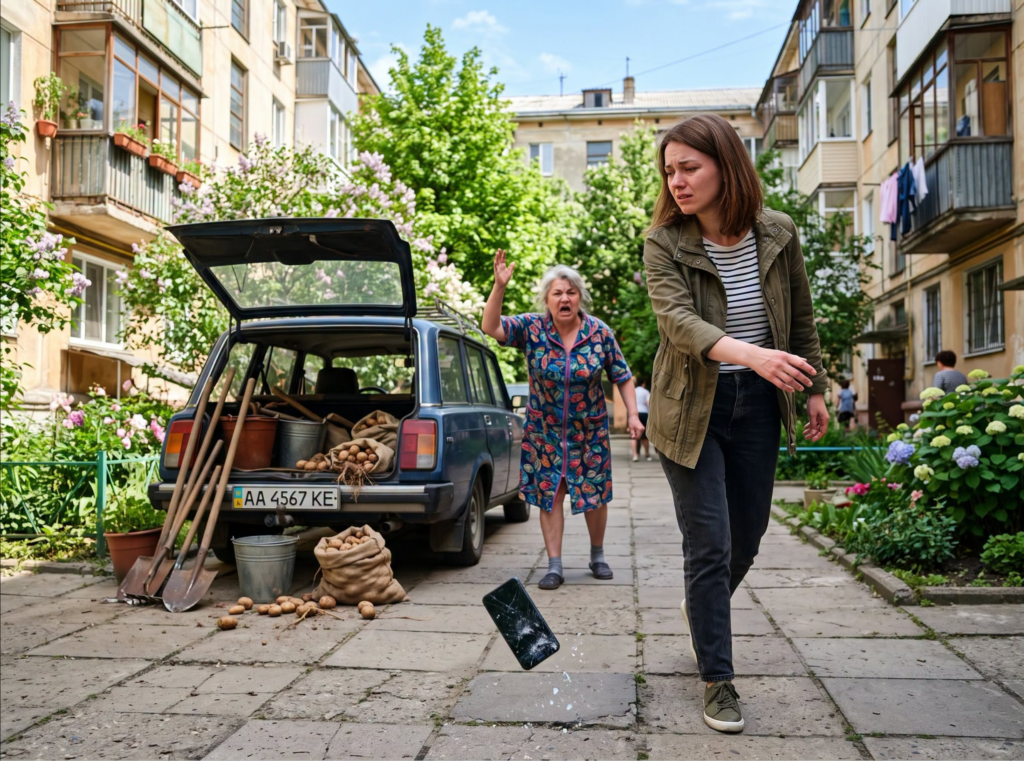
– If you don’t get in the car right now, forget that you have a mother! Don’t ever come near my house again! – Tamara Petrovna’s voice cracked with anger, and her face turned bright red in the courtyard of the Kyiv apartment building.
Thirty-five-year-old Alina slowly removed the canvas gloves her mother had forced her to wear and simply dropped them onto the ground. She didn’t shout. She didn’t cry. She just stepped back toward the entrance of the building.
The family members standing around watched in shock.
Her stepfather, Valeriy, stood beside the old Passat holding a fuel can, while her aunt Larisa angrily tied up the sacks of potatoes meant for planting. The same “family tradition” that had repeated every May for years was about to begin again: a trip to the old farm, several days of exhausting labor, aching backs, and finally a few sacks of potatoes that could have been bought much cheaper at a store.
But this year, Alina said no.
– I did the calculations, Mom, – she said calmly. – The travel expenses alone cost us nine thousand hryvnias every season. Then there’s the plowing, the fertilizer, the spraying. And we haven’t even talked about the time we lose and the damage to our health. We can buy the same amount of potatoes at the store for much less. I’m not going anymore.
After those words, there was silence for several seconds.
Then Larisa shouted angrily:
– You’re ungrateful! This land belongs to our family! You grew up here! In the 1990s, these potatoes kept us alive, and now you’re ashamed of hard work?
Alina had heard those words for years.
Every spring, the same thing happened. Instead of resting after a long year of work, she spent her vacation at the farm. She woke up at dawn, dug the soil, weeded, carried heavy sacks, while her family repeated: “This is your duty. This is our tradition.”
But Alina was tired.
– Times were different before, – she replied. – Back then, we needed it. But now we’re only doing it out of habit. I don’t want to sacrifice my entire life for this anymore.
But Tamara Petrovna refused to accept her answer.
In anger, she stepped toward her daughter and pushed her arm. Alina’s phone slipped from her hand, fell onto the concrete, and the screen immediately cracked.
Nobody said a word.
Valeriy looked away. Larisa simply pressed her lips together.
A few minutes later, the car drove away, leaving Alina alone in the courtyard. For the first time, she truly felt that her own family was punishing her for finally standing up for herself.
They didn’t speak for days.
Alina bought a cheap new phone but didn’t contact her mother. She waited for an apology. For a single message. For some sign that her family realized they had gone too far.
But nothing happened.
On the fourth day, however, Uncle Ivan, the neighbor from the farm, called her.
– Alina, don’t panic, – he said in a tired voice. – Your mother and Larisa were taken to the hospital. Tamara’s blood pressure became dangerously high, and Larisa’s back completely locked up. Valeriy is left alone with the land. The sacks are still sitting outside in the rain.
Alina felt anger and sadness at the same time.
She knew this would happen.
Yet she didn’t rush to help immediately. For the first time in her life, she decided not to take responsibility for the consequences of other people’s choices.
A week later, however, she went to the farm to collect her old belongings.
She expected to find a broken family.
But the sight that greeted her was completely different.
There was tea and fresh pastries on the veranda table. Larisa looked healthier, and Valeriy was happily talking on the phone.
– Here comes our great helper, – Larisa remarked with a slight hint of irony.
Alina said nothing.
– You thought we wouldn’t manage without you? – the woman continued. – Valeriy made a deal. We rented out the entire thirty acres of land to a local farmer for five years. He has already paid for the first year.
Alina looked at her in confusion.
– But… what about the potatoes?
At that moment, Tamara Petrovna stepped out of the room.
– The farmer also brought thirty sacks of potatoes, – she said. – It will be enough for the whole winter.
That was when Alina finally understood the truth.
The “sacred family tradition” was never really about the land.
The farmer had offered this solution before, but her mother always refused. Not because the work was necessary, but because she was used to everyone obeying her.
As long as Alina silently worked, it was easy to hide behind the idea of tradition.
But when her daughter finally said no, the entire system collapsed.
– So it wasn’t the tradition that mattered? – Alina asked quietly. – It was that everything had to happen the way you wanted?
Tamara Petrovna turned toward the window and said nothing.
Alina packed her belongings, walked out through the gate, and made a decision: she would no longer sacrifice her own life because of someone else’s stubbornness.
But did she make the right choice?
Does an adult child have the right to break a family tradition when it only brings suffering? Or should she have given in for the sake of peace and her elderly mother’s feelings?