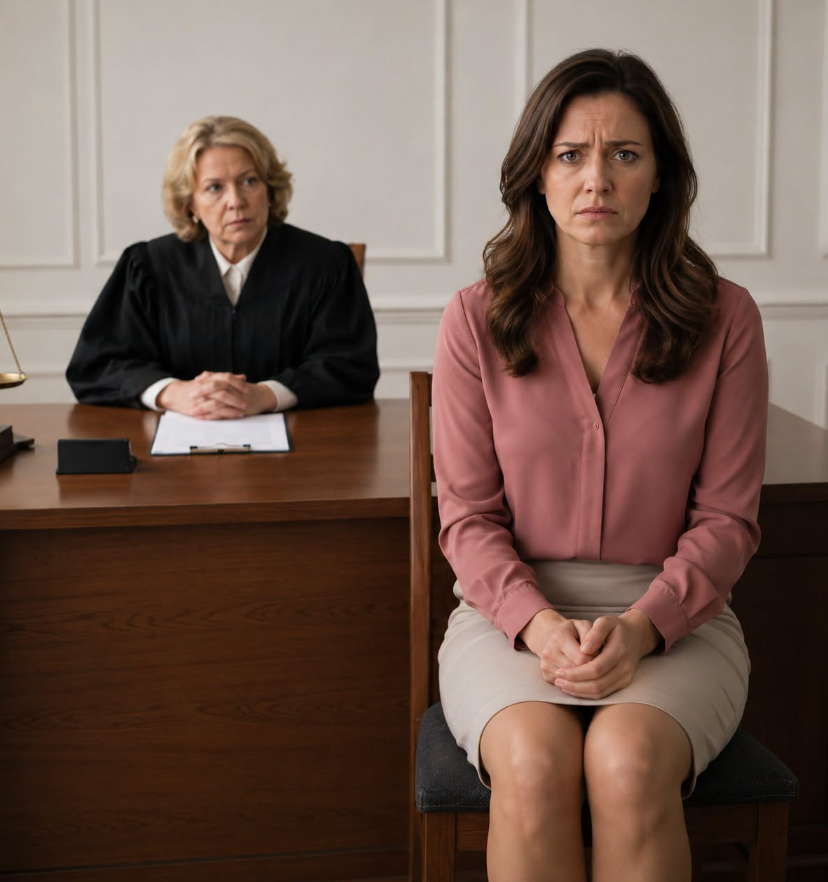
“And who are you, according to the documents?” the judge asked. “No one. My son bought the apartment.”
A heavy silence settled over the courtroom. It was so quiet that even the soft ticking of the wall clock could be heard. Serafima Petrovna sat confidently in her chair, as if the verdict had already been decided in her favor.
I, however, only tightened my grip on the folder in my hands. Inside were the documents that proved the truth—and would determine whether my children would still have a home.
Eleven years earlier, when I married Eduard, I believed love could overcome anything.
I was wrong.
From the very first day we met, my mother-in-law made it clear that she would never accept me.
“A kindergarten teacher?” she sneered. “My son could have done much better.”
Over the years, I got used to her insults. At every family gathering, I was always served last. She spoke about me as though I weren’t even sitting at the table.
When our daughter, Polina, was born, she visited the hospital for barely forty minutes. She looked at the baby, remarked that “her nose is exactly like Eduard’s,” and left. During the first five years of our son Timosha’s life, she never once took him for a walk.
I swallowed every insult because Eduard always said the same thing.
“Mom’s just like that. Don’t let it get to you. What matters is that we’re together.”
And we were.
We took out the mortgage together, planned our future together, and made every payment together.
Eduard earned more as a construction site manager. I earned less as a kindergarten teacher. But every paycheck I brought home went toward supporting our family.
The apartment wasn’t his.
It was ours.
Then, on a freezing morning in March, my phone rang.
A car accident.
For three days I sat in the hospital corridor, refusing to give up hope.
On the fourth day, the doctor looked at me, and without saying a single word, I knew it was over.
At thirty-nine, I became a widow.
With two young children.
Two weeks later, Serafima Petrovna came to my apartment.
She wasn’t there to comfort us.
“We need to sell the apartment,” she declared. “We’ll split the money in half. A small rental on the outskirts of town will be enough for you.”
At first, I thought I had misunderstood her.
“This is jointly owned property,” I answered calmly. “I’m a co-owner, and the children also own shares.”
“Oh, please,” she scoffed. “My son earned every penny.”
I tried explaining that I was a co-borrower on the mortgage and that the government family subsidy had also been used to pay for the apartment.
She wasn’t interested in facts.
In her mind, the apartment already belonged to her.
She started showing up every week.
Using her own key, she would let herself in, inspect the refrigerator, criticize the apartment, and one day even tried to pack up Eduard’s clothes.
“These are my son’s belongings.”
“My daughter falls asleep every night wearing her father’s sweater,” I replied quietly. “They’re staying here.”
The next day, I changed the locks.
That was when the real war began.
A week later she returned with a man who introduced himself as a lawyer and claimed he needed to inspect the apartment.
“Do you have a court order?” I asked.
He didn’t.
I closed the door.
That very afternoon, I hired a real attorney.
He reviewed all my documents in less than twenty minutes before smiling reassuringly.
“Try not to worry. No one can force you out of this apartment. You are an owner. Your children are owners. And because government family assistance was used to purchase the property, this is legally nothing like the situation your mother-in-law imagines.”
For the first time since Eduard’s death, I felt a glimmer of hope.
A few weeks later, the lawsuit arrived.
Serafima Petrovna was demanding my eviction.
On the day of the hearing, my former brothers-in-law sat beside her, looking at me as though I were the thief.
Her attorney argued at length that because Eduard had earned most of the money and paid the mortgage, the apartment rightfully belonged to his family.
Our lawyer simply placed the documents before the judge.
The marriage certificate.
The mortgage agreement.
The proof of the government family subsidy.
The children’s ownership records.
The judge examined every page carefully before slowly looking up.
“Do I understand this correctly?” he asked my mother-in-law. “You’re asking this court to evict your own grandchildren from an apartment in which they legally own a share?”
For the first time, Serafima Petrovna lost her confidence.
A few minutes later, the ruling was announced.
Her claim was dismissed.
As I walked out of the courthouse, I felt years lighter.
But on the courthouse steps, she caught up with me.
“Elina… I’d like to see my grandchildren.”
I stopped.
She didn’t apologize.
She showed no remorse.
She simply wanted to see them.
I looked at the woman who had ignored me for eleven years.
Who had never once cared for my children.
Who hadn’t hugged me after her son’s death, but had instead tried to take away our home.
“When you asked the court to evict us,” I said quietly, “you knew exactly what you were doing. You were trying to put two small children out on the street. Until you apologize to them—not to me—we have nothing to discuss.”
I didn’t wait for an answer.
I went home.
The moment I stepped through the front door, Timosha threw his arms around my neck.
“Mom, is everything okay?”
Smiling, I hugged him tightly.
“Yes, sweetheart.
We’re staying home.”
That evening, as my children’s laughter filled the kitchen, I realized something.
I hadn’t won the case just to keep an apartment.
I had won the security that Eduard had always wanted his family to have.
And no one would ever take that away from us again.