Every single morning, she called.
Exactly at eight o’clock.
Not 8:05. Not 8:10. Eight sharp. For seven years, she never missed a day. At first, I found it touching. I thought I was lucky to have a mother-in-law who cared so much about us.
It took me years to realize it wasn’t care.
It was control.
Her name was Magdalena. She always smiled, always spoke in a gentle voice, but every sentence carried an invisible judgment. She never had to raise her voice. One quiet remark was enough to make me question myself for the rest of the day.
“You’re making this soup again? Tamás has hated bay leaves since he was a child.”
“My dear, red nail polish isn’t appropriate for a married woman.”
“Flowers on the windowsill? They only collect dust.”
Each comment seemed harmless on its own. Together, they slowly chipped away at my confidence.
Over seven years, I learned every rule in that family.
Don’t laugh too loudly.
Don’t disagree with Magdalena.
Don’t hurt her feelings.
And above all, always put her comfort first.
I didn’t even notice when I started changing.
First, I moved the flowers away from the window.
Then I replaced my bright red nail polish with beige.
Later, I even planned every meal around what she might criticize.
Little by little, my own preferences disappeared.
Magdalena came whenever she wanted. She had a key to our apartment because, as she liked to say, “You never know when it might be needed.” She never knocked.
She simply walked in, rearranged my kitchen, straightened the curtains, and explained how Tamás’s shirts should really be folded.
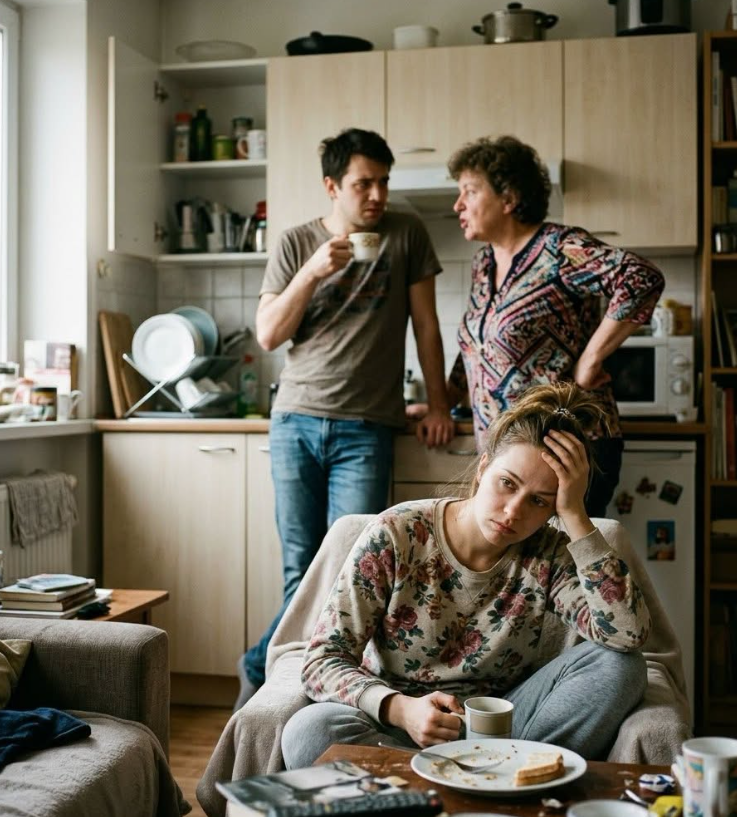
I would stand there, pretending it didn’t hurt.
Tamás always had the same answer.
“Don’t be upset. Mom is only trying to help.”
Help.
That one word excused every crossed boundary.
Whenever I complained, he shrugged.
“That’s just how she is.”
Eventually, it wasn’t Magdalena’s comments that hurt the most.
It was the fact that my husband never stood beside me.
I slept less and less. Every time the doorbell rang, my stomach tightened. Before eight every morning, I found myself staring anxiously at my phone, already waiting for it to ring.
I didn’t know there was a name for what I was feeling.
Anxiety.
The turning point didn’t come after a fight.
It happened on a quiet April morning.
I was standing in front of the bathroom mirror when a strange question crossed my mind.
What do I actually like?
Not Tamás.
Not his mother.
Me.
What color?
What music?
What would I choose for breakfast if no one were watching?
I stared at my reflection for several minutes.
I couldn’t answer.
The realization terrified me. I had spent so many years living according to someone else’s expectations that I had completely forgotten who I was.
That afternoon, I called a psychologist.
When Magdalena found out, she laughed.
“In our family, people don’t go to psychologists. We’re not crazy.”
Tamás, once again, said nothing.
But I went anyway.
During our third session, the psychologist asked me one simple question.
“If no one judged you, what would you do tomorrow?”
I looked out the window for a long time before answering.
“I’d move away.”
Even saying the words out loud felt like taking my first full breath in years.
“What’s stopping you?”
“I thought it would make me selfish.”
The psychologist remained silent.
“And now?”
I looked down at my hands.
Beige nail polish.
Safe.
Invisible.
“I don’t think I was being selfless anymore,” I whispered.
“I think I was disappearing.”
That evening, I sat down with Tamás.
I wasn’t looking for a fight.
I just wanted him to hear me.
I told him everything.
The daily phone calls.
The unannounced visits.
The constant criticism.
The knot in my stomach.
The fact that I no longer recognized the woman I had become.
He listened quietly.
Then he said the words I should have expected.
“But Mom isn’t a bad person.”
I looked at him.
“This isn’t about whether she’s a bad person. It’s about what all of this has done to me.”
Silence filled the room.
Finally, he asked,
“Do you want me to choose between you and my mother?”
I shook my head.
“No. I want my feelings to matter for once.”
I could see it in his face.
He didn’t understand.
For forty years, he had been taught that his mother’s needs always came first.
He didn’t know how to live any other way.
The next morning, I packed one suitcase.
A few clothes.
My documents.
My laptop.
And my favorite coffee mug—the only thing in the apartment I had chosen entirely for myself.
“Are you really leaving?” Tamás asked.
I nodded.
“For the first time in my life, I’m choosing myself.”
I rented a tiny apartment across town.
There was nothing special about it.
A bed.
A table.
A few shelves.
Yet it felt more like home than the place I had lived for seven years.
The first night, I barely slept.
Not because I was afraid.
Because of the silence.
No phone ringing.
No key turning in the lock.
No criticism about dinner.
No comments about my curtains.
Just peace.
The next morning, I went to a drugstore and bought bright red nail polish.
I painted my nails.
I placed flowers on the windowsill.
I laughed out loud at a silly video without worrying who might hear me.
They were such small things.
But in those tiny moments, I found the woman I had lost years earlier.
I don’t know what Magdalena tells the neighbors about me now.
Maybe she calls me ungrateful.
Maybe Tamás still believes I overreacted.
But I know one thing with absolute certainty.
People who are used to you sacrificing yourself for their comfort will call your very first boundary an act of betrayal.
The truth is, I didn’t betray my family.
I simply stopped betraying myself.
And that was the beginning of finally coming home—to the only person I had abandoned for far too long.
Myself.