Olga Nikolayevna stepped out of the notary office and paused for a moment, squinting into the sudden, sharp October sunlight. The air was already cold; autumn promised nothing good—only haste and decay. In her bag lay the draft of the deed of gift.
Everything was ready. Only one certificate remained: proof of no outstanding debts, and the signature.
She had made the decision long ago. The “three-room” apartment in a quiet downtown street was her only significant asset, but she did not regret it. For Ilya, she would have regretted nothing. Her son and his wife,
Svetlana, had been living from one rented flat to another for three years, always tight, always temporary. Now there was finally a chance for them to have a proper home, to have children, to begin a normal life.
Olga had already pictured herself in a small country house with a stove, where the veranda could be insulated for winter. It would not be luxury, but it would be enough. A person does not need much.
When Ilya hugged her and said, “You’re so good, Mom,” Olga felt, for the first time in a long while, truly useful.
In front of the office, a woman was sweeping fallen leaves. She wore a blue work coat, a worn jacket underneath. Her movements were tired but mechanical. When Olga passed her, the woman suddenly straightened.
Her face was gray, as if life had slowly drained the color from it, but her gaze was sharp—unsettlingly precise.
“Don’t sign the deed of gift until you look into the blue box under your son’s bed,” she said quietly.
Olga froze, as if she had been shoved.
“What? Who are you?”
“I used to be a cleaner. They fired me yesterday. Your daughter-in-law arranged it. She said I don’t do my job properly.”
The woman laughed bitterly.
“But I saw everything. What they don’t know is that walls talk when you clean them long enough.”
Olga nervously adjusted her bag.
“This is madness. Leave me alone.”
“Check the box. Blue shoebox. Under the bed. Everything is there.”
The woman turned away and began scraping at the leaves as if the conversation had never happened.
On the bus home, Olga sat without perceiving the people around her. The sentence repeated in her mind like a poorly set clock: “blue box.” Ridiculous. Surely revenge. A wounded person’s last attempt to cause harm.
Ilya was her son. The child who once collected pebbles for her by the river.
Yet something shifted inside her. A small crack in trust that she could no longer seal.
That evening Ilya called, cheerful.
“Mom, we’re going to Svetka’s this weekend. Could you water the plants?”
“Of course, son.”
Her voice was steady, but something inside her was no longer the same.
On Saturday she entered the apartment with her own key. In the hallway, the smell of expensive perfume mixed with stale garbage. As if their life wanted to be both perfect and careless at the same time.
The room was tidy—too tidy. Behind the order there was a tense artificiality.
In the bedroom, she stopped.
The bed.
Her knees weakened as she knelt.
There, under the bed, was indeed a blue box.
Her hands trembled as she pulled it out. Her heart was beating as if it wanted to burst from her chest.
At first, only old papers: receipts, warranty slips. Relief flickered through her. It’s nonsense.
Then she saw the folder.
A preliminary sales agreement for the apartment. Her apartment.
Ilya’s name was listed as the seller.
The date: one week after the deed of gift.
The price: suspiciously low.
Below it, a brochure for a retirement home. In the margin, handwriting: “fast placement, even in cases of dementia.”
The next document concerned microloans. Deadlines, debts, penalties. Huge sums.
Ilya was in debt.
And finally, a psychiatric report.
Olga’s name.
“Early senile dementia. Guardianship recommended.”
She had never been examined there.
The air thickened. She could not breathe properly.
Then she heard the key in the lock.
Footsteps.
Laughter.
“I told you she’d sign without thinking,” said Svetlana.
“I hope so, because the banks are already on our necks,” Ilya’s voice sounded tired.
They entered.
They saw her.
Silence fell.
Svetlana’s face hardened immediately.
“What are you doing here?”
Olga slowly stood up.
“I’m reading.”
Ilya went pale.
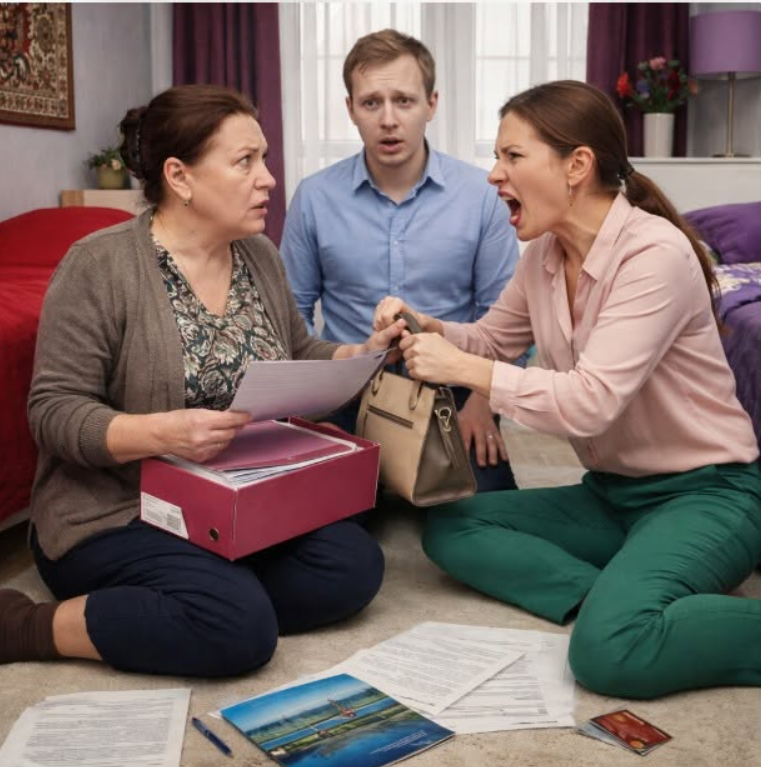
“Mom… it’s not like that…”
“Then how is it?”
The silence became heavy, suffocating.
Ilya broke it first.
“It’s only temporary! Just until we settle the debts! After that everything will go back to normal!”
Svetlana cut in:
“You don’t understand anyway! You could be put under guardianship! The papers are ready!”
At that point Olga was no longer trembling. A strange calm settled over her.
“You’ve already decided I’m not a human being.”
She put the papers into her bag.
“I’m taking this.”
Svetlana reached toward her, but Olga pushed her away.
“No.”
Her voice was not loud. But it stopped them.
“I’m leaving now. And I will report you.”
They did not follow her.
Walking down the stairs, she felt for the first time: there is no way back. But there is forward.
The next day she changed the locks.
The contract was invalidated.
Silence on the phone.
A week later she returned to the office.
The woman was there among the leaves.
“Is he still alive?” she asked.
“Still.”
And Olga told her everything.
The woman listened, then nodded.
“My son almost took everything from me too.”
Silence.
“What’s his name?” Olga asked.
“Valya.”
A week later they were sitting in a café. Two women who had lost too much, but not everything yet.
“You know, Valya… if you want, come live with me. There are plenty of rooms.”
The woman laughed through tears.
“I snore.”
“I growl in the mornings.”
They smiled.
And in that moment, the silence was no longer a threat—but a beginning.