The police officer wasn’t in a hurry. He didn’t need to be. There was that kind of silence in the apartment that doesn’t mean peace, but tension — when everyone knows that what once looked like a “family matter” has stepped outside the door and become an official case.
— “Valentina Sergeyevna,” he finally said calmly. “Can you tell me, do you want to stay here, or go home with your daughter?”
My mother looked at me. She didn’t answer immediately. It was clear she wasn’t weighing the question, but the fear.
Svetlana cut in:
— “Of course she wants to stay here. She’s just confused. An elderly person, you know…”
She turned to the officer.
— “That’s not an answer to the question,” he said.
Nikolai laughed nervously.
— “Come on… this is ridiculous. We take care of her. She has a home, she has support, she’s safe here.”
— “Locked in?” the officer asked, glancing at the key next to the door.
The air changed.
My mother spoke quietly:
— “I… want to go out.”
Not loudly. Not dramatically. Just simply. But that sentence carried more weight in the room than any argument.
Svetlana’s face tightened.
— “Valentina Sergeyevna, just yesterday you said that…”
— “Yesterday I didn’t understand what I was signing,” my mother interrupted softly.
That was the moment Nikolai’s gaze first truly flashed toward me. Not with anger. Rather like someone suddenly realizing the story would not end where it began.
The officer nodded.
— “Then the lady will come with us.”
Svetlana suddenly exploded:
— “This is insane! This is our family! You can’t just take her away like that!”
— “No one is ‘taking’ anyone,” the officer replied calmly. “The elderly lady is making a free choice.”
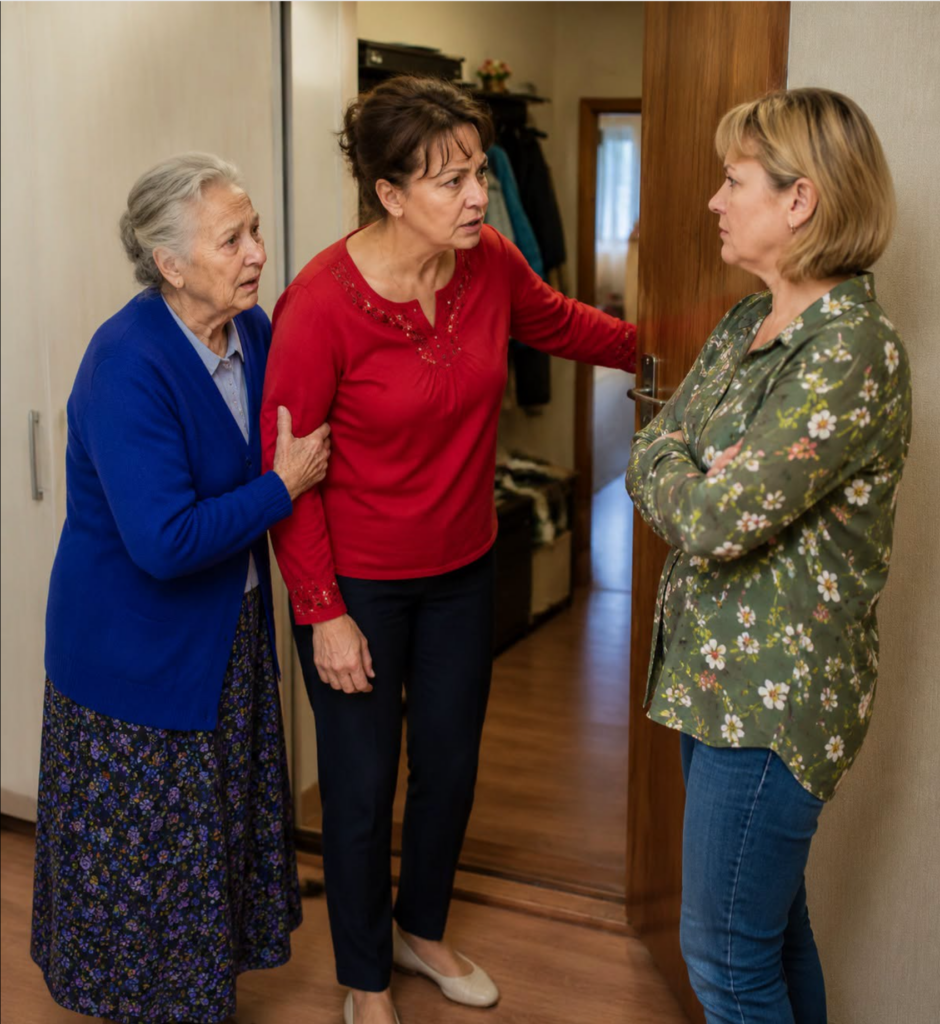
Nikolai stepped closer.
— “Len, did you do this? Seriously? The police? Against your own brother?”
I looked at him. There were many years of family memories between us, but for the first time I felt no guilt.
— “Not against you. For Mom.”
For a moment he just stood there. Then he turned away, as if the conversation no longer made sense.
— “Fine. Take her. Then she’ll come back when she ‘doesn’t understand the situation’ again.”
The words were cold. Not shouting. More like a certainty that he had already decided what to believe.
The officer gestured.
— “Valentina Sergeyevna, shall we proceed?”
My mother slowly stood up. Her movements were cautious, as if it wasn’t her body that had stiffened, but her trust. As I stepped beside her, she instinctively took my hand.
That gesture said everything.
In the hallway we passed the locked door. The key was still on the outside. The officer looked at it for a moment, then said nothing — he just made a note.
Then we left the apartment.
The air outside was colder, but somehow clearer. My mother stopped in the stairwell, as if she had forgotten how to keep walking.
— “Are we going home?” she asked quietly.
— “Yes,” I said.
But I already knew: that “home” was no longer the same place as yesterday.
At the police station there was no drama. That was the strangest part. A table, papers, questions, a report. As if they were examining a slowly unraveling fabric, not a family falling apart.
At first my mother was confused, but as she began to explain what had happened — the key, the phone, the pension, the “signatures” — her voice gradually grew stronger.
She didn’t shout. She just became precise.
Meanwhile I took out the documents: copies of bank accounts, authorizations I had never properly seen, strange transfers.
The officer took notes.
— “Did you sign all of these?” he asked my mother.
— “I don’t know… I remember some. But not like this… not how they showed it.”
That sentence was enough to make the report more serious.
Later, an older officer also entered. They spoke briefly, then looked at me.
— “Ma’am, this is no longer a family dispute category. Possible legal violations and financial abuse are also being considered.”
I wasn’t happy about it. No one is happy about a sentence like that. But somewhere deep down I still felt relief. Because finally someone had said it out loud: what I had been sensing was not an exaggeration.
It was evening when we left the building.
My mother sat in the car for a while, just looking at the street.
— “I didn’t want trouble,” she said quietly.
— “I know,” I replied.
— “I just… didn’t think it was so easy to lock someone in.”
I didn’t answer right away.
— “It wasn’t easy. No one just asked loudly enough.”
She looked at me.
— “What happens now?”
That was the question I had been avoiding all day.
— “Now you’ll be safe,” I said finally. “We’ll sort out the rest.”
But inside I knew that “sort out” meant months. Law, papers, arguments, and likely the final collapse of a family.
At home she sat down at the kitchen table. The same one where, in the morning, everything had still seemed normal.
— “My blue cup…” she said softly.
— “We’ll find it,” I replied.
She smiled, but it was a tired smile.
— “I thought in old age you don’t have to be afraid anymore.”
I couldn’t answer that.
I just sat down beside her and let the silence finally not be against her, but around her.
And for the first time that evening, what I was thinking about wasn’t what we had lost — but that we had finally managed to open the door that someone had kept locked from the outside for far too long.