At 68, Carol had never seen the ocean. For most of her life, the sea had existed as a distant promise—something softly spoken about, always postponed. Her late husband used to say he would take her “when things finally settled down.” But life never settled, and the promise slowly faded into a gentle ache she learned to live with.
So when her son Sam invited her to a family beach vacation in Florida, something inside her lit up. It felt like a second chance at an old dream. She imagined walking barefoot on warm sand, hearing waves roll in at night, and maybe—quietly—feeling close to her husband again through the place he never managed to take her.
Carol prepared like it was something sacred. She bought a wide-brim summer hat, packed light, airy clothes, and even let her granddaughter Susie convince her to paint her nails a bright “vacation pink.” For the first time in years, she felt like she was stepping into something joyful.
But the illusion cracked the moment they arrived at the hotel.
The lobby was bright, polished, and full of promise. Yet in the family suite, her daughter-in-law Jennie closed the door behind them and handed Carol a folded sheet of paper.
A schedule.
Carol unfolded it slowly. There were no outings, no dinners, no leisure time. Only blocks of duty. From 7 a.m. until late night, her role was clearly defined: childcare, cooking, cleaning, constant availability. Not as a guest—but as unpaid help.
Carol looked up, confused. Jennie’s voice was calm, but sharp.
“Now that we’re all here, you’ll help out. You know your place.”
The words landed like a weight in the room.
Before Carol could respond, her young grandson Matt leaned in and whispered something that cut even deeper than Jennie’s tone.
“Dad says you’re the helper.”
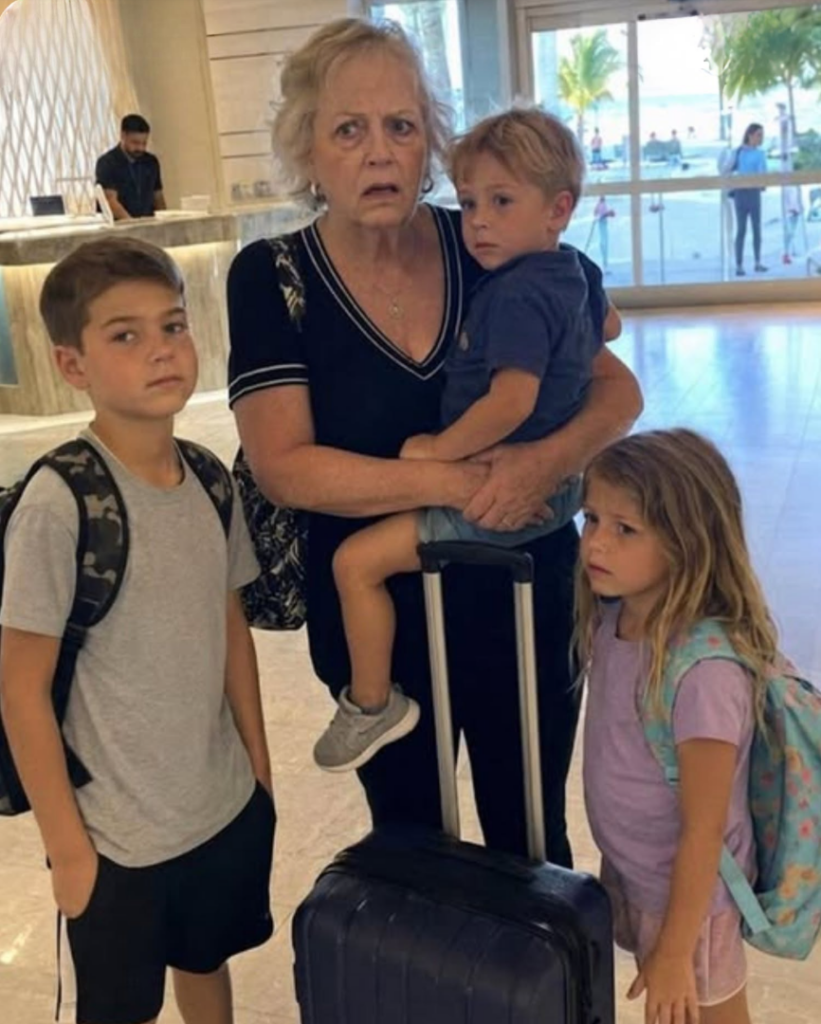
Something in Carol went still. Not anger—not yet. Something colder. Clearer. A realization that this wasn’t confusion or misunderstanding. It was a role they had already decided for her.
And then, instead of arguing, she chose silence.
Because silence, she understood, could also be strategy.
That night, Carol made a quiet phone call from the hotel bathroom. On the other end were her church friends—a tight-knit, unstoppable group known as “The Flamingo Six.”
All she said was: “I need you.”
And they came.
By morning, the hotel had changed.
The lobby erupted in color and chaos as six older women swept in wearing loud tropical prints, flamingo visors, and unapologetic confidence. One carried a karaoke machine. Another shook maracas like she was announcing a festival.
They didn’t ask permission. They simply took space.
Within minutes, the pool area had transformed into their domain. Eighties music played loudly, aqua aerobics spontaneously broke out, and laughter echoed across the resort. Carol, once invisible, suddenly found herself at the center—not as labor, but as someone being celebrated.
Every time Jennie tried to redirect Carol back toward childcare duties, one of the Flamingos would appear with perfect timing.
“She’s unavailable right now,” one would say sweetly. “Margarita mindfulness session.”
Or: “Occupational therapy: seashell edition.”
Sam tried to regain control, but quickly realized something unusual was happening. Not rebellion in the traditional sense—just a complete reordering of the environment around Carol, as if the rules no longer applied.
And for the first time in a long time, Carol laughed without restraint.
The rest of the trip shifted completely.
Sam and Jennie, forced to care for their own children, discovered how exhausting the “invisible work” really was. Every tantrum, meal, and mess became their responsibility.
Meanwhile, Carol finally lived the vacation she had been promised. She walked the shoreline at sunrise, felt the ocean breeze without obligation, and listened to the waves as if they were speaking directly to her.
The sea was no longer a symbol of loss. It was simply there—real, steady, alive.
On the final evening, the Flamingo Six took over a small stage by the pool. Without warning, they performed a slightly off-key but deeply heartfelt version of “Respect,” dedicated entirely to Carol.
The crowd applauded. Carol cried—not from sadness, but from something closer to release.
On the drive home, the car was quiet. Not peaceful exactly—but reflective.
Sam and Jennie eventually apologized. Not perfectly, not eloquently, but enough to acknowledge what had happened: they had mistaken her love for availability, and her presence for obligation.
Carol listened without interruption.
When she got home, she placed the seashells she had collected beside her husband’s photograph.
For a long moment, she just stood there.
Then she smiled.
Not because she had finally seen the ocean.
But because she now understood she never needed permission to reach it again.