Under the golden sky of an autumn morning, the village of Saint-Martin-sur-Loire seemed to hold its breath. It was as if everyone instinctively knew this day would be unforgettable: the wedding of Marie Lefèvre and Damien Dubois.
Marie was a gentle young woman with warm honey-colored eyes and a quiet kindness that made her beloved by the village. She had grown up among vineyards and country paths, always close to her family. Damien, a young engineer from Lyon, had met her during a local wine festival. One conversation, one shared laugh, and something irreversible had begun between them.
The Lefèvre family courtyard had been transformed into a dreamlike setting. Flower garlands hung between trees, long tables were filled with homemade dishes, and the air carried the scent of fresh bread, cheese, and slow-cooked meals. Everything felt simple, but deeply warm and sincere.
Then the Dubois family arrived.
The contrast was immediate. Elegant cars, polished appearances, and assessing eyes. Madame Dubois stepped out first, her posture rigid, her expression already distant. She looked around as though she had entered a world beneath hers. Her husband followed more quietly, visibly uneasy but composed.
The celebration began in joy. Glasses clinked, laughter filled the air, and Marie—radiant in her white dress—seemed to float through it all. She leaned toward Damien and whispered:
— “I’ve never been this happy.”
But suddenly, Madame Dubois’s voice cut through the music.
— “Excuse me. Everyone, please listen.”
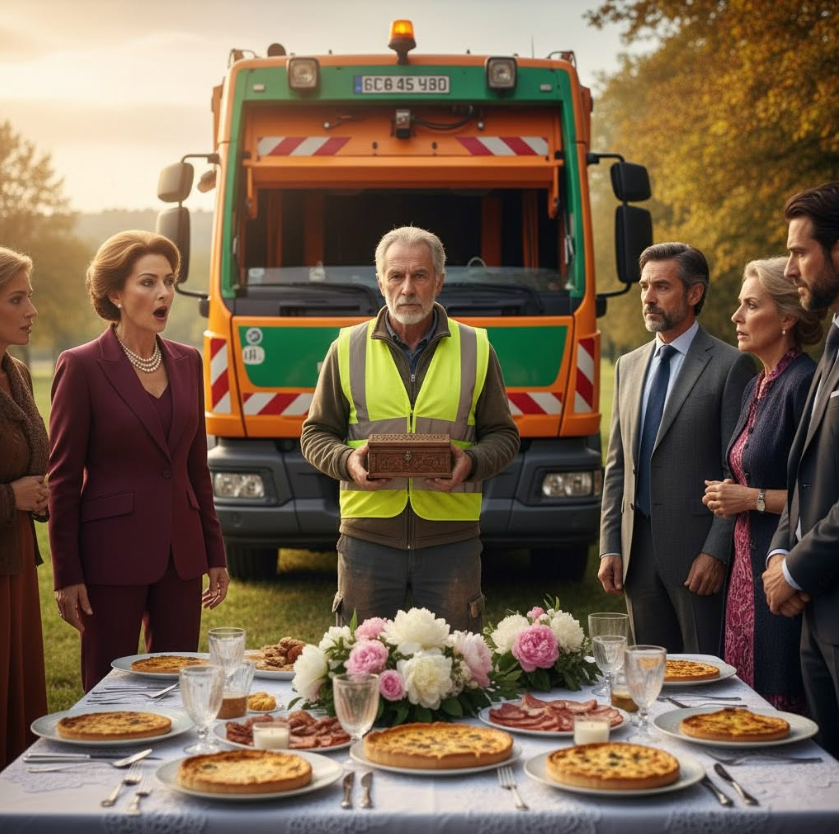
Silence fell instantly. Even the musicians stopped.
She rose slowly, commanding attention.
— “We have recently learned something that must be addressed publicly.”
A heavy tension settled over the crowd.
— “The bride’s father works at the municipal waste facility. He is a garbage collector.”
A murmur spread through the guests. Marie’s heart tightened.
— “In our family,” Madame Dubois continued coldly, “we have certain standards. This… is unacceptable.”
She lifted her phone and showed a photo of Jean Lefèvre in his work uniform beside a waste truck.
The silence became suffocating.
Marie’s mother stood up, trembling but determined.
— “Yes, my husband works with waste. But because of that work, he raised our daughter, paid for her education, and built our life with dignity.”
Some guests nodded quietly. Others looked down, uncomfortable.
But Madame Dubois remained unmoved.
— “Henri, we are leaving.”
Yet her husband did not move. He stared at the ground, shaken.
Then, from the distance, a deep engine rumble grew louder.
A garbage truck stopped in front of the house.
All eyes turned toward the street.
Jean Lefèvre stepped out calmly. He was still in his work clothes. In his hands, he carried a small wooden box.
He walked forward without hurry.
— “Since we are speaking about my job… let me speak as well.”
He placed the box on the table.
— “You think I am only a garbage collector. But I was not always this.”
A surprised silence followed.
— “Thirty years ago, I was a chemical engineer. An explosion trapped ten workers inside a facility. I entered the burning building to save them. I succeeded… but I lost my career and my health afterward.”
He opened the box: old documents, photographs, and a medal.
— “This medal was given to me for saving lives. And one of the men I pulled out of that fire… was Henri Dubois.”
The groom’s father went pale.
— “It was you…”
Jean nodded.
Shock swept through the crowd. The man they had just dismissed was the one who had once saved the family patriarch’s life.
The weight of the moment was overwhelming.
For the first time, Madame Dubois looked uncertain.
Jean continued softly:
— “I chose this work later. Because dignity is not defined by status. And because I wanted to raise my daughter without shame, only respect.”
He placed another document on the table.
— “This land belongs to me. I bought it little by little over the years. It is under Marie’s name, but she didn’t know. I never wanted her life to be measured by wealth.”
Marie’s eyes filled with tears.
— “Dad… why didn’t you tell me?”
— “Because your worth is not what you own. It is who you are.”
A deep silence filled the courtyard.
Henri Dubois stepped forward slowly.
— “You saved my life… and today, you remind me of something I had forgotten.”
They shook hands, both deeply moved.
Madame Dubois lowered her gaze.
— “I was wrong.”
Her voice was no longer sharp, only human.
Gradually, the tension dissolved. Music started again, conversations resumed, and the atmosphere softened—but everything had changed. It had become more sincere, more grounded, more real.
Marie hugged her father tightly.
— “I’m proud of you.”
Jean smiled gently.
— “Then everything is as it should be.”
Under the fading golden sky, the wedding became more than a celebration. It became a quiet lesson: true dignity is never defined by status, but by the courage and integrity of one’s heart.