Vera realized her marriage hadn’t ended in a courtroom, or at the registry office, or even the moment her husband András lied to her face. It ended on an ordinary Saturday morning when she opened the door to the apartment she had spent nine years saving for.
Nine years of sacrifices. Skipping vacations. Eating cheap meals. Taking extra shifts. Counting every single coin. All so she could finally have a place of her own.
She stepped inside—and froze.
In her kitchen, her mother-in-law was cooking.
In the living room stood a worn, unfamiliar sofa that definitely hadn’t been there yesterday.
A large traditional carpet hung on the freshly painted wall, completely changing the space she had carefully planned.
Shoes lined the hallway—men’s shoes, children’s shoes, bags, coats.
It wasn’t her apartment anymore.
It looked like someone else had moved in and simply forgotten to ask her permission.
A small boy looked up from the floor and said:
“Mom, the lady is here.”
Lady.
Vera stood motionless. The word didn’t even process at first. Her mind refused to connect it: a stranger being called “the lady” in her own home.
Then her mother-in-law, Tamara, appeared in an apron, as if she were hosting a family Sunday lunch instead of occupying someone else’s property.
“Oh, Vera dear! We thought you’d come tomorrow. We were told you’d be at work today.”
Vera’s voice came out quiet. Controlled. Dangerous in its calm.
“This is my apartment.”
Tamara waved her hand dismissively.
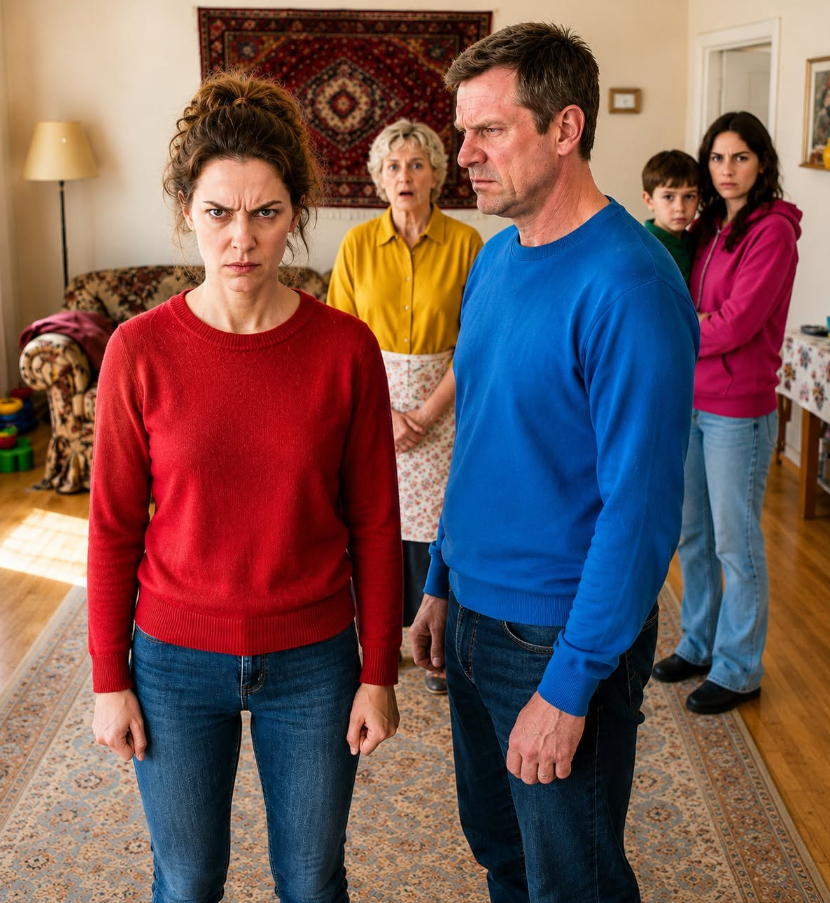
“Oh, well, for now it’s kind of shared. Until things settle.”
That sentence changed everything.
Not because it was loud. But because it erased her entirely.
Vera expected anger. But at first there was none—only a strange mental freeze, like her brain was trying to reboot.
Then clarity began to rise.
This didn’t happen without her husband.
András had given them the keys.
Without asking.
When he arrived, he didn’t rush in like someone fixing a disaster. He arrived carefully, as if hoping reality could be negotiated into something less uncomfortable.
“I didn’t want to upset you,” he said.
Vera looked at him.
“This is my apartment.”
“I know, but they’re in a bad situation…”
“So you moved them in above my head?”
He sighed. “We’re family.”
Vera gave a short, humorless laugh.
“No. You are family. I’m just the funding source.”
The rest of the day felt like a surreal invasion of normal life. Everyone acted as if they belonged there. As if Vera were the guest.
The grandfather drilled curtain rods into her walls.
The sister-in-law unpacked bags.
The child ran across her floor.
The mother-in-law cooked in her kitchen.
No one asked her anything.
“We’ll only stay a couple of months,” Tamara said casually.
“In your language,” Vera replied quietly, “’temporary’ means you ask first.”
András tried to stay neutral, but neutrality was already a choice—and not in her favor.
“You’re making this bigger than it is,” he said.
“No,” Vera replied. “You made it smaller by removing me from it.”
The breaking point wasn’t a scream. It was realization: everyone in that room had accepted her silence as permission.
So when Vera said they had two hours to leave, they laughed.
Then they got offended.
Then panic started.
And finally—movement.
The most unexpected moment came from András’s father. He stood in the middle of the room and said:
“This isn’t right.”
Silence fell instantly.
“We didn’t ask her. We just moved in. That’s not okay.”
For the first time, the illusion cracked.
Not everyone agreed. Not everyone understood. But something irreversible had shifted.
When they finally left, the apartment didn’t immediately feel like home again. It felt empty in a strange, bruised way.
Vera sat on the floor and looked at the marks they left behind: scratches on the wall, a sticky counter, displaced furniture.
This wasn’t just inconvenience.
It was violation.
And the person who opened the door wasn’t a stranger.
It was her husband.
The divorce didn’t happen instantly. It unfolded slowly—through legal conversations, arguments, silence, and repeated promises that came too late.
“I just wanted to help,” András kept saying.
“You don’t help by taking what isn’t yours,” Vera replied every time.
Eventually she went to a lawyer.
“Is the apartment in your name?” he asked.
“Yes.”
“Purchased before marriage?”
“Yes.”
The lawyer nodded calmly.
“Then there is no property dispute. This is not a financial conflict. It’s a boundary violation.”
That word stayed with her: boundary.
András kept trying. Flowers. Messages. Apologies.
“I’ll change,” he said.
Vera shook her head.
“It’s not about change. It’s about what you already did.”
The hardest moment wasn’t anger.
It was when she finally said:
“I don’t trust you anymore.”
And that was the end of it.
The legal divorce was quick. The emotional one wasn’t.
Slowly, the apartment returned to her. New furniture replaced the old chaos. Clean walls replaced borrowed memories. The space stopped being a battlefield and became hers again.
One evening her friend Nina visited.
“Are you okay?” she asked.
Vera looked around.
“Not okay,” she said. “But clear.”
“That’s good?”
“It means I don’t have to ask permission to exist in my own life anymore.”
And that was the beginning of something else.
Freedom, not as celebration—but as order restored.
András appeared once more later, standing outside her work with tired eyes.
“I miss you,” he said.
Vera looked at him for a long moment.
“No,” she said quietly. “You miss the version of me who accepted everything.”
And that was the last time they spoke.
Over time, the apartment stopped being a symbol of loss. It became just life. Hers.
She learned to say no without explaining it.
She learned that love without respect is not safety.
And that “family” is not a permission slip.
One evening, sitting by the window as sunlight fell exactly where she liked it, Vera realized something simple:
The important question was never who enters your life.
It’s who you allow to stay.
And for the first time, she understood:
Not everyone gets a key.
And that wasn’t loneliness.
That was peace.