I stood facing Artur, and for a moment I truly couldn’t comprehend that the man in front of me was the same one I had shared a home with—shared mornings, shared silence, and dinners that had long since stopped meaning anything.
He was calm. Too calm. As if nothing had happened. As if it wasn’t his forged signature on a contract that was now tearing my life apart piece by piece.
He turned toward the window. He always did that when he wanted to avoid responsibility—like the world outside the glass was more important than the consequences behind him.
And then something inside me broke. Not loudly. Not dramatically. More like something final snapping into place. Like thin glass finally giving up under pressure it had been holding for too long.
“Withdraw the money from the account,” I said quietly. “Reverse it. Now.”
He didn’t look at me immediately. When he finally did, there was a half-smile on his face—ironic, dismissive.
“Klára…” he said. “You don’t understand. I have connections. This isn’t something you just undo with a phone call. The advances are gone, the debts are settled. It’s done.”
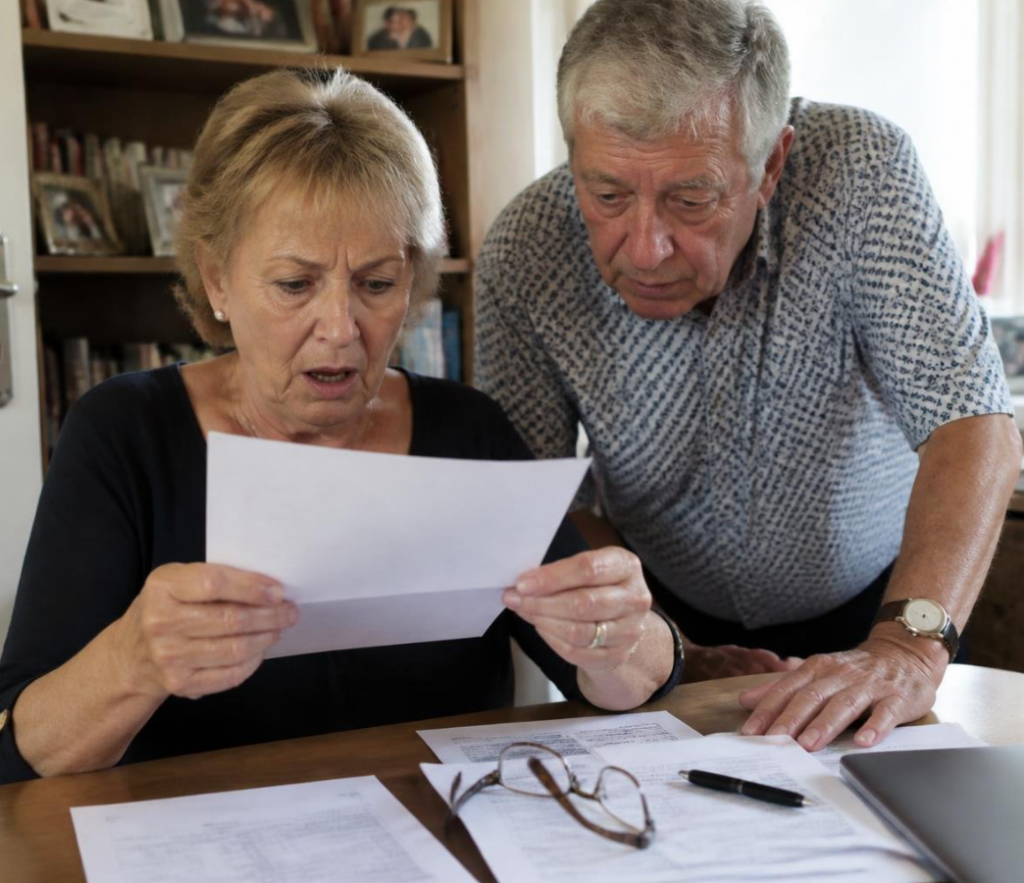
Very slowly, I placed the contract on the table.
“Then I’ll take back what’s mine.”
He didn’t respond. He just watched me leave, as if calculating whether I had suddenly become a problem he could no longer control.
In the kitchen, I took out my old phone—the one I only used for bills. My hands were steady. That was the strangest part.
I photographed every page of the contract. Every signature. Every detail.
Then the laptop.
I opened the land registry website.
And there it was.
A request for ownership transfer.
Submitted.
Not approved yet—but already in motion. Already alive.
There was no panic at first. Only silence. Then something sharper: clarity.
He hadn’t just lied.
He had already begun selling it.
Half an hour later, I stood at Lidia’s door. My neighbour—retired lawyer. She let me in without asking questions.
When she saw the documents, she didn’t speak at first. She just read.
Page after page. Her expression slowly changed.
“Klára…” she said finally. “This isn’t a family dispute. This is a criminal offence.”
I nodded.
“I know.”
“You must report this.”
“I will. But I need your help to write it.”
She didn’t hesitate.
We sat at the table and wrote the complaint together. With every sentence, I felt like I was taking something back—piece by piece, word by word.
When I returned home that evening, Artur was in the living room. The TV was off. A glass of wine in his hand, as if that alone could restore control.
“Don’t dramatize,” he said calmly. “Everything will sort itself out.”
I looked at him and, for the first time, saw not strength—but its cracks.
“It already has,” I said. “Just not the way you think.”
His brow tightened.
“What did you do?”
“I reported it. You’ll be at the police station at nine tomorrow.”
I placed the complaint on the table.
The silence that followed was heavy, suffocating.
“You have no idea who you’re dealing with,” he said. “I have people. I’ll fix this.”
“No,” I said quietly. “Not anymore.”
And I went to bed.
For the first time in a long time, sleep came without fear.
Morning arrived with police at the door.
Two officers. Calm, professional. Artur tried to maintain his composure, but his hands betrayed him—they trembled slightly.
He didn’t look at me when they took him.
And that, strangely, felt like the most important moment of all.
That evening, Lidia called.
“They stopped the registration,” she said. “It didn’t go through. You were just in time.”
I sat down then, and only then did exhaustion arrive.
Not relief.
Something quieter. Final.
I hadn’t just protected a piece of land.
I had protected myself.
A week later, he came back.
Not the same man. Something in him had collapsed.
“Why?” he asked simply.
“Because you sold me too,” I replied.
Silence stretched between us.
“I didn’t want to lose you,” he said.
“And I wanted to find myself again,” I said.
Then I left.
No slammed doors. No drama.
Because some endings don’t need noise to be absolute.
In autumn, I stood again beneath the old apple tree.
The ground was damp, the air heavy with earth and fading seasons.
And I understood then: what remained was not emptiness.
It was space.
And in that space, for the first time in a long time, I could begin again.