— Mom, will Grandma Nóra make something for me too? — Misi asked while I buttoned up his new shirt.
He stood in front of the hallway mirror, stretching his neck like a grown man preparing for an important meeting. The collar was stiff, but he didn’t complain.
On the table lay his drawing: a birthday card for his grandmother — a woman in a blue dress, a huge cake, balloons, and a small red cat in the corner, even though Grandma Nóra had never owned one.
Misi added it anyway, because every story needs something warm and alive.
I didn’t answer right away. There are moments when a mother knows the truth is too sharp for a child.
— Maybe she will, — I said finally.
Misi looked at me through the mirror. He no longer believed everything adults said, but he still hoped it would turn out well.
My husband, Sándor, appeared from the kitchen just then. He had heard the question. His face already carried that familiar tension—his mother’s celebrations always brought it out.
— Liza got a sled, Szonja got a dollhouse, and I got a half-finished maze book, — Misi said quietly.
Sándor swallowed.
— It was still a good book, right? You finished it.
The boy didn’t argue. He simply slipped the drawing into a folder, as if that could organize feelings too.
Even then, I knew: this was never about the gift. It was about belonging.
Grandma Nóra’s house was large, with heavy curtains, porcelain figurines, and rules that never needed to be spoken. On the walls hung framed photos of the “favored grandchildren”:
Szonja hugging her grandmother, Liza in festive clothes, always smiling, always chosen. Misi appeared in only one photo, standing slightly aside, as if he had wandered into it by accident.
In the car, he clutched his drawing tightly.
— Dad… what if she doesn’t like the cat? — he asked.
— She will, — Sándor said automatically, though his voice lacked certainty.
The house smelled of roasted meat, oranges, and sweets. The others were already there, as if we had stepped into a performance already in progress.
Grandma Nóra appeared later. She looked at the adults first, then at Sándor.
— Finally, — she said, as if we had been late.
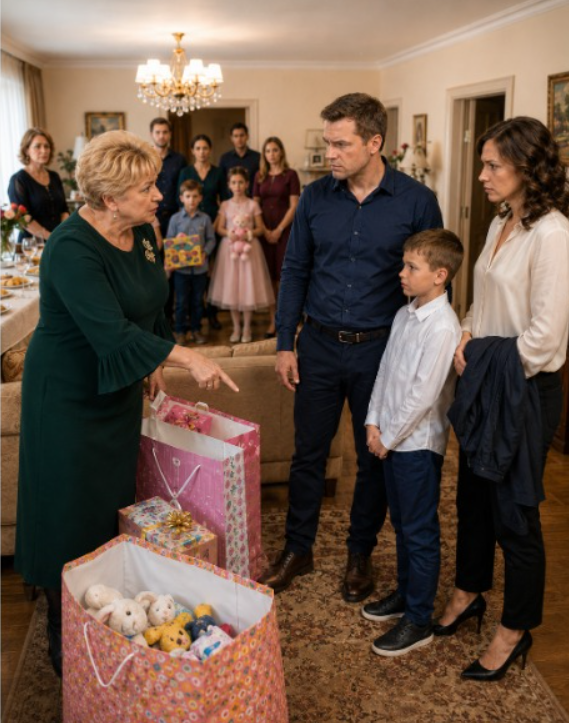
Then came the gifts.
Szonja got a glittering craft set, Liza received clothes and a book, the older grandchildren each had their packages. Misi stood still. He didn’t step forward. He simply waited.
Then it was said:
— There wasn’t enough.
For a second, no one understood. Then everyone did.
— Too many children, — Grandma Nóra added. — You can’t give to everyone.
The air froze.
— Mom… he is my son, — Sándor said.
— I know, — she replied coldly. — But things aren’t always equal.
And in that sentence lived everything she believed: hierarchy, entitlement, order.
Misi looked at me.
— So there wasn’t one for me?
It wasn’t accusation. It was confusion dressed as hope.
Sándor stood up.
— That’s enough, — he said. — He is my son. And I won’t pretend this is okay.
He didn’t shout. That made it worse.
The argument didn’t explode; it dismantled the room slowly. People looked away, shifted uncomfortably. Only Misi remained in the center.
Then we left.
In the car, he stayed silent for a long time, holding the drawing.
— Dad… if I get a gift later, do I have to be happy? — he asked.
Sándor answered after a pause:
— You don’t have to pretend anything that doesn’t feel good. Love isn’t an obligation.
At home, Misi carefully cut out the cat from the drawing. Slowly, precisely, as if rescuing it. Then he placed it on the shelf.
— This is the guard, — he said.
— What does it guard? — I asked.
— That everyone here matters.
Days passed in silence. No big drama, only distance. Then a letter arrived. Simple envelope, handwritten lines: an apology. Not perfect, not warm—but for the first time, not defensive.
Misi read it for a long time.
— I don’t know, — he said.
He didn’t have to decide.
By spring, Grandma Nóra came to our home. She brought no gifts. That was the condition.
Instead, she brought a drawing: a cat. Poorly drawn, with a crooked tail.
— I’m not good at drawing, — she said.
Misi looked at it.
— The tail looks like a carrot.
— I know, — she nodded.
And for the first time, she didn’t defend herself.
They sat at the table. Misi corrected the lines, explained, laughed a little. She listened.
It didn’t become a perfect relationship. No fairy-tale ending appeared.
But something else did: effort.
That evening, Sándor said:
— I used to think family is where you endure everything.
— And now?
— Now I think it’s where you don’t let a child grow up without a place.
Misi placed both cats on the shelf—the old cut-out one and the new drawing.
— This is the memory, — he said. — And this is the new one.
— What’s the memory? — I asked.
He thought for a moment.
— That sometimes I wasn’t given a place.
Then he shrugged.
— But I’m not there anymore.
And in that sentence, there was more strength than any adult explanation could hold.