After losing her mother to breast cancer, Claire’s world didn’t collapse all at once; instead, it slowly lost its familiar shape, layer by layer. In the weeks after the funeral, every movement, every sentence, every family gathering felt as if she were living someone else’s life. Her father became quieter, but not in the grief-stricken, broken way Claire expected—rather, he was tense and calm at the same time, as if he were constantly calculating something. And then there was Laura, her mother’s sister, who began appearing more and more often in the house—at first just “to help,” later almost as if she belonged there.
Three months after the funeral, her father’s announcement arrived like a poorly timed yet carefully prepared verdict. One evening, when the silence at dinner stretched too long, he set down his fork, looked at Claire and Robert, and said he was going to marry Laura.
The sentence wasn’t shouted, wasn’t dramatic, and yet it cut through the air like a blade.
The explanation came quickly. They said grief had brought them closer, that after her mother’s death they had found comfort in each other, and that this comfort had slowly turned into something deeper, unavoidable. The words were orderly, well-constructed, as if they had been rehearsed many times before. Claire listened, trying to hold on to the version in which this was only a distorted but still human story: two broken people finding each other in loss.
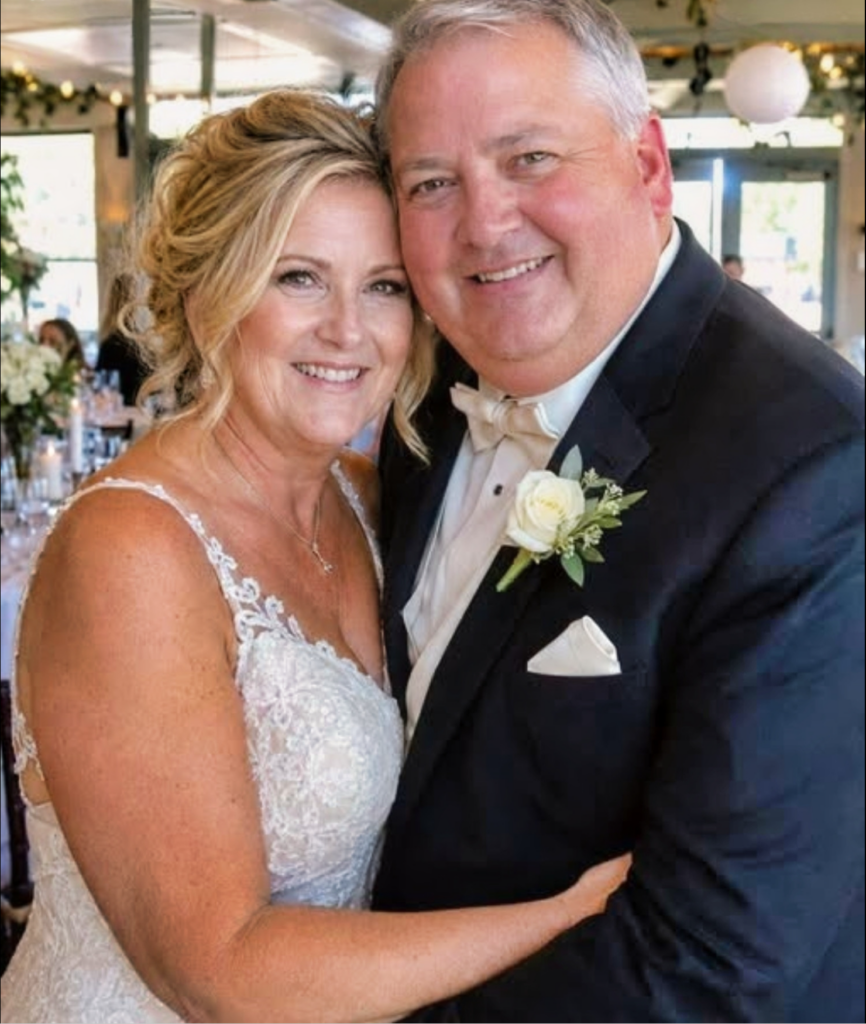
But something didn’t add up. The speed. The excessive calm. The way Laura was no longer moving through the house like a guest, but like a partner, as if her role had been assigned long ago and only now spoken aloud.
Robert remained silent, but his silence was not acceptance. It was observation.
The day of the wedding was clear, almost offensively bright. White chairs lined the garden, guests spoke in quiet elegance, as if nothing could happen on this day to disturb the order of the world. Claire moved between the decorated tables, sensing a tension behind every smile that others might not have noticed.
Then Robert stepped beside her.
He didn’t say much. Only that she should come with him. He led her to a secluded room in the house where the sounds of the outside world were muted, as if even the world itself respected what was about to happen there. Robert took a yellowed envelope from the inside pocket of his jacket.
“This is what Mom left behind,” he said quietly.
Claire’s hands trembled as she took it. The weight of the paper felt disproportionate, as if she were holding not paper, but the truth of an entire life.
The letter began in their mother’s handwriting.
There was no sentimentality. No farewell. Instead, a kind of cold precision, as if written by a lawyer or an investigator. And as Claire read, the lines slowly tore apart the story she had known until then.
Her father was not the man he pretended to be. According to the letter, he had been having an affair with Laura, her mother’s sister, for years. It was not a sudden passion, but a long, parallel life, carefully hidden from the family’s eyes. Her mother had already suspected it before her illness, but after her diagnosis everything had become clear to her.
And there was something even darker than that.
A child. A secretly kept life, recorded under another man’s name to avoid scandal. A truth carefully buried for years, like a mistake that should never have happened.
Claire felt as if the air in the room had suddenly become too dense.
But the letter was not only revelation. It was also a plan.
While fighting her illness, their mother had quietly and methodically rearranged the future. She had altered legal documents, reorganized inheritance arrangements. She left her entire fortune to Claire and Robert, strictly excluding their father and Laura from any inheritance whatsoever. She did not do it out of anger, but out of precision—like solving an equation that could only be closed this way.
The final lines of the letter did not threaten. They did not ask for anything. They simply stated a fact: the truth would come to light when her father took the step that would permanently seal his relationship with Laura.
When Claire returned to the wedding, the world looked the same, but nothing was the same anymore. Music played, guests laughed, the cake stood ready, as if waiting for the climax of a happy story.
Then Robert stepped forward beside her.
He did not shout. He did not create a scene. He simply held up the letter, and together with Claire, they spoke the truth. At first, the words fell into confused silence, then slowly the atmosphere shattered like a poorly held illusion.
Smiles froze. Glasses lowered. Their father’s face showed first confusion, then anger, and finally something like tired defeat. Laura did not look at anyone—not even for a moment—as if she were no longer part of the scene, only a role that had suddenly been forced to stop.
The romantic wedding turned into a public collapse within minutes.
Claire and Robert did not stay to watch the consequences. They didn’t need to. What they had needed to see, they had already seen: the story their family had told itself had never been real.
Months later, Laura disappeared from their lives quietly, without a trace, as if she had never belonged there. Their father remained alone in the house, where every object reminded him of what he had lost—not his wife, but the illusion behind which he had hidden himself.
Their mother’s final act was not revenge. Not anger. It was precise, cold justice. The closing of a story in a way that prevented lies from taking on new forms.
And although she was no longer alive, her presence could still be felt in every decision—as if, quietly, from the background, she were still holding together what remained of the truth.