Antal shoved the plate of cold scrambled eggs away with such force that the thin porcelain screeched across the glass table. The sound sliced through the silence of the kitchen like a blade. The bitter smell of coffee mixed with the tension that made Veronika’s chest tighten.
Beyond the window, gray November rain streamed down the glass, and inside everything felt too narrow, too cold, too dangerous.
“Do you even hear yourself?!” Antal’s voice exploded into a hoarse yell. “Who do you think you are to order me around? Your job is to cook, clean, and stop whining all the time!”
Veronika stepped backward. Her heel struck the cold tile floor. Her fingers twisted the kitchen towel so tightly it seemed to be the only thing still holding her together.
She had prepared for this conversation for an entire week.
Standing in front of the bathroom mirror, she had rehearsed the words over and over again. She wanted to stay calm. Gentle. Understanding. She believed that if she spoke carefully enough, she could still reach the man she had fallen in love with two years earlier.
But that man no longer existed.
“Antal…” she said quietly. “We’re a family. We can’t keep living like this. We need to move out. Living beside your mother… I’m suffocating.”
The man’s face hardened instantly.
“So now my mother is in your way?!”
“That’s not what I said…”
“Yes, it is!” He slammed his hand onto the table. “You’re ungrateful. You got everything from us!”
Veronika’s heart pounded wildly.
“I just want peace…”
Antal suddenly stepped toward her.
The movement was fast. Too fast.
His arm swung upward. Veronika instinctively recoiled, slipped on the parquet floor, and in the next moment she was falling.
The world shattered apart.
A dull crash.
Blinding pain.
Her head struck the sharp corner of the windowsill.
The last thing she saw was Éva Nádasdy’s pale face in the kitchen doorway.
Then everything went dark.
But once, everything had been different.
When Antal proposed to her by the Danube, Veronika had felt she had finally found home. Back then Antal laughed easily, paid attention to her, and brimmed with plans for the future. At night they took long walks and dreamed about the home they would one day share.
Veronika worked in a tiny pottery studio.
She loved the smell of clay. The steady hum of the wheel. The moment when something beautiful emerged from a shapeless lump.
Since childhood, she had dreamed of having a family.
Her parents were gone. She had no one left except a distant aunt living on the other side of the country.
So when Antal said:
“Let’s stay at my mother’s place for a few months until we get back on our feet.”
Veronika agreed without hesitation.
The apartment was enormous, with old bourgeois ceilings and dark wooden furniture. Everything smelled faintly of mothballs and old books.
And in every corner hovered Éva’s presence.
On the very first day, the woman looked Veronika up and down.
“Are you really going to marry her?” she asked her son, as if Veronika were not even there.
At the time, Antal laughed.
“My mother is like this with everyone.”
But Éva never changed.
In fact, she became worse.
She criticized everything.
The soup was too salty.
The towels were arranged incorrectly.
There was dust on the floor.
The mugs were not lined up evenly.
Veronika tried her best.
On weekends she baked apple-cinnamon pie. She woke up at dawn to clean. She smiled even when she wanted to cry.
But Éva’s gaze always remained just as cold.
One day Veronika bought a turquoise tablecloth with tiny golden patterns using her salary. She wanted to bring a little life into the gloomy apartment.
Éva lifted the fabric with two fingers.
“You have horrible taste.”
That evening Veronika tearfully told Antal what had happened.
His face reddened with anger.
“You should be grateful you can live here at all! Without my mother, you’d have nothing!”
Then he grabbed his car keys and stormed out.
He came home at dawn.
His shirt reeked of alcohol and unfamiliar women’s perfume.
That was the first time Veronika cried silently into her pillow.
And not the last.
The bedroom door opened quietly.
Éva stood there.
“You can’t keep a man,” she said coldly. “You’re too weak for this life.”
From that day on, everything only got worse.
Antal stayed out late every night. He constantly stared at his phone. Strange women’s names flashed across the screen.
Veronika buried herself in overtime work at the studio.
At least there she found peace.
The clay did not hurt her.
The wheel did not scream at her.
The cups did not humiliate her.
But at home, every evening felt like she was slowly disappearing.
And then came that morning.
The plate of scrambled eggs.
The shouting.
The fall.
When Veronika woke up, the smell of disinfectant and medicine hit her.
She was in a hospital.
Her head throbbed painfully.
Slowly she sat up, then stepped uncertainly into the hallway.
Soft voices drifted from the nurses’ station.
And then she heard Éva’s voice.
But it sounded completely different.
Broken.
“Doctor… please… help her…” the older woman whispered. “She’s still so young.”
Veronika froze.
“Where is your son?” the doctor asked.
A long silence followed.
Then Éva spoke softly.
“My son became exactly like his father.”
Bitterness filled every word.
“Selfish. Cowardly. My husband treated me the same way. I endured it for years. By the time I finally escaped, there was nothing left inside me… only coldness.”
Her voice trembled.
“When I saw Veronika… I saw myself in her. I thought if I was harsh enough, she would leave this place. I thought she would save herself from what my son would eventually do to her.”
Éva began to cry.
Really cry.
“But instead of saving her… I hurt her too.”
Veronika slowly slid down the wall onto the floor.
It felt as though everything she had believed suddenly collapsed inside her.
Two weeks later, she was discharged from the hospital.
Antal never visited her once.
He did not call.
He did not write.
As if Veronika had never existed.
Éva came to pick her up in a taxi.
At home, the smell of warm honey tea and baked apples greeted her.
For the first time, the apartment no longer seemed so cold.
“I’ll look for a place to rent tomorrow,” Veronika said quietly.
Éva slowly turned toward her.
“Why would you leave?”
Veronika stared at her in shock.
At that moment the front door burst open.
Antal walked in.
Beside him stood a tall blonde woman in a red coat. Her strong perfume instantly filled the apartment.
Grinning, Antal tossed down his bag.
“Finally, you’re home. Pack your things, Nika. Inessza is moving in from now on.”
The woman looked around smugly.
Éva slowly stood up.
The silence almost hurt.
“Antal,” she said quietly. “Have you completely lost your mind?”
“Oh, come on,” he waved dismissively. “Veronika leaves, Inessza stays. Simple.”
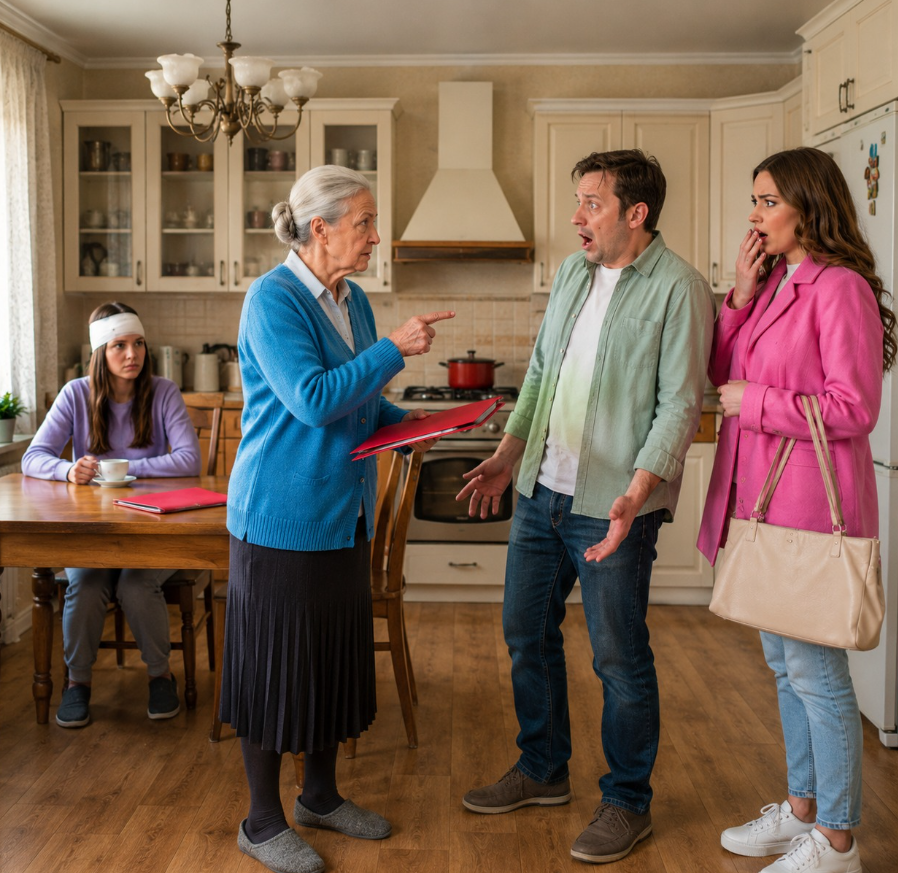
Éva pulled out a red folder.
She threw it onto the table.
“No. Veronika stays. You leave.”
Antal laughed out loud.
“Is this some kind of joke?”
“No.”
Éva’s voice was as cold as ice.
“The apartment is in my name. You own nothing here.”
Antal’s face turned pale.
“And one more thing. The car loan I’ve been paying for you? Starting tomorrow, you’ll pay it yourself.”
Inessza turned toward Antal in disbelief.
“You told me the apartment and the car were yours…”
“Shut up!” Antal shouted at her.
But Éva was not finished.
She pulled out another document.
“I transferred my country house to Veronika. At least she should have a safe home.”
A frozen silence fell over the kitchen.
It was as if all strength drained from Antal’s body.
Disgusted, Inessza snatched up her handbag.
“I’m not going to struggle beside some bankrupt loser.”
The door slammed behind her.
Slowly, Antal dropped to his knees.
“Mom… please…”
Éva stepped back.
“You have fifteen minutes. Leave the key in the hallway.”
Two years passed.
Sunlight fell in golden stripes across the shelves lined with cups and vases.
Veronika sat beside the pottery wheel in her own ceramic studio.
She was smiling.
Truly smiling.
Behind her, a quiet, gentle man prepared tea. He was the kind of person who loved not through loud words, but through small acts of care.
The door opened softly.
Éva Nádasdy stepped inside carrying a basket of fresh pastries.
Beside her, a small blond boy toddled along holding her hand.
“Grandma!” the child laughed.
Éva laughed with him.
Honestly.
Freely.
Veronika wiped her clay-covered hands on her apron and walked toward them.
Because in the end, she understood something important:
not every family is the one we are born into.
And sometimes the people who save us are the very ones who once caused us pain — because they are the ones who learn, far too late, how to truly love.