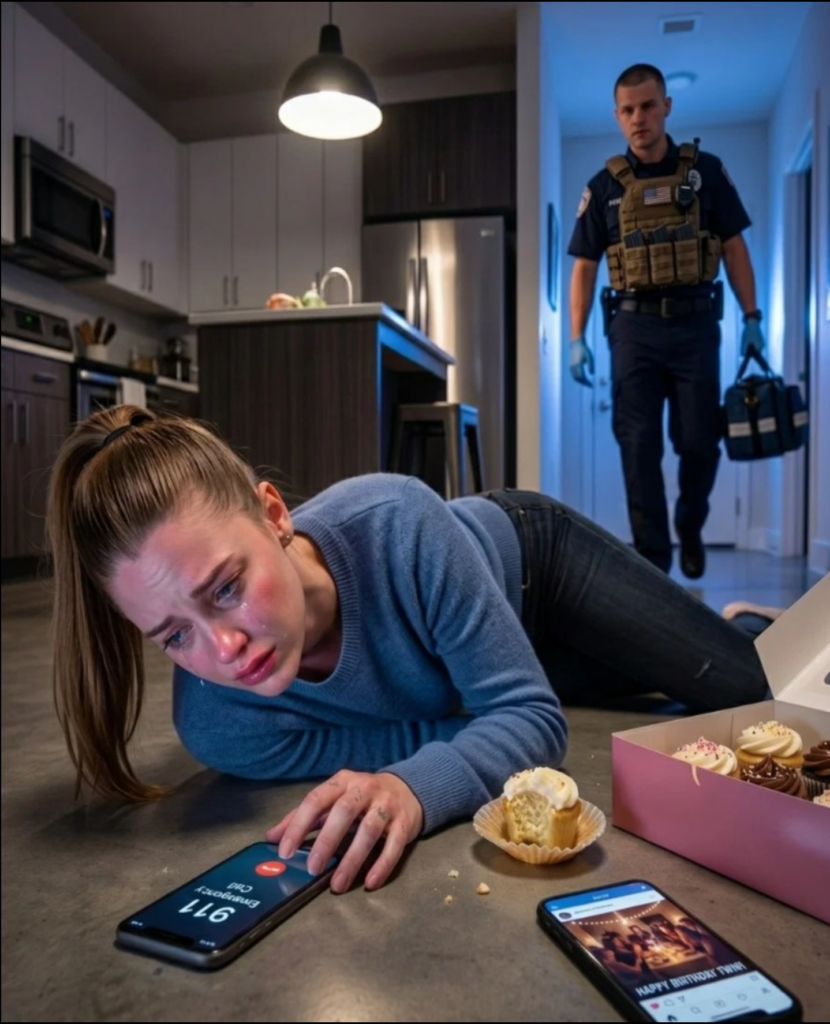
The emergency call went through while I was already lying on the cold kitchen floor, gasping for air that no longer reached my lungs.
My throat was swelling shut. Every breath burned. Through my blurred vision, the half-eaten vanilla cupcake lay in front of me like silent evidence of something far more serious than an allergic reaction.
“Are you alone?” the dispatcher asked.
“Yes…” I managed to force out.
Then there was a short pause. Too short to be harmless.
And then she said something that cut deeper than the fear of suffocating itself.
“Ma’am… your sister already called us.”
My twin sister.
The dispatcher carefully explained that Harper had claimed I had a history of exaggerating allergic reactions to get attention.
Dazed, I stared toward the kitchen counter, trying to understand how Harper even knew I was in danger.
I had told no one I was alone.
I hadn’t told anyone I was going to eat the cupcake.
And yet she had called emergency services before I did.
Ten minutes later, paramedics stormed into my apartment. By then my lips were numb, my chest felt crushed under a weight, and the world was fading.
In the ambulance, a paramedic named Daniel pressed the oxygen mask tighter to my face while epinephrine slowly began to work.
Then he looked at me seriously.
“You’re not imagining it,” he said calmly. “Your oxygen level was dangerously low.”
He hesitated briefly.
“And your sister’s first call unfortunately made the situation seem less urgent.”
That should have been the worst moment of my life.
But it wasn’t.
The worst moment came later.
When I realized this hadn’t started with a cupcake.
Four weeks earlier, my grandmother Eleanor had suffered a stroke. I was the first to arrive at the hospital. I held her hand as she slipped into a coma. For years I had been the one managing her groceries, sorting her medication, and filling her lonely afternoons with conversation.
My mother rarely visited.
Harper almost never did.
When they finally arrived at the hospital, my mother didn’t even ask how Eleanor was doing.
Her first question was about the will.
The next evening she organized a so-called family meeting. In reality, it was a performance meant to present Harper as the “responsible daughter” and appoint her as medical decision-maker.
In between, my mother casually mentioned Harper’s big birthday party.
Our birthday.
We were twins.
Same day. Same blood. Same family.
“And what about me?” I asked.
My mother just waved it off.
“You never liked parties anyway.”
The night before our birthday, a pink box suddenly appeared at my apartment door.
Cupcakes.
With a small note.
*Happy Birthday.
Maybe we can start over.
– Harper*
They came from the only bakery I trusted. The only place in the city that guaranteed nut-free baking.
I should have thrown the box away.
But loneliness makes people vulnerable.
And that night, I was more vulnerable than ever.
The next day, no one contacted me.
No call.
No message.
No birthday wishes.
Only photos on social media of Harper’s huge party—golden lights, laughing guests, champagne glasses, and a perfect three-tier cake.
I sat alone in my silent apartment.
So I placed a candle on a cupcake, lit it, and whispered to myself:
“Happy birthday.”
Then I took a bite.
At first it tasted like vanilla.
Then almond.
And my body understood before my mind did that I might die.
When I woke up hours later in the hospital, with IVs in my arm and pain in every part of me, the truth hit me like a blow:
This was not an accident.
Daniel came back into my room later.
“Did your sister know about your allergy?”
I nodded slowly.
“Since we were children.”
He didn’t need to hear more.
The next morning Harper arrived with tearful eyes, white lilies, and a perfect performance of a concerned sister. My mother played her role just as convincingly.
“She was just trying to help,” she told everyone in the hallway.
I said nothing.
I watched.
After they left, I showed Daniel the photo I had taken of the cupcake box before eating.
The label of the supposedly safe bakery looked slightly off.
Daniel carefully peeled it back.
The sticker came off.
Underneath was the real logo.
A bakery known for almond creams and nut-based desserts.
The room went silent.
Someone had swapped the label.
Someone had wanted me to trust it.
And in that moment, my fear turned into something else.
Clarity.
With help from an old shared account my mother had never properly secured, I eventually found messages never meant for my eyes.
Messages between Harper and my mother.
About almond flour.
About my allergy.
About a plan to call emergency services first so I would look hysterical.
But one message froze my blood completely:
“If she dies, she can’t inherit anything.”
I read it over and over.
Not out of shock.
But because my mind refused to accept that a mother could write something like that about her own child.
That same week, I met my grandmother’s lawyer.
And there I learned the truth.
Eleanor had changed her will.
Everything went to me.
The house.
The fortune.
Everything.
They knew it.
And they had decided to get rid of me before it became official.
So I organized one final family meeting at the hospital.
Everyone came.
My mother.
Harper.
Aunts, cousins, relatives.
The lawyer calmly read the new will. Immediately, chaos broke out.
“That’s fake!” Harper screamed.
My mother went pale.
Then the lawyer produced a letter.
A personal letter from my grandmother.
And suddenly the room fell silent.
Eleanor wrote that love is not shown through words, but through who stays when it becomes inconvenient.
She wrote that I was the only one who never asked for anything.
And she wrote one sentence that destroyed my mother:
“Victoria never learned to love without expecting something in return. And Harper learned to become like her.”
Then I handed over the messages.
No one spoke.
No one could.
And in that moment, a weak voice came from the hospital bed.
“Victoria.”
My grandmother was awake.
Her eyes were clear.
No confusion.
No weakness.
Only truth.
She looked at my mother, and for the first time in my life, nothing was twisted, hidden, or softened.
Everything was exposed.
What followed was not a dramatic finale.
It was something far heavier.
Finality.
Investigations began.
Evidence was collected.
Charges were filed.
My father left my mother a few weeks later.
And I slowly began rebuilding something from the ruins of my life.
I moved into my grandmother’s house.
Not as a victim.
Not as a survivor.
But as someone who finally understood that family is not defined by genetics—but by the people who would never destroy you just to win.
I didn’t seek revenge.
I chose distance.
Because sometimes the most powerful thing a person can do is very simple:
Survive what was meant to destroy them—
and still not disappear.