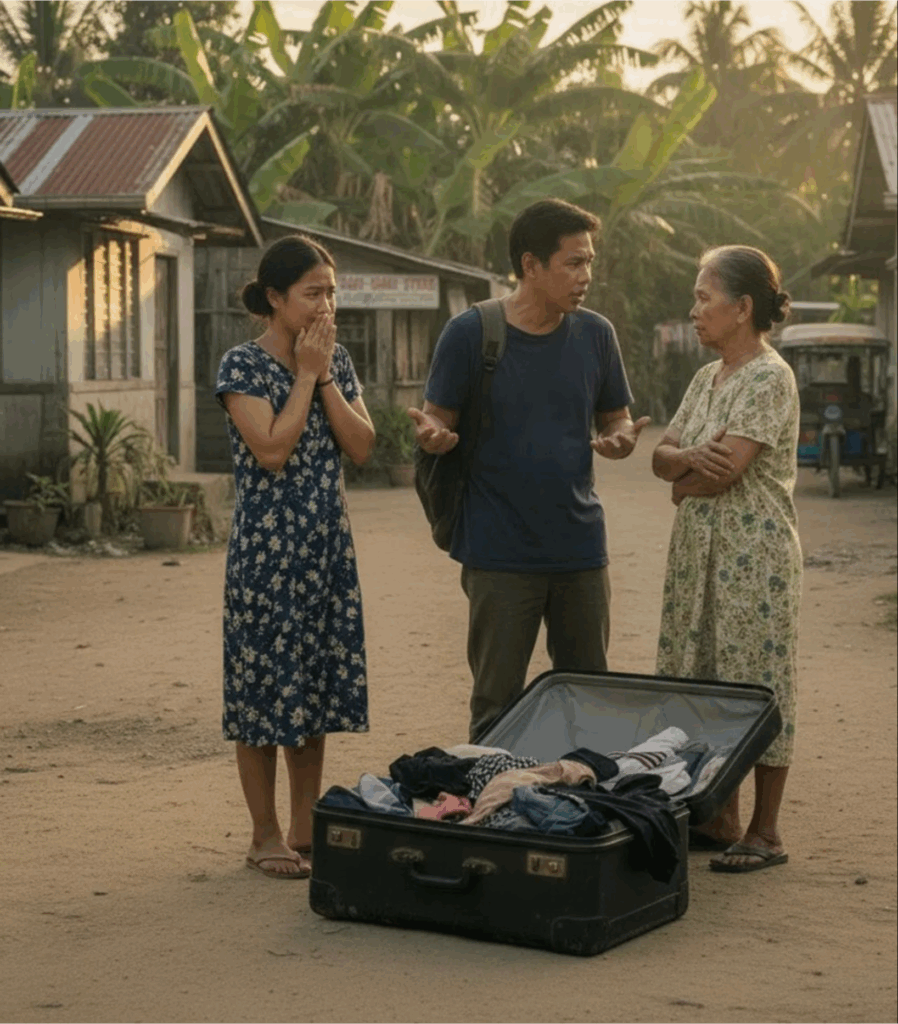
Eugenia Pavlovna Kolganova never imagined that at the age of fifty-three she would earn her living as a night watchwoman at a cemetery. For thirty years she had worked in the library of the Belogorsk school:
sorting dusty books, teaching children the value of silence, and believing that life was predictable. Then her husband ran away with a young shop assistant, her savings disappeared, and the school laid her off under the excuse of staff reductions.
“What am I supposed to fear?” she muttered before her first shift, pulling on her old boots. “The dead never hurt anyone. The living are far more dangerous.”
The “Old Pines” cemetery lay on the edge of town. Dense forest surrounded it on three sides, while rusted factory buildings stood on the fourth. The guard booth was a crumbling metal shack: inside were a squeaky iron bed, a kettle, an old television, and four security camera monitors.
The first evening passed quietly. Eugenia drank tea and occasionally glanced at the black-and-white screens. On one, the wind stirred the dry grass; on another, an angel statue cast a long shadow.
But exactly at midnight, a figure appeared on one of the monitors.
Eugenia froze. She knew the gate was locked, and the key was still in her pocket.
The shadow stood motionless beside a distant grave beneath an old birch tree.
At that same moment, dogs raced past the guard booth, barking wildly. Five large dogs, as though fleeing from some invisible danger.
The next morning, Eugenia wrote a resignation letter.
“A shadow scared you?” grumbled her boss, Boris Ilyich, a former soldier. “Tonight we’ll install another camera. Then we’ll see what it really is.”
The new camera faced a black granite grave. According to the inscription, a father and his son were buried there:
The father had survived his son by only one month.
The following night, Eugenia watched the monitor with growing tension. She placed a flashlight on the table beside an old hunting knife.
At exactly midnight, the figure appeared again.
But this time it did not stand still. It knelt beside the grave, while four dogs lay around it like guards.
“It’s a person…” Eugenia whispered.
Gathering her courage, she grabbed the flashlight and walked toward the grave.
One of the dogs immediately growled. It was a huge gray animal with a wolf-like muzzle.
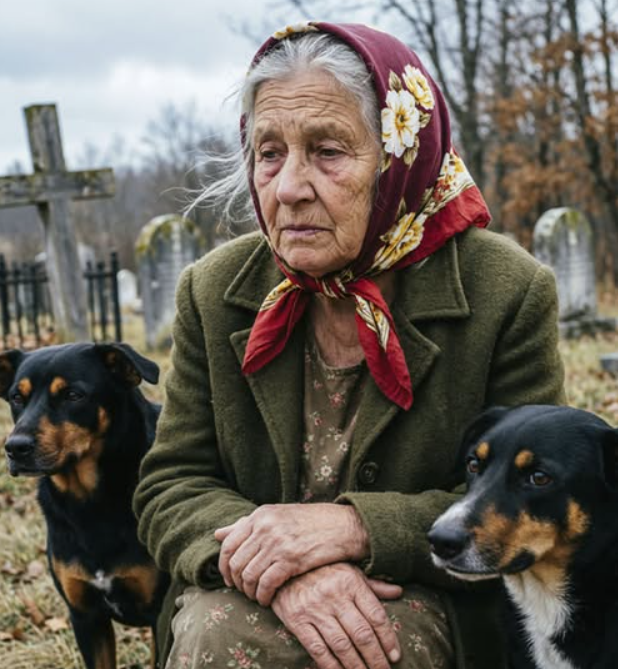
“Quiet, Rex,” an elderly woman said softly. “She won’t hurt us.”
The woman was small and bent with age, but there was a strange strength burning in her eyes.
“Why are you here?” Eugenia asked cautiously.
The old woman smiled bitterly.
“I’m not afraid of the dead. The living have already done everything possible to me.”
Eugenia invited her into the guard booth for a cup of tea.
There she learned that the woman’s name was Klavdia Petrovna Gromova. The man and soldier buried in the grave had been her husband and son.
“My son died in Afghanistan,” she said quietly. “My husband died one month later from grief.”
She had lived alone for forty-three years. She had one grandson, Denis, in whom she placed all her hope.
“When I turned eighty-six,” Klavdia confessed, “he told me: ‘Grandma, I need your apartment. You can choose — a nursing home or the cemetery.’”
Eugenia listened in horror.
“I was afraid,” Klavdia admitted. “He called me every day. He hung a calendar on the wall and forced me to tear off the pages. Like a countdown to my death.”
In the end, the old woman fled to the cemetery. The dogs became her only companions.
Eugenia felt her heart tighten with pain.
“You can’t stay among the graves,” she said firmly. “You’ll sleep in the booth at night.”
From then on, they spent their nights together. They drank tea, shared old stories, while the dogs slept beside the iron stove.
Klavdia had once been a literature teacher. Eugenia realized they had worked at the same school years earlier.
“Do you remember Andrei Korolyov?” Eugenia asked one evening.
The old woman nodded with a smile.
“The quiet boy who was always reading books. I knew he would become a good man.”
Andrei later became a district police officer.
But one rainy night, Klavdia never arrived at the booth.
Terrified, Eugenia ran to the grave.
The old woman lay unconscious on the cold ground, burning with fever. The dogs stood guard around her, as if refusing to let anyone take her away.
An ambulance rushed her to the hospital with life-threatening pneumonia.
For twelve days she remained unconscious.
On the thirteenth day, she finally opened her eyes.
“Call Andrei…” she whispered.
When Andrei Korolyov arrived, he quietly sat beside her bed.
“I investigated everything,” he said softly. “Denis died six months ago. A heart attack. His wife moved away. And there’s something else you should know.”
He pulled out an old letter.
“Before your son Fyodor left for the army, he was in love with another woman. She was carrying his child. A daughter was born… your granddaughter.”
Klavdia stared at him in shock.
“I have family? They’re alive?”
“Yes. And they want to meet you.”
The old woman began to cry slowly. Not loudly — just quietly, as though forty-three years of pain were dissolving all at once.
A month later, she was discharged from the hospital.
At the entrance, Eugenia stood waiting with the four dogs. Beside her stood a dark-eyed woman with three laughing children.
“Grandma,” the woman said through tears. “We searched for you for so long.”
Klavdia embraced them with trembling hands.
She never returned to her old apartment. Instead, she moved in with her granddaughter, into a warm house that always smelled of fresh pastries, where four soft beds awaited Rex, Dina, Graf, and Tuzik on the veranda.
And Eugenia remained at the “Old Pines” cemetery.
But she was no longer afraid of the night.
Because she had learned that sometimes, in the loneliest places, a person finds what they have been searching for all their life: another human being who does not turn away from them.