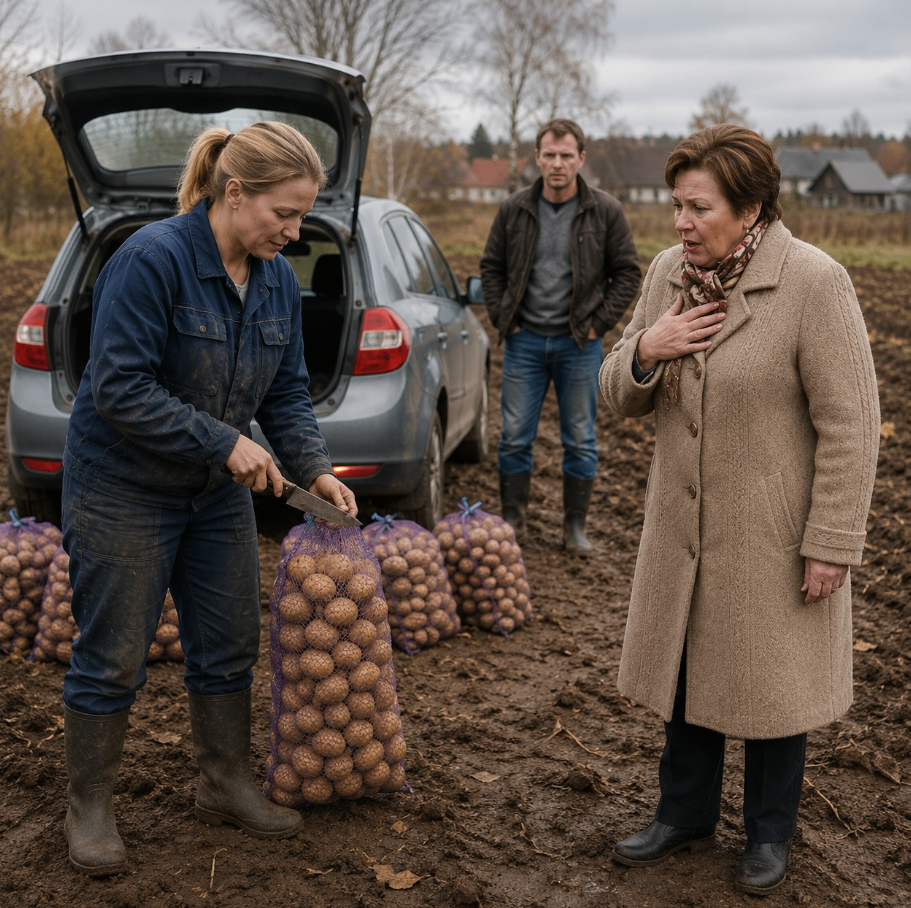
— “For these potatoes, Svetochka, you can transfer the money to my card via phone number,” Ludmila Borisovna said, her voice flowing softly, almost syrupy. She gracefully shook off her plump hands, her freshly done French manicure glinting in the pale autumn light.
“You are an educated girl with a university degree. You surely understand: in this world, everything has its price.”
Her words fell into the cool air of autumn—heavy, ordinary, and strangely unreal.
I was standing in the middle of a plowed field in the settlement called “Pine Grove.” In my hands was a heavy plastic bucket filled to the brim with golden, carefully selected potatoes. My palms burned with blisters; damp soil had worked itself deep under my nails.
My back ached so badly I wanted to collapse right there among the rows and not move again.
All of this harvest had been my idea. My attempt to build a relationship with my husband’s mother.
Back in March, Ludmila Borisovna had dramatically complained during Sunday lunches about her aching back. She sighed about the unused land, about her small pension, about how vegetables had become too expensive.
I, a finance department head used to numbers and strict schedules, suddenly decided to help. I offered to plant potatoes, greens, and tomatoes myself.
“Oh, Svetochka, you’re such a treasure!” she had cooed then, pouring tea into delicate porcelain cups.
And so I threw myself into it. Every weekend from May onward, I woke at dawn. While my husband Maxim slept in after business trips, I drove out to the countryside.
I brought everything: premium seeds, rolls of protective covering. I took off my business clothes, put on worn T-shirts, and went straight into the soil. I weeded stubborn grass until my hands bled with effort. I carried heavy watering cans whenever the village pump stopped working.
And Ludmila Borisovna? She came only on Sundays, right at lunchtime. She sat in a wicker rocking chair, placed a plate of cookies beside her, and “supervised” the entire process.
— “Svetа, you’re digging too shallow!”
— “Svetа, you’re hilling it wrong—you’re losing all the moisture!”
She never once touched a tool. Yet every time neighbors passed by, she proudly declared: “Look at the harvest my son Maxim and I grew!” Not a word about me.
And now September had come. I took two days off to dig everything up before the heavy rains. I worked alone, turning over every row. Looking at eight full, tightly packed sacks, I felt a strange, almost primal pride.
And now, standing by the car trunk, I heard a demand for payment.
“Excuse me, I don’t understand,” I asked quietly.
She wasn’t at all embarrassed. She pulled a small notebook with gold embossing from her coat pocket.
“You understand perfectly, Svetochka. Whose land is it? Mine. You used my water from my well. If you want to take the sacks to the city, you must compensate for resource usage. It’s simple economics.”
I slowly lowered the bucket.
Maxim was standing two meters away. He nervously wiped the car’s side mirror, pretending not to hear.
“Maxim,” my voice trembled despite me. “Do you hear what your mother is saying?”
He turned reluctantly, shifting his weight, avoiding my eyes.
“Well… Mom does have a point. It is her land. We used someone else’s property. Just transfer it—we won’t go broke.”
A burning wave rose through my chest.
“Ludmila Borisovna,” I stepped closer, “when you complained about your health in spring and asked for help, you forgot to mention this was a paid land lease agreement?”
She adjusted her silk scarf.
“I’m giving you the vegetables at cost. Twenty-five thousand for everything. That’s already a family discount.”
“A family discount?” I echoed.
“Don’t start,” Maxim muttered. “Just transfer it. Why make a scene? It’s just potatoes.”
I looked at the sacks. Each one represented weeks of exhausting labor under the sun. To him, they were just potatoes. To me, they were humiliation.
“Alright,” I said quietly. “Let’s calculate this like real economics.”
I pulled out my phone.
“My expenses: premium seeds—seven thousand. Fertilizer—six thousand. Fuel for all the trips—about forty thousand for the season.”
I looked up at her.
“And most importantly, my labor. Twenty weekends. Ten hours each. Based on my salary as a finance director, my work here is worth two hundred fifty thousand.”
I paused.
“Total: three hundred three thousand. Minus your twenty-five thousand. You owe me two hundred seventy-eight thousand rubles.”
Her face flushed deep red.
“Are you insane?!”
“You were the ones who turned this into accounting,” I replied evenly.
Maxim grabbed my shoulder.
“Svet, stop!”
I shook him off.
“Respect has to be earned.”
Then everything escalated.
I pulled out a sharp garden tool and sliced open the first sack. Then the second. Then the third.
Potatoes spilled out like a heavy golden waterfall onto the wet soil, rolling into puddles, sinking into mud.
“You’re crazy!” Ludmila Borisovna screamed.
“If this is your economy,” I said calmly, cutting open another sack, “then it belongs back to the ground.”
Maxim rushed toward me.
“Stop!”
“I already stopped, Maxim. I’m not running anymore.”
Sack after sack collapsed into messy piles on the earth. Inside me, there was no panic anymore—only cold, precise calm.
“You ungrateful girl!” she shrieked. “We let you into our family!”
“You let my wallet into your family,” I said, dropping the tool.
She dropped to her knees in the mud, desperately gathering potatoes into her expensive coat.
“Let’s go,” I said to Maxim, opening the car door.
“What about Mom?”
“Stay. Help her collect her capital.”
The drive home was silent.
A week passed like a heavy echo. Then the second battle began—paperwork, demands, threats.
But in the end, something shifted.
We bought a small piece of land the following spring. And there, nothing grew anymore except flowers.