Commander Alejandro Martínez first felt it not as a clear thought, but as a subtle shift in the cabin’s atmosphere—like the aircraft itself had, for a brief moment, lost its internal balance.
The card Elena Vázquez held in her hand looked entirely unremarkable at first glance. No gold trim, no logos, no symbols of authority. Yet the name on it…
Elena Vázquez.
Majority shareholder.
A name that did not simply exist in Martínez’s world. He knew it from confidential reports, high-level briefings, and documents that were never meant to be connected to a face. And that was what made the moment so unsettling: that face was now real. Right in front of him. Inside his cabin.
For a brief second, the commander could not speak. A man trained for emergencies, turbulence, and crisis decision-making suddenly found himself in a situation without procedure, without protocol, without a script.
Victoria reacted first, but her confidence had already begun to fracture. Her eyes moved uneasily between her husband, Elena, and the airline director, who now stepped forward with visible tension, as if trying to contain something already slipping out of control.
“Commander… I think we should reconsider this situation,” the director said quietly, carefully choosing every word.
“Reconsider?” Alejandro repeated, sharper than intended, though even his authority now sounded slightly unsteady. He tried to anchor himself in his role, but it no longer felt solid.
The director nodded toward Elena. “She is not just another passenger.”
Silence fell over the cabin like a heavy curtain. Conversations stopped. Even the faint hum of the air system seemed louder in the stillness.
Every gaze turned to Elena Vázquez.
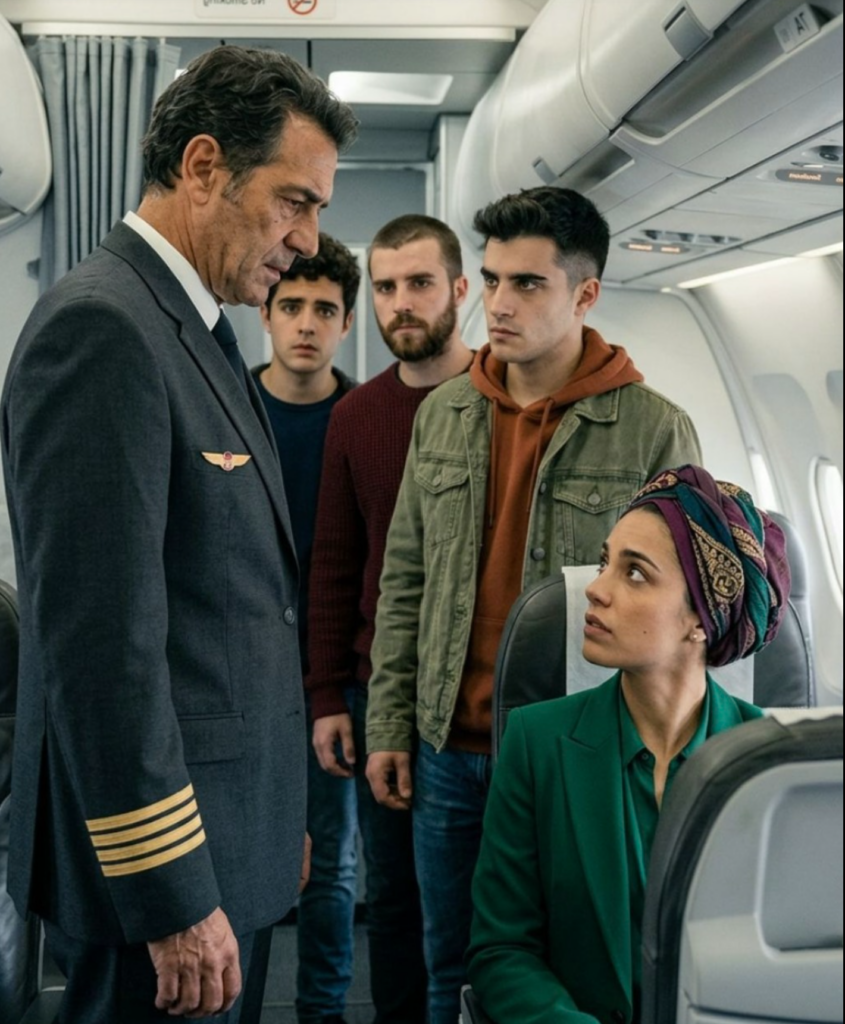
She remained completely composed. No anger. No triumph. No urgency. Only a steady, controlled calm that made the moment even heavier.
Alejandro looked again at the card. His hands tightened almost imperceptibly. Only now did he understand what disturbed him most—not just who she was, but that he had already acted before knowing.
He began to speak, perhaps to apologize, perhaps to regain control of the situation. But before a word could leave his mouth, Elena gently raised her hand.
Not a command. Not a threat. Just a quiet interruption.
“There is no need to apologize yet,” she said evenly. “Not at this point.”
A low murmur spread through the cabin. Some passengers had already begun recording. Others simply watched in silence.
Victoria tried to recover her composure. “This is absurd… we only wanted to change seats.”
Elena slowly turned toward her. Her expression was not sharp or aggressive—rather precise, like a mirror reflecting something uncomfortable with complete clarity.
“No,” she said calmly. “You didn’t just want to change seats. You wanted to move someone you believed was beneath you.”
Victoria fell silent.
Elena turned back to the commander.
“How long have you been flying?”
“Thirty-two years,” he replied automatically.
“And in all that time,” she continued, “how many people have you judged before truly seeing them?”
He did not answer. Not because he lacked one, but because he knew any answer would only deepen the truth.
Elena let the silence settle before continuing.
For six months, she explained, she had traveled anonymously. Not as an observer from a distance, but as an unseen passenger within the system. She had watched how people were treated differently based on appearance, clothing, and perceived importance.
And today, she said, they had shown her exactly what still needed to change.
Alejandro felt the weight of her words settle heavily inside him.
“I didn’t have enough information,” he tried to justify quietly.
“Exactly,” she replied at once. “And yet you decided anyway.”
The cabin fell completely silent.
“You decided I didn’t belong here,” she continued. “Not based on rules. Based on assumption.”
Victoria lowered her gaze. For the first time, she looked small, stripped of certainty.
“And you made that decision,” Elena said, “with full confidence that no one would question it. That is the real issue.”
Alejandro took a slow breath. There was no protocol for this. No command structure. No way to regain control.
“I was wrong,” he said finally. “And I accept responsibility.”
The director stepped forward, ready to resolve the situation formally, but Elena raised her hand once more.
“This is not about resolution,” she said. “It is about understanding.”
“What do you expect from us?” he asked.
Elena paused, choosing her words carefully.
“I do not expect you to forget this moment,” she said. “I expect you to carry it.”
A brief silence followed.
“Because next time,” she added quietly, “when you think you can immediately categorize someone… you might be wrong.”
The words lingered in the air, heavy and final.
Victoria spoke one last time, uncertain. “So… we don’t change seats?”
Elena opened her book again, as if the conversation had already ended.
“No,” she said.
But it hadn’t truly ended.
Something had shifted.
Not in the cabin.
But in Alejandro Martínez.
Later, after landing, Elena Vázquez left the aircraft without ceremony or attention. The director apologized and promised changes.
“Do not regret it,” she said. “Use it.”
And then she disappeared into the terminal crowd.
She left behind no anger, no threats—only a lesson.
That day, the commander did not lose his position.
He lost something else:
certainty.
And in its place, something far harder to ignore remained:
awareness.