The heavy suitcase hit the freshly painted hallway floor with a dull, final sound, as if it had brought not only luggage, but the first tension of a shared life. Dust particles briefly swirled in the ceiling light before slowly settling back down.
Metal carabiners on the bag gave a faint clink afterward—a cold, matter-of-fact sound in a space that should have sounded warm.
At that very moment, Zinaida stepped out of the kitchen.
She held a linen towel in her hands, her fingers still warm from washing dishes. Through the half-open kitchen door, a dense, almost heavy aroma drifted out: slowly simmered borscht, sweet beetroot,
fried meat, garlic, freshly baked pampushki whose tops still glistened slightly. It was the kind of smell that instantly turns a house into a home.
“Well then, Zinulya, I brought the most important things,” Gennady said, taking off his cap. He ran a tired hand through his short, slightly graying hair. His hands were large, rough, marked by work. “I’ll bring the tools tomorrow with the car. But we need to settle something right away. Directly, without detours.”
He stood there a little awkwardly, shifting his weight from one heavy work boot to the other, as if he didn’t quite know how to start such a conversation in a foreign house that was soon supposed to be his home too.
Zinaida tilted her head slightly. Her movements were calm, controlled, almost economical. She was 56, a woman who had learned to keep order not only in cupboards but in life itself.
This red-brick house knew every one of her decisions. Every room carried a piece of her past—and of her late husband, with whom she had built it.
“What is it about?” she asked at last.
Her voice was calm, but not soft. More like a door slowly opening, without knowing what might be behind it.
Gennady cleared his throat. Then he took a few steps into the room, not quite sitting down, but lowering himself heavily onto the edge of a chair, as if even sitting were a negotiation.
“If we’re going to live together,” he began, staring somewhere past her, “then we do it strictly separately. Budget, household, everything. I’m not your sponsor, Zin. And I don’t pay for other people’s wishes.”
For a moment, the air in the room changed.
The kitchen smell remained the same, but it suddenly felt farther away, as if an invisible wall had been drawn between kitchen and hallway.
Zinaida stayed silent. She slowly folded the towel, carefully, as if this small motion could help her organize her thoughts.
“Explain that more clearly,” she said quietly.
Gennady spoke faster now, more confidently, as if he had rehearsed these sentences many times in his head.
“We split rent in half. Electricity, water, everything shared. Food only basic items together—bread, milk, that sort of thing. Everything else separately. Meat, treats, extras. And everyone has their own shelf in the fridge. Clear structure. No arguments. No chaos.”
He nodded slightly, as if he had just presented a logical solution.
Zinaida looked at him for a long time. Then her gaze drifted, almost involuntarily, to his hands resting on her freshly cleaned table—already as if claiming the space. Something tightened inside her. Not anger. More like coldness.
“Fine,” she said eventually.
A short word. Heavier than expected.
“Then it’s separate. Your shelf is at the top.”
That night, the house didn’t sleep badly—but it slept differently.
The next morning everything was normal, and yet nothing was. Zinaida went to work, checking numbers as if they were other people’s lives on paper. But in her mind, it wasn’t numbers that circled, but sentences: *I’m not your sponsor. I don’t pay for other people’s wishes.*
In the evening, she shopped differently. Deliberately. Carefully. Meat with perfect marbling, fresh herbs, thick cream, potatoes with earthy skin. Everything smelled like something that didn’t just fill you up, but comforted you.
At home, she took out a thick notebook.
“No emotions anymore,” she thought. “If he wants contracts, he gets contracts.”
When Gennady returned, the hallway was already filled with warmth. In the kitchen, a pan was sizzling, fat crackling softly, and the smell of frying meat settled into every corner like a promise.
He stopped. For a moment, he even forgot to take off his shoes.
“Zin… that smells incredible,” he said more quietly than usual.
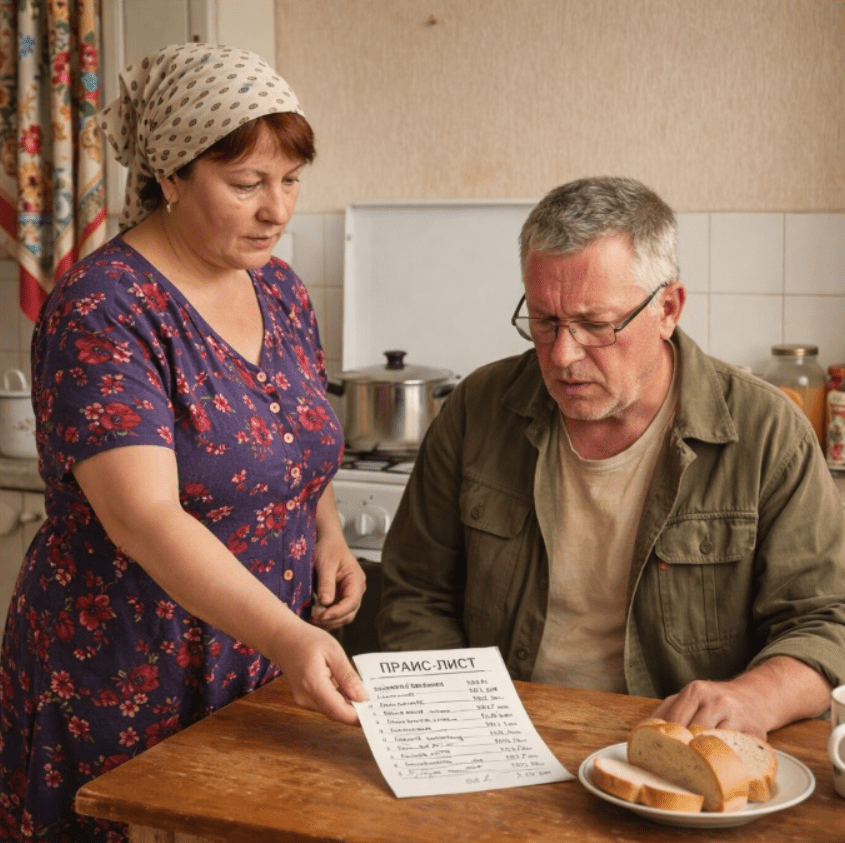
But she placed a sheet of paper on the table in front of him.
He frowned.
“What is this?”
“Your new system,” she said calmly.
He began to read.
With each line, his face changed. First confusion. Then disbelief. Then something almost like panic.
“Cooking—by tariff?” His voice cracked. “Kitchen usage? Washing machine extra? Maintenance fee?! Have you completely lost your mind?!”
Zinaida turned the meat in the pan, as if the conversation only mattered on the edge of her attention. The surface browned slowly, sizzling, perfect.
“You wanted separate finances,” she said calmly. “Then cooking is work. Time, energy, preparation. And everything has a price.”
“But we live together!”
She looked at him directly now.
“No. You wanted to live like two separate people. I’m just following your rules.”
Silence.
Then his hand slammed the table so hard the salt shaker trembled.
“This isn’t life!”
“Then change it,” she said quietly.
In the following days, the house became strange—and almost absurd.
Gennady cooked himself tasteless porridge, washed clothes in the sink, struggled with cheap ready-made meals that tasted like plastic and exhaustion. His movements slowed, his shoulders grew heavier.
Zinaida lived beside him—not against him, but not with him either.
Until one evening he returned soaked, exhausted, with a look that was no longer defiant, but empty.
“I can’t do this anymore,” he said quietly.
And in that sentence was more truth than in all the previous arguments.
He placed an envelope on the table.
“My entire salary. I don’t want this anymore.”
Zinaida looked at him for a long time. Then she set the wooden spoon down.
“You tried to control love like a risk,” she said calmly. “And in doing so, you made everything cold.”
He nodded, exhausted.
“I was afraid.”
The silence that followed was no longer hard. It had softened.
“Then let’s talk properly now,” she said at last.
And for the first time, there was no contract between them—only a beginning.