Malcolm Reeves straightened his navy blazer as he moved through the busy halls of Heathrow Airport. The constant roll of suitcases, overlapping announcements, and streams of travelers had long since become background noise to him.
In his hand, his passport was held with deliberate precision, as if it carried not just travel details, but years of discipline and ambition.
At forty-three, Malcolm was far more than a successful businessman. He was the founder and CEO of Reeves Global Consulting, a London-based firm that had rapidly grown into a respected force in international strategy and investment advisory.
A recently secured partnership with a major Swiss investment group had marked a turning point in his career. For the first time in years, he allowed himself a small but meaningful luxury: a first-class seat to Zurich.
At the boarding gate, a few passengers recognized him from a recent financial article. Polite smiles, brief congratulations, respectful nods followed. Nothing unusual for someone in his position. Yet everything shifted the moment he stepped onto the aircraft.
First class was quiet, refined, almost carefully controlled in its elegance. At the entrance stood the pilot, personally greeting passengers. Tall, rigid posture, immaculate uniform, a practiced professional smile.
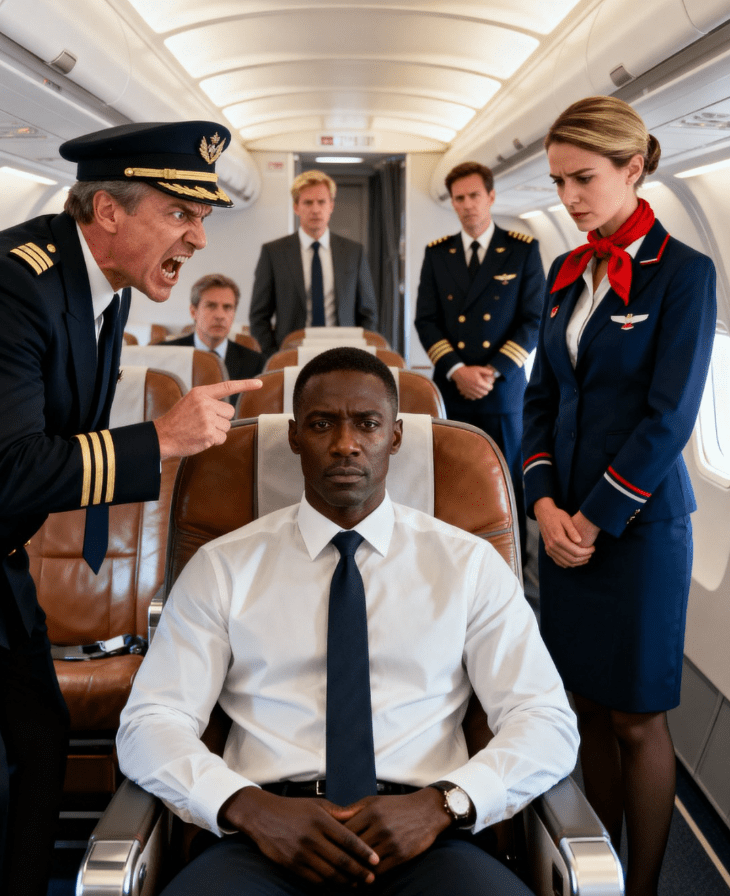
But when his eyes landed on Malcolm, something in his expression changed.
— Sir, he said after glancing at the boarding pass, you might be in the wrong queue. Economy is further back.
A few heads turned.
Malcolm looked up calmly.
— My seat is 2A. First class.
The pilot let out a short, dismissive laugh.
— First-class passengers usually don’t dress like that.
His gaze lingered just a fraction too long on Malcolm’s appearance—long enough to make the implication unmistakable.
A silence settled over the cabin. A flight attendant hesitated, then said nothing. Other passengers shifted uncomfortably, sensing the tension but unwilling to intervene.
Malcolm did not raise his voice.
— I’ll take my seat, he said simply.
And he walked past.
The flight continued in an atmosphere that seemed outwardly normal, yet subtly fractured. Champagne was offered promptly to others, while his service was delayed. Attention felt uneven, gestures slightly colder in his direction. Nothing openly confrontational—just enough to be felt, never quite enough to be easily proven.
Malcolm observed everything quietly. He made no complaint, no scene, no reaction. Not out of weakness, but control. He understood that some moments are not resolved in the moment itself.
They are documented in silence.
As the aircraft descended toward Zurich, passengers began preparing to disembark. The calm returned, as if nothing had happened.
The pilot reappeared, now wearing his professional smile again.
— Sir, we’ve arrived. You may disembark.
Malcolm stood, adjusted his blazer, and picked up his briefcase. Then he paused.
— Before I leave, I’d like to speak with you.
His voice was calm. Even. Unshaken.
He opened his bag and removed a black folder. From it, he produced an official identification card bearing the emblem of a European aviation authority.
The atmosphere shifted instantly.
— European Aviation Ethics Council, Malcolm said. I serve on the board.
The cabin went still. A few phones quietly lifted.
The pilot’s expression tightened.
Malcolm continued without raising his voice:
— Today I experienced behavior that falls directly under the scope of our oversight. Bias in passenger treatment. Assumptions based on appearance.
A pause.
— You did not question my ticket. You questioned my place.
The pilot tried to respond, but no words came.
Malcolm closed the folder.
— This incident will be formally reported.
Then, more softly:
— And I hope it will be learned from.
He gave a slight nod and walked off the plane.
No one spoke.
Within an hour, the incident surfaced online. The hashtag #FlyWithRespect spread rapidly. The airline issued a public apology. The pilot was suspended pending investigation, and new training programs addressing bias and inclusion were announced.
Malcolm declined any compensation.
— This isn’t about money, he said later. It’s about responsibility.
Messages poured in from around the world. Travelers sharing similar experiences. Young pilots promising to do better. Strangers thanking him for speaking without raising his voice.
One message stood out:
“You showed that dignity doesn’t ask permission to exist.”
A month later, Malcolm boarded another flight—this time to Oslo.
At the gate, a young pilot shook his hand respectfully.
— Welcome aboard, Mr. Reeves. It’s an honor to have you with us.
Malcolm offered a faint smile and took his seat.
Outside the window, the sky stretched wide and silver-gray, quiet and endless. The engines hummed into motion.
He knew one flight could not change the world.
But sometimes, one moment is enough to remind it how it should change.