The pounding started at 3:07 a.m.Not a polite knock. Not the uncertain tap of someone with a dead battery or a misdelivered package. This was sharp. Urgent. The kind of sound that cuts through sleep and pulls you upright before your mind can catch up.
Beside me, Aaron shifted but didn’t wake. Down the hall, Lucy slept. The house was completely still—too still—except for the faint blue glow of the baby monitor we still used out of habit.
Then it came again.Three hard strikes.And a voice.Low. Controlled. Unmistakable.“Maya. Open the door. Now.”Denise.Our neighbor.
That alone made my stomach drop.
Denise wasn’t dramatic. She didn’t exaggerate. She was the kind of woman who noticed everything and spoke only when something truly mattered. If she was standing on my porch at three in the morning, something was very wrong.
I crossed the hallway barefoot and opened the door.She stepped inside immediately.“Pack a bag,” she said. “Right now. Your family isn’t who they say they are.”
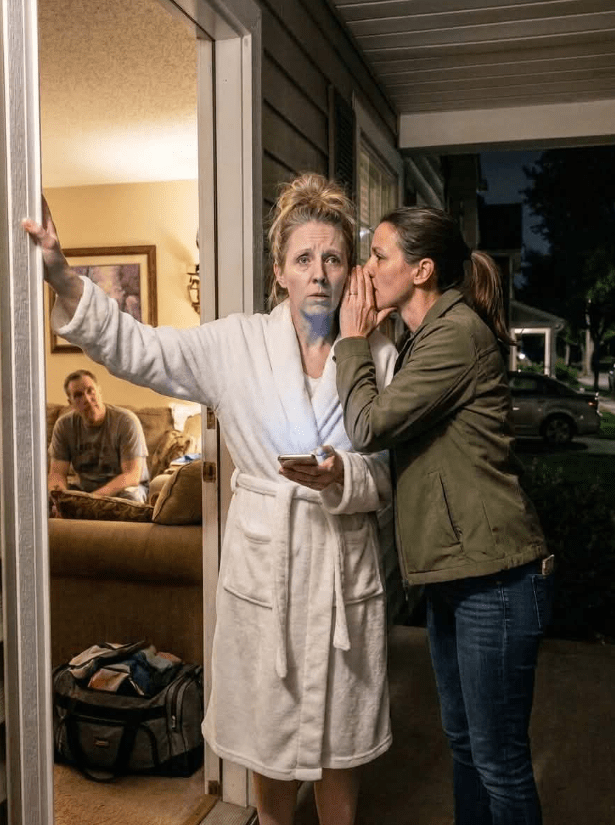
For a moment, I just stared at her.“My what?”Her eyes moved past me toward the stairs. “Wake Aaron. Wake Lucy. Bring documents. Ten minutes.”
Aaron appeared behind me, groggy and already irritated. “Denise, what is this?”She turned to him, her expression steady. “Your brother is on his way here. And he’s not coming alone.”
That woke him.Caleb.Even hearing his name tightened something in my chest. For months, he had been pressing into our lives—calls, guilt, pressure—ever since Aaron refused to co-sign another one of his “fresh start” loans.
Then came their mother, showing up unannounced, crying about loyalty while Caleb waited outside like a storm that hadn’t broken yet.
We thought that was the worst of it.
We were wrong.“How do you know?” I asked.Denise pulled out her phone and handed it to me.A screenshot.
A deleted message from a private church group:
Heading over tonight. Time to get my brother back.Another reply underneath:Bring the truck. We may need to move things fast before she starts claiming abuse.
My blood ran cold.“They’re not coming to talk,” Denise said quietly. “They’re coming to overwhelm you.”That was when everything shifted.
Not because I fully understood what was about to happen.But because, suddenly, every excuse we had ever made for them stopped making sense.
By 3:11 a.m., I was in Lucy’s room, pulling open drawers with shaking hands.The night had split into before and after.We left the house at 3:26 a.m.
I remember the exact time because panic distorts everything, and I kept staring at the microwave clock as I stuffed documents into a bag—passports, birth certificates, insurance papers—like I might need proof later that this had really happened.
Aaron carried Lucy downstairs. She was awake enough to be confused, still clutching her stuffed rabbit.“Are we going on a trip?” she whispered.“Yes,” I said.
It was the only truth she could carry.Denise stood in the kitchen, making calls in a voice I had never heard from her before—calm, precise, already thinking ahead.
“I’ve called a deputy,” she said. “But you shouldn’t be here when they arrive.”That sounded paranoid.Until the garage door lifted.And I saw headlights at the far end of the cul-de-sac.
Waiting.Watching.Aaron reversed too fast. No one spoke.By the time we reached the main road, my hands were numb.We checked into a hotel off the interstate.
Locked the door. Closed the curtains. Turned off the lights.Only then did the full explanation come.This hadn’t started tonight.
For weeks, Caleb had been preparing—telling people Aaron wasn’t thinking clearly, that I was isolating him, that something was wrong inside our home.
Building a narrative.Setting the stage.“They needed a reason,” Denise said. “In case they had to force it.”At 4:02 a.m., the deputy called.They had arrived.
Caleb. Their mother. Another man. A truck.They hadn’t gotten inside—but not for lack of trying. There had been shouting in the driveway. Accusations. Claims that I was unstable, that Aaron needed help, that Lucy was being kept from her “real family.”
The story was already written.All they needed was access.By morning, something in Aaron had changed.He stopped defending them.Stopped softening their behavior into something manageable.
Stopped calling it “complicated.”Later that day, he checked his account.That was when we found the final piece.Someone—his mother—had logged in days earlier.Downloaded our contacts.Opened files containing Lucy’s school information.
It wasn’t a visit that had gone too far.It was preparation.That realization changed everything.We weren’t dealing with a difficult family.
We were dealing with people who believed access to our lives was their right—and that force was acceptable if denied.
We didn’t go home that weekend.We changed the locks.Filed reports.Sent legal notices.And for the first time, Aaron drew a boundary without hesitation.
]Weeks later, in court, he said it clearly:“My wife didn’t take me away from my family. She helped me see that my family isn’t safe when they don’t get their way.”
That was the truth.Not dramatic.Not hidden.Just ignored for far too long.We moved that winter.No forwarding address.No second chances.
Because the real danger hadn’t been the truck in the driveway.It had been everything that made that truck feel justified.And it all started at 3:07 a.m.
With a knock that didn’t ask for permission.And a sentence that finally made us stop explaining away what we already knew:Your family isn’t who they say they are.