Oksana stared at the cracked plastic of her thermos as if it might somehow explain how everything had come to this. The dark, sugary tea spread slowly across the gray asphalt, seeping into tiny cracks, disappearing without a trace.
She didn’t move to pick up the pieces. Her mind was wrapped in a dense, heavy fog after fourteen hours of a night shift at the sorting facility.
Her legs throbbed as if weights had been tied to her sneakers. The thought of going home filled her with quiet dread. Behind that door waited stale air from always-closed windows, Denis’s constant раздражённое sighing,
and her mother-in-law’s endless requests. There was always something: tea, soup, medicine, attention. Oksana kept giving, and giving, until there was almost nothing left of her.
A rough, wet touch brushed her hand.She flinched and looked down. A large, shaggy dog—some mix of Saint Bernard and German Shepherd—was curiously sniffing the spilled tea.
“Balu, no! Don’t eat off the ground!” a hoarse male voice called out.A man in a thick jacket approached. He smelled faintly of damp earth and tree bark. He grabbed the leash and gave her an apologetic look, his hands rough, his eyes calm and attentive.
“Sorry about him—he’s basically a vacuum,” he said with a small smile. “I wasn’t paying attention. Let me buy you another drink. There’s a kiosk around the corner. I’m Gleb.”
Oksana was about to refuse automatically. She opened her mouth to say “it’s fine,” but instead felt a lump rise in her throat.“It’s not about the tea…” she murmured. “I’m just… so tired.”
And just like that, something inside her cracked. Words poured out before she could stop them. She told him about scanning endless boxes all night, about numb fingers and aching shoulders.
About Denis, who called himself a crypto investor but never brought home money. About the apartment filled with humming machines. About her mother-in-law, who had moved in six months ago and “couldn’t even stand up,” yet somehow controlled the entire household.
Gleb didn’t interrupt. He didn’t offer empty sympathy. He just listened.
“People like you,” he said quietly when she finished, “the ones who carry everything… they forget they have limits too.”Oksana let out a bitter laugh.
“I think I’ve already hit mine.”The next morning, she went home like usual. The air inside was heavy, thick with dust and the constant hum of computers. Her mother-in-law lay in bed, weakly asking for water, just like always.
Everything looked the same.But Oksana said loudly, so Denis could hear:“I’ve been sent on a three-day work trip. Leaving now.”He barely responded from his room.
She closed the door behind her.But she didn’t go far.Gleb was already waiting. The plan was simple: he would message Denis, pretending to be a wealthy buyer interested in the expensive computer part Denis had listed.
An hour later, they came back.Oksana’s hand trembled as she quietly turned the key and opened the door just a crack.
“Mom, hurry up!” Denis’s voice came from inside—energetic, sharp. “Stop pretending! Our sponsor’s gone! Set the table properly!”And then her mother-in-law’s voice—clear, lively, full of strength:
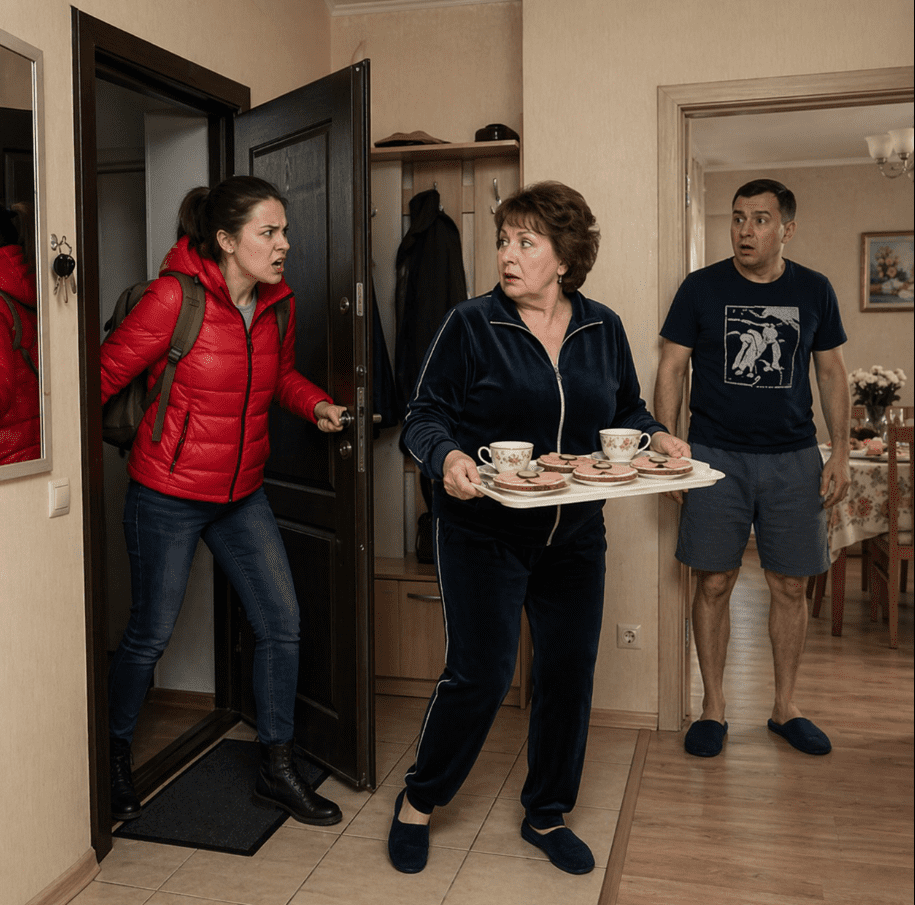
“I’m coming! I even took out the red caviar!”Oksana pushed the door open.The scene before her felt unreal. Her mother-in-law moved quickly and easily, carrying a heavy tray filled with dishes, dressed neatly, her posture straight and confident. No weakness. No pain.
Denis froze when he saw Oksana.“Oksana… you…”“Yes, me,” she said calmly. Too calmly. “Amazing recovery. Must be the caviar.”Gleb stepped in behind her, silent but unmistakable.
“You have two hours,” Oksana continued. “This is my apartment.”
The argument that followed was loud, messy, full of accusations and anger. Denis shouted, his mother protested, but Oksana didn’t back down. Every word they said only made things clearer.
Two and a half hours later, their bags and boxes were piled outside.Denis paced angrily, while his mother—remarkably agile now—helped move things.
Oksana walked past them without a word.Inside, the apartment felt unfamiliar in its silence. No humming machines. No complaints. Just stillness.
She opened the window wide. Fresh air rushed in, sweeping away the weight of the past years.She sat down in the kitchen. Her hands still trembled slightly, but not from exhaustion anymore—something else.
Relief.Freedom.She stood up and poured herself a cup of tea.This time, she didn’t rush. She didn’t think about anyone else. No one was waiting, no one was demanding.
She just sat there, sipping slowly.And with every sip, she felt it more clearly—this quiet, simple moment was worth more than everything she had sacrificed before.